Copy 1
Outlines of the course of qualitative analysis followed in the Giessen laboratory / By Henry Will ; With a preface by Baron Liebig.
- Heinrich Will
- Date:
- 1846
Licence: Public Domain Mark
Credit: Outlines of the course of qualitative analysis followed in the Giessen laboratory / By Henry Will ; With a preface by Baron Liebig. Source: Wellcome Collection.
18/152 page 2
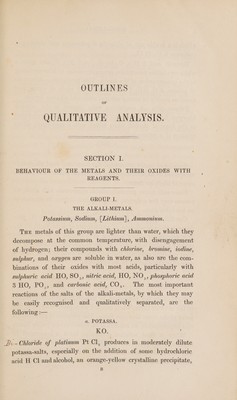
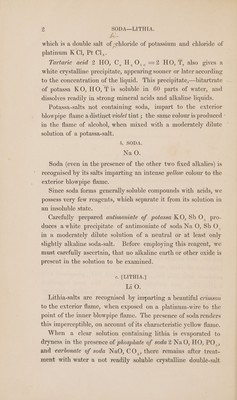
![9 SODA—LITHIA. s~ which is a double salt of <chloride of potassium and chloride of platinum K Cl, Pt Cl,. Tartaric acid 2 HO, C, H,0O,, =2 HO, T, also gives a white crystalline precipitate, appearing sooner or later according to the concentration of the liquid. This precipitate,—bitartrate of potassa KO, HO, Tis soluble in 60 parts of water, and dissolves readily in strong mineral acids and alkaline liquids. Potassa-salts not containing soda, impart to the exterior blowpipe flame a distinct violet tint ; the same colour is produced - in the flame of alcohol, when mixed with a moderately dilute solution of a potassa-salt. b. SODA. Na O. Soda (even in the presence of the other two fixed alkalies) is recognised by its salts imparting an intense yellow colour to the exterior blowpipe flame. Since soda forms generally soluble compounds with acids, we possess very few reagents, which separate it from its solution in an insoluble state. Carefully prepared antimoniate of potassa KO, Sb O, pro- duces a white precipitate of antimoniate of soda Na O, Sb O, in a moderately dilute solution of a neutral or at least only slightly alkaline soda-salt. Before employing this reagent, we must carefully ascertain, that no alkaline earth or other oxide is present in the solution to be examined. ce. [LITHIA.] Li O. Lithia-salts are recognised by imparting a beautiful crimson to the exterior flame, when exposed on a platinum-wire to the point of the inner blowpipe flame. The presence of soda renders this imperceptible, on account of its characteristic yellow flame. When a clear solution containing lithia is evaporated to dryness in the presence of phosphate of soda2 NaO, HO, PO., and carbonate of soda NaO, CO,, there remains after treat- ment with water a not readily soluble crystalline double-salt](https://iiif.wellcomecollection.org/image/b33097847_0001_0018.jp2/full/800%2C/0/default.jpg)
 No text description is available for this image
 No text description is available for this image
 No text description is available for this image