The thyroid : surgery, syndromes, treatment / E.P. Sloan ; edited by members of the Sloan Clinic: Guy A. Sloan [and others].
- Sloan, E. P. (Edwin Plummer), 1878-1935
- Date:
- [1936], ©1936
Licence: Public Domain Mark
Credit: The thyroid : surgery, syndromes, treatment / E.P. Sloan ; edited by members of the Sloan Clinic: Guy A. Sloan [and others]. Source: Wellcome Collection.
379/508 (page 357)
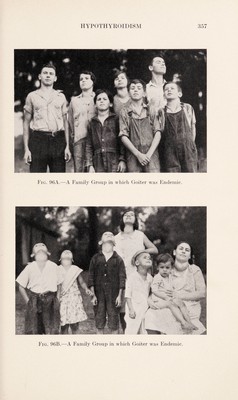
![CHAPTER XVI HYPOTHYROIDISM The direct effect of thyroid deficiency is the retardation of all the vital processes. The indirect effects, through this retardation of the vital processes, are the subthyroid syndromes: myxedema, cachexia strumi- priva, and examples of repressed differential development (cretinism, infantilism, deaf mutism, deformities and subnormal mentality). These syndromes vary in intensity with the degree of thyroid insufficiency, the suddenness with which the thyroid deficiency occurs, and the age and stage of development of the individual at the time that thyroid function was diminished or abolished. All the vital processes, physical, mental and emotional, are dependent upon thyroid function. In adult life the repression of these is manifested by subthyroid syndromes such as lowered metabolism, myxedema and cachexia strumipriva. The repression of the vital processes of the mother by thyroid deficiency affects the child in utero greatly. This is evident after birth. This evidence consists of retarded or disturbed differentia] development such as cretinism, deaf mutism, deformities and subnormal mentality. Thyroid deficiency in childhood and youth produces both the subthyroid syndromes seen in the adult, and various degrees of retarded or disturbed differential development. Hypothyroidism may be due to functional insufficiency of the gland itself, or may be due to a deficiency in the available supply of iodin or other constituents necessary for the elaboration of the thyroid hormone. Functional deficiency of the gland may be due to athyroidism, destruction of gland tissue by disease, or surgical removal. When due to athyroidism, it dates back to infancy and is attended by disturbances of differential development. In a large percentage of cases of athyroidism, the defective development of the gland itself is the result of retarded development of the gland during fetal life in the mother. When due to destruction of the gland by disease, the deficiency appears later in life and is usually accompanied by gross degenerations such as large degenerated adenomas. When due to surgical removal of gland substance, it follows the operation within a few weeks. As the various manifestations of hypothyroidism or athyroidism are considered, usually, as clinical entities, the following hypothyroid states will be discussed separately. . fPostoperative (Cachexia Strumipriva) Myxedema|Spontaneoug 2. Cretinism 3. Mild, almost imperceptible, types of hypothyroidism 1.](https://iiif.wellcomecollection.org/image/b29929064_0379.jp2/full/800%2C/0/default.jpg)