A dictionary of terms used in medicine and the collateral sciences / by the late Richard D. Hoblyn.
- Richard Hoblyn
- Date:
- 1899
Licence: Public Domain Mark
Credit: A dictionary of terms used in medicine and the collateral sciences / by the late Richard D. Hoblyn. Source: Wellcome Collection.
19/858 page 5
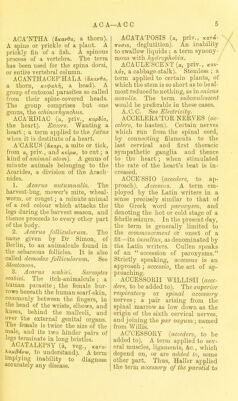
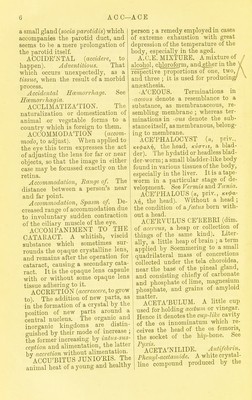
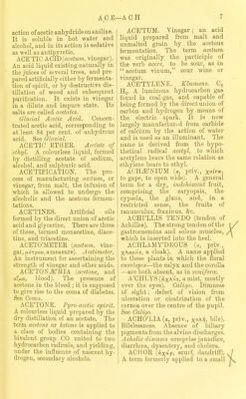
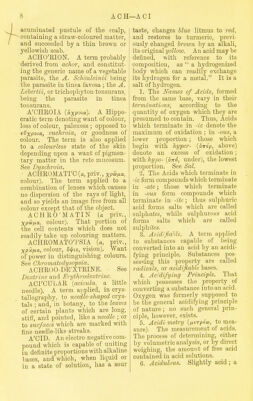
![ACA'NTHA {&Kavea, a thorn). A spine or prickle of a plant. A prickly fin of a fish. A spinous process of a vertebra. The term has been used for the spina dorsi, or entire vertebral column. ACANTHACEP'HALA (&Ka^ea, a thorn, Ke(pa\ri, a head). A group of entozoal parasites so called from their spine-covered heads. The group comprises but one genus, the ccMnorhynchus. ACA'RDIAC (a, priv., Kaphla, the heart). Excors. Wanting a heart; a term ajiplied to the foetus when it is destitute of a heart. A'CARUS {&Kapi, a mite or tick, from o, priv., and Kelpw, to cut; a kind of animal atom). A genus of minute animals belonging to the Acarides, a division of the Arach- nides. 1. Acarus autumnalis. The harvest-bug, mower's mite, wheal- worm, or rouget; a minute animal of a red colour which attacks the legs during the harvest season, and thence proceeds to every other part of the body. 2. Acams folliculorum. The name given by Dr Simon, of Berlin, to an animalcule found in the sebaceous follicles. It is also called demodex folliculorum. Sec Steatozoon. 3. Acarus scabiei. Sarcoptes scabiei. The itch-animalcule ; a human parasite; the female bur- rows beneath the human scarf-skin, commonly between the fingers, in the bend of the wrists, elbows, and knees, behind the malleoli, and over the external genital organs. The female is twice the size of the male, and its two hinder pairs of legs terminate in long bristles. ACATALEPSY (i, veg., Kara- \a/i0dvw, to understand). A term implying inability to diagnose accurately any disease. ACATA'POSIS (a, priv., Kard- TToais, deglutition). An inability to swallow liquids ; a term synony- mous with hydrophobia. AOAULE'SCENT (a, priv., Kav- \6s, a cabbage-stalk). Steniless ; a term applied to certain plants, of which the stem is so short as to be al- most reduced to nothing, as in cniciis acaulis. The term subcaulcscent would be preferable in these cases. A.C.C. See Electricity. ACCELERA'TOR NERVES {ac- celcro, to hasten). Certain nerves which run from the spinal cord, by connectiug filaments to the last cervical and first thoracic sympathetic ganglia and thence to the heart ; when stimulated the rate of the heart's beat is in- creased. ACCE'SSIO {accedere, to ap- proach). Access IIS. A term em- ployed by the Latin writers in a sense precisely similar to that of the Greek word jMi-oxysm, and denoting the hot or cold stage of a febrile seizure. In the present day, the term is generally limited to the commencement ot onset of a tit—its insuUus, as denominated by the Latin writers. Cullen speaks of an accession of paroxysms. Strictly speaking, accessus is an approach ; accessio, the act of ap- proaching. ACGESSORII WILLISII {acce- dere, to be added to). The superior respiratory or spinal accessory nerves; a pair arising from the spinal marrow as low down as the origin of the sixth cervical nerves, and joining the par vagitm ; named from Willis. ACCESSORY {accedere, to be added to). A term a])plied to sev- eral muscles, ligaments, &c., which depend on, or are added to, some other part. Thus, Haller applied the term accessory of the parotid to](https://iiif.wellcomecollection.org/image/b2178047x_0019.jp2/full/800%2C/0/default.jpg)
 No text description is available for this image
 No text description is available for this image
 No text description is available for this image