Volume 1
Watts' dictionary of chemistry / revised and entirely rewritten by H. Forster Morley and M.M. Pattison Muir ; assisted by eminent contributors.
- Date:
- 1888-1894
Licence: Public Domain Mark
Credit: Watts' dictionary of chemistry / revised and entirely rewritten by H. Forster Morley and M.M. Pattison Muir ; assisted by eminent contributors. Source: Wellcome Collection.
Provider: This material has been provided by the Royal College of Physicians of Edinburgh. The original may be consulted at the Royal College of Physicians of Edinburgh.
17/796
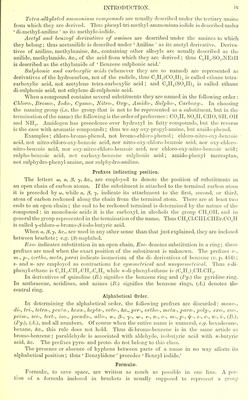
![It is unfortunate that there is a want of uniformity among authors in the method of recording physical constants. Specific gravities are given by most authors without any mention of the temperature of the water that is taken as standard. Some take water at 0°. some at 4°, and others compare the siibstance with water at the same temperature as itself. Taking the specific gravity of water at 4° as unity, that at 21° will be 998 ; that is to say, for a substance whose specific gravity is about 1 we may make an error of 002 by assuming that the author used water at 4° as a standard, whereas he really used water at 21°. Under such circumstances it would be preposterous to give four places of decimals, and such indefinite specific gravities have been cut down to three decimal places, and even then the last figure is somewhat doubtful. Heats of formation are usually calctdated on the assumption that the heat of formation of 44 g. of carbonic acid is 96,900, and that of 18 grms. of water is 68,360; Stohmann, Eodatz, and Herzberg, however, use 94,000 and 69,000 respectively, hence their heats of formation are not directly comparable with those of other observers. Molecular refraction is the value of the expression M^~—^, where M is the mole- cular weight, /n the index of refraction, and d the specific gravity of the liquid at 20° compared with water at 4° (Landolt, P. 123, 595 ; Bruhl, A. 200, 139). Other constants, such as , have also been used; these are of course not comparable with those first mentioned (cf. Brtihl, A. 235, 1). The specific rotation is given by most observers for a tube of liquid 100 mm. long, but many French chemists use a 200 mm. tube as a standard, and some even 50 mm. When the length of tube is stated it is easy to apply the correction, but when, as is often the case, an author does not give the length of tube, his numbers are indefinite. The rotation measured for the neutral tint is of course not the same as that measured for the sodium line, yet authors occasionally fail to mention the kind of light employed. The angular rotation ought to be divided by the specific gravity of the liquid during the experiment, in order that the effect of equal weights of material may be compared ; yet it is to be feared that many authors neglect to perform this division, and also to mention that they have not done it. Authors frequently fail to state whether their melting and boiling-points have been corrected for the exposure of part of the stem of the thermometer. This may make a difference of 5°. The immersion of the whole of the mercury in the liquid or vapour is indicated by i.V. Eeferences. Where the same paper is referred to several times in the course of one article, the full reference is given once, and in other places there will be found the first letter or the first two letters of the author's name, inclosed within brackets ; thus, if (Perkin, O. J. 45, 390) and (P.) are found in the same article, the (P.) is a contraction for (Perkin, C. J. 45, 390). Short Article Expanded. In order to make sure that the contractions employed are thoroughly understood, a short specimen article will be expanded by simply exchanging the contractions for their equivalents:— Bromo-di-oxy-benzoic acid CH.Bi^OHJ.^COoH [ir:2:6:l]. [184°, anhydrous]. From c-di-oxy- benzoic acid in ether and Br (Zehenter, M. 2, 480). Prisms (containing aq); v. sol. alcohol v. si. sol. water. Fe.,Cl6 gives a violet colour to its aqueous solution.—AgA'aq.—BaA'.27;Uq.— KA'liaq. May be expanded thus :— Bromo-di-oxy-benzoic acid C„H2Br(OH),CO,H[Br:OH:OH:C02H = a;:2:6:l] melts at 184° after it has been deprived of its water of crystallisation. It is formed, according to Zehenter (Monatshefte, vol. 2, p. 480), by adding bromine to an ethereal solution of consecutive di-oxy-benzoic acid. It crys- tallises in prisms, and the crystals contain one molecule of water of crystallisation to each molecule of the acid. These crystals are very soluble in alcohol, but very slightly soluble in water. Ferric chloride colours its aqueous solution violet. It forms the following salts C(,HwBr(OH),CO.Ag,H,i,0 ; jC0H,,Br(OH).,CO,j2Ba>7|H2O; and C.H.BrfOHJ.CO.K.liH.O.](https://iiif.wellcomecollection.org/image/b21995990_0001_0017.jp2/full/800%2C/0/default.jpg)




 No text description is available for this image
 No text description is available for this image
 No text description is available for this image