Volume 1
Watts' dictionary of chemistry / revised and entirely rewritten by H. Forster Morley and M.M. Pattison Muir ; assisted by eminent contributors.
- Date:
- 1888-1894
Licence: Public Domain Mark
Credit: Watts' dictionary of chemistry / revised and entirely rewritten by H. Forster Morley and M.M. Pattison Muir ; assisted by eminent contributors. Source: Wellcome Collection.
Provider: This material has been provided by the Royal College of Physicians of Edinburgh. The original may be consulted at the Royal College of Physicians of Edinburgh.
45/796 page 19
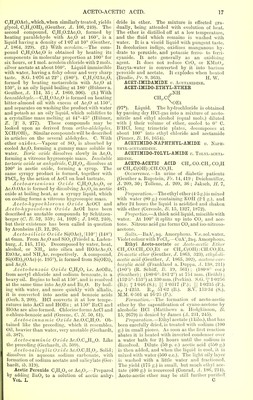
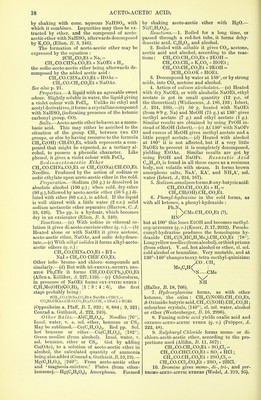
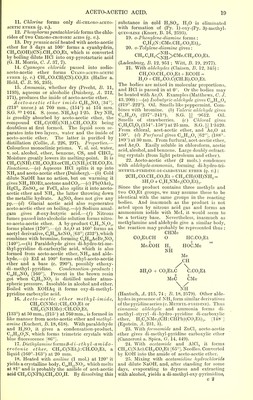
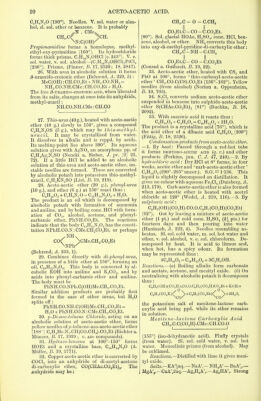
![11. Chlorine forms only £K-chloro-aceto- ACETIC ETHER (q. V.). 12. Phosphorus pentachloride forms the chlo- rides of two Chloro-crotonic acids (q. v.). 13. Dry prussic acid heated with aceto-acetic ether for 3 days at 100° forms a cyanhydrin, CH3.C(OH)(CN).CH2.C02Et, which is converted by boiling dilute HC1 into oxy-pyrotartaric acid (G. H. Morris, C. J. 37, 7). 14. Cyanogen chloride passed into sodio- aceto-acetic ether forms Cyano-aceto-acetic ether (q. v.) CH3.CO.CH(CN).C02Et (Haller a. Held, C. B. 95, 235). 15. Ammonia, whether dry (Precht, B. 11, 1193), aqueous or alcoholic (Duisberg, A. 212, 171), produces the imide of aceto-acetic ether. Aceto-acetic ether imide C6HnNO„ [34°]. (213° uncor.) at 760 mm., (154°) at 154 mra. S.G. g2 1-014. S. (cone. NH3Aq) 1-25. Dry NH3 is greedily absorbed by aceto-acetic ether, the compound CH3.C(OH)(NH2).CH2.CO,Et being doubtless at first formed. The liquid soon se- parates into two layers, water and the imide of aceto-acetic ether. The latter is purified by distillation (Collie, A. 226, 297). Properties.— Colourless monoclinic prisms. V. si. sol. water, v. sol. alcohol, ether, benzene, CS2 and CHC13. Moisture greatly lowers its melting-point. It is CH3.C(NH).CH2.C02EtorCH3.C(NH2):CH.CO,,Et. Beactions.—(a) Aqueous HC1 splits it up into NH3 and aceto-acetic ether (Duisberg).—(b) Cold dilute NaOH has no action, but on warming it gives NH„HOEt, acetone andC02.—(c) Pb(OAc)2) HgCl2, ZnS04, or FeCl3 also splits it into aceto- acetic ether and NH.„ the latter throwing down the metallic hydrate. AgN03 does not give any pp.—(d) Glacial acetic acid also regenerates aceto-acetic ether on boiling.— (e) Sodium amal- gam gives /3-oxy-butyric acid.—(/) Nitrous fumes passed into alcoholic solution forms nitro- so-aceto-acetic ether. A by-product CHH17N505, forms plates [170°].—(g) Ac.,0 at 160° forms an acetyl derivative, CsH^AcNGv [63°] (232°), which combines with bromine, forming C6Hl0AcBr,NO2 [140°].—(h) Paraldehyde gives di-hydro-tri-me- thyl-pyridine di-carboxylic acid, which is also formed from aceto-acetic ether, NH3, and alde- hyde.— (i) EtI at 100° forms ethyl-aceto-acetic ether and a base (c. 290°), possibly ethoxy- di-methyl-pyridine. Condensation-products : CloH13N03 [160°]. Present in the brown resin got when C6HuN02 is distilled under atmo- spheric pressure. Insoluble in alcohol and ether. Boiled with KOHAq it forms oxy-di-methyl- pyridine carboxylic acid. 16. Aceto-acetic ether methyl-imide, CH3.C(NMe) :CH,.CO.,Et or CH3.C(NHMe): CH.CO,Et, (133°) at 50 mm., (215°) at 760 mm., is formed in like manner from aceto-acetic ether and methyl- amine (Kuchert, jB. 18,618). With paraldehyde and H2SO, it gives a condensation-product, C13H2304N, which forms trimetric crystals with blue fluorescence [86°]. 17. Dieihylamine forms fi-di- ethyl -amid o - crotonic ether, CH3.C(NEt.,): CH.CO.,Et, a liquid (160°-163°) at 20 mm. 18. Heated with aniline (1 mol.) at 120° it yields a crystalline body, 0,^,^0.,, which melts at 81° and is probably the anilide of acet-acetic acid CH3.C(NPh).CH2.C02H. By dissolving this substance in cold H2S04, H20 is eliminated with formation of (Py. l)-oxy-(Py. 3)-methyl- quinoline (Knorr, B. 16, 2593). 19. o-Phenylene-diamine forms : C6H4(N: CMe.CH2.C02Et)2. 20. o-Tolylene-diamine gives: CH3.C(iH3<^2>CMe-CH2-c°2Et- (Ladenburg, B. 12, 951; Witt, B. 19, 2977). 21. With aldehydes (Claisen, B. 12, 345): CH3CO.CH„.CO.,Et + BCOH = H,0 + CH,.CO.C(CH.R).C02Et. The bodies are mixed in molecular proportions, and HC1 is passed in at 0°. Or the bodies may be heated with Ac.,0. Examples (Matthews, C. J. 43, 200):—(a) Isobutyric aldehyde gives C10H1(iO3 (219°-222°). Oil. Smells like peppermint. Com- bines with bromine, (b) Valeric aldehyde gives C,,Hl803 (237°-241°). S.G. if -9612. Oil. Smells of strawberries. (c) Chloral gives CSH9C1303 (154°-158°) at 25 mm. S.G. if 1-3420. From chloral, acet-acetic ether, and AcO at 150°. (d) Furfural gives CnH1204 [62°], (188°- 189°) at 30 mm. From furfural, acet-acetic ether, and Ac20. Easily soluble in chloroform, acetic acid, alcohol, and benzene. Large doubly-refract- ing crystals (from light petroleum and ether). 22. Aceto-acetic ether (2 mols.) condenses with aldehyde-ammonia, forming di-hydro-tri- METHYL-PYRIDINE-DI-CAEBOXYLIC ETHER (q. V.) I 2CH.i.CO.CH,.CO.,Et + CH3.CH(OH)NH, = 3H20 + C5H2NMe3(C02Et)2. Since the product contains three methyls and two C02Et groups, we may assume these to be identical with the same groups in the reacting bodies. And inasmuch as the product is not acted upon by nitrous acid gas and forms an ammonium iodide with Mel, it would seem to be a tertiary base. Nevertheless, inasmuch as methylamine and aldehyde give a similar body, the reaction may probably be represented thus : CHMe CO.Et.CH O HC.CO.Et Me.COH H, HOC.Me NH Me AH 3H20 + C02Et.C C.CO..Et ii ii MeC CMe \ / NH (Hantsch, A. 215, 74 ; B. 18, 2579). Other alde- hydes in presence of NH3 form similar derivatives of the pyridine series (v. Methyl-pyrimne) . Thus cinnamic aldehyde and ammonia forms di- methyl - styryl - di - hydro - pyridine di-carboxylic ether, H,C5NMe-'(CH:CHPh)(C0-'Et)->. [148] (Epstein, A. 231, 3). 23. With formamide and ZnCl2 aceto-acetio ether gives di-methyl-pyridine carboxylic ether (Canzeroni a. Spica, C. 14, 449). 24. With acetamide and A1C13 it forms CH,.C(NAc).CH2.CO,Et [65°]. Needles. Converted by KOH into the amide of aceto-acetic ether. 25. Mixing with acetamidine hydrochloride and dilute NaOH, and, after standing for some days, evaporating to dryness and extracting with alcohol, yields a di-methyl-oxy-pyrimidine, c 2](https://iiif.wellcomecollection.org/image/b21995990_0001_0045.jp2/full/800%2C/0/default.jpg)
 No text description is available for this image
 No text description is available for this image
 No text description is available for this image