Volume 1
Watts' dictionary of chemistry / revised and entirely rewritten by H. Forster Morley and M.M. Pattison Muir ; assisted by eminent contributors.
- Date:
- 1888-1894
Licence: Public Domain Mark
Credit: Watts' dictionary of chemistry / revised and entirely rewritten by H. Forster Morley and M.M. Pattison Muir ; assisted by eminent contributors. Source: Wellcome Collection.
Provider: This material has been provided by the Royal College of Physicians of Edinburgh. The original may be consulted at the Royal College of Physicians of Edinburgh.
58/796 page 32
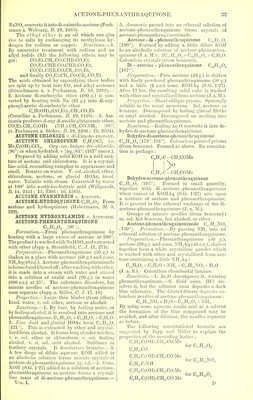
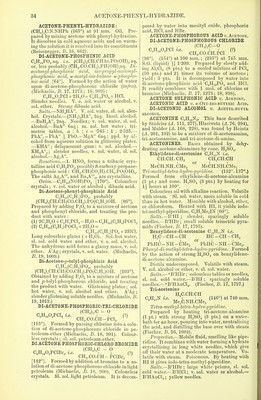
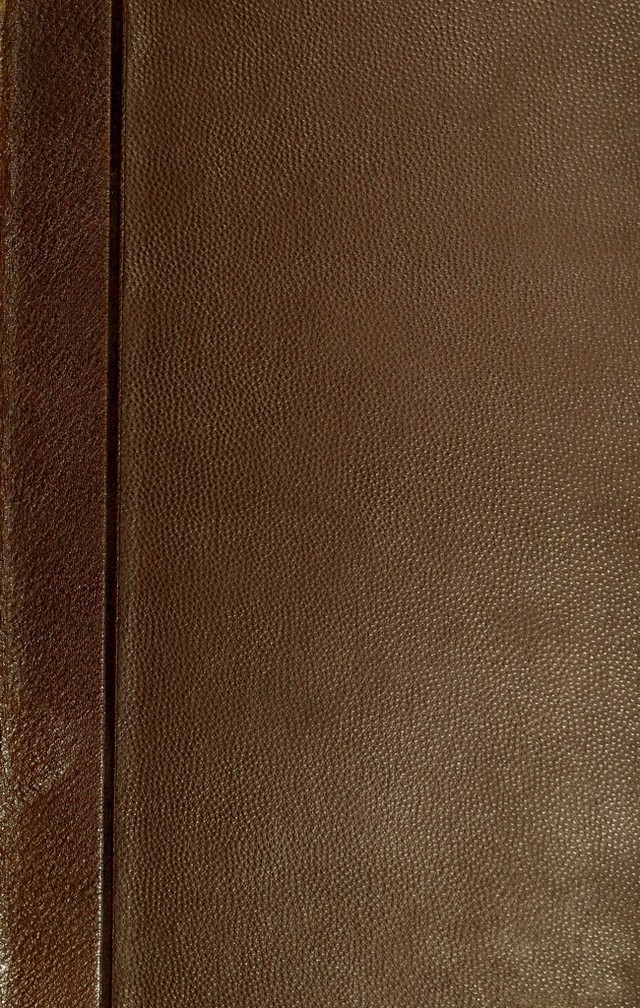
![iso-butyric acid. Alcoholic HC1 forms the imido-ether Me.,C(OH)C(OEt):NH (Pinner, B. 17, 2009). Diacetone cyanhydrin CMe,(CN).O.CMe,(OH), is prepared by adding 1 mol. HC1 (gaseous or aqueous) to 1 rnol. KGN immersed in acetone, dissolving the product in ether, and evaporating (Urech, A. 164, 259). Thick shining anhydrous prisms, easily soluble in water, alcohol, and ether. Melts at 135°-152° and sublimes below its melting point in long needles. Decomposed at ord. temp, by HC1 into NH4C1, acetone, and a-oxy-iso-butyric acid. Substitution Products v. Beomo-acetone, Chlobo-acetone, Chxoeo-bboho-acetone, Iodo- ACETONE, CYANO-ACETONE, ThIO-ACETONE. Meta-acetone. — This name was given by Fremy (A. Ch. [2] 59, 6) to an oil occurring among the products of the distillation of sugar, starch, or gum, with quicklime. He ascribed to it the formula C6HluO and boiling-point 84°. Gottlieb (A. 52, 128) converted it by chromic mixture into propionic acid (called therefore Metacetonic acid). Benedikt (A. 162, 303) found V.D. 3-53 instead of 3-59, and stated that it did not combine with NaHS03. Meta-acetone has also been examined by Favre (A. Ch. [3] 11, 80), Cahours (C. B. 30, 319), who describes it as present in crude wood spirit, Lies-Bodart (J. 1856, 455), and Schwartz (J. 1850, 533). Never- theless Pinner (B. 15, 586; 16, 1729) considers metacetone to be a very complicated mixture. H. W. Para-acetone v. Pinacone. ACETONE-ALCAMINES. — These are pro- ducts derived from the acetonamines by reduc- tion, their CO being converted into CH(OH). Diacetone - alcamine C, H15.NO i.e. NH2.CMe,.CH2.CH(OH).Me (175°). Formed by reduction of diacetonamine by gradually adding sodium-amalgam to its solution in alcohol diluted with aqueous ammonia. Liquid, having a faint ammoniacal odour, miscible in all pro- portions with water. Absorbs CO., from the air ; fumes with HC1. (C6H15NOHCl).,PtCl4 forms orange-red triclinic crystals, easily soluble in hot water. Ethylidene-diacetone-alcamine H2C-CH(OH)-CH, C8H17NO i.e. | | MeHC — NH — CMe2 Oxy - tri - methyl - hcxa - hydro -pyridine [123°]. Colourless crystalline solid. Easily soluble in water and alcohol, sparingly in ether, and ben- zoline. Formed by reduction of ethylidene- diacetonamine with sodium-amalgam in slightly acid aqueous solution. The hydro-chloride forms slender needles, the sulphate large flat prisms (Fischer, B. 17, 1794). Triacetone-alcamine C^H^NO H,C-CH(OH)-CH2 i.e. | | [128-5°] Me,.C—NH — CMe2_ Oxy-tetra-mcthyl-hcxa-hydro-pyridine. Formed together with pseudotriacetonamine by reduc- tion of triacetonamine with sodium-amalgam in slightly acid aqueous solution (Fischer, B. 17, 1788). Pseudotriacetonalcamine [180°]. SI. sol. water and ether, crystallises from hot alcohol. Its platino-chloride (CsH19NO,HCl)2PtCl4,5H20 forms rhombic crystals (Heintz, A. 183, 290, 317). Methyl-tri-acetone-alcamine CJ0H21NO [74°] or, when hydrated, [60°]. Formed from tri- acetone-alcamine by Mel and MeOH at 100° (E. Fischer, B. 16, 1605). Slender plates (from water). Strongly alkaline. H. W. ACETONE ALCOHOL v. Acetyl-caebinol. ACETONE-AMMONIA v. Acetonamines. ACETONE-BENZIL C„Hlfi03 i.e. Ph.CO.CPh(OH).CH.,.CO.CH3 [78°]. Preparation.—Benzil is shaken with excess of pure acetone and a little cone. KOH, and the crystals obtained are dissolved in ether (free from alcohol), which is allowed to evaporate. CuH,„0,+ 0,^0 = 0,^0., (Japp a. Miller, C. J. 47, 21). Properties.—Colourless square prisms. Sol. ether or alcohol. Besolved by heat into its con- stituents. Reactions.—1. Chromic mixture gives ben- zoic and acetic acids.—2. Dry NH3 gives ace- tone-benzilimide (a. v.).—3. Alcoholic hydroxy- lamine gives C17H1(i02(NOH), [146°] ; m. sol. benzene, si. sol. ether. This body is not affected by further treatment with hydroxy] amine. Dehydro-acetone-benzil C17H1402 i.e. CH Ph.CO.CPlv/ 2N>C0 [149°]. Preparation.—Benzil is shaken with excess of pure acetone and excess of cone. KOH (J. a. M.) C14H10O2 + C3Ht0 = C17H1402 + H20. Properties.—Colourless prisms. Beactions.—1. Converted by bromine in chlo- roform to a bromo derivative, C1;H13Br02 [172°]; slender needles (fromglaeialHOAc).—2. Chromic acid in glacial HOAc forms an acid, C1GH1403, [152°]; needles. Salts, AgA'—BaA'2 2aq. Dehydro-acetone-di-benzil C31H2404 [195°]. Formation.—1. From acetone-benzil and di- lute alcoholic KOH.—2. From acetone, excess of benzil, and a little cone. KOH. 2C, ,H10O2 + C3H60 = C31H2lO 4 + H20. Properties.—Colourless crystals (from ben- zene) ; si. sol. boiling alcohol. Crystallises from alcohol with one molecule EtOH. ACETONE-BENZILIMIDE C17H17N02 [176°]. From acetone-benzil and dry NH;!. Flat plates (from alcohol). Heated with HC1 and oxalic acid, gives a red gum (J. a. M.). ACETONE-BORIC ACID v. Acetone. ACETONE - BROMIDE = di - Beomo - peopane (q. v.). ACETONE - BR0M0F0RM C,H7OBr3 i.e. Me2C(OH).CBr3 [175°], or, when hydrated [167°]. From bromoform (5g.), acetone (30g.), and soda- lime (8g.) (Willgerodt a. A. Miiller, C. C. 1884, 808). ACETONE CAEBOXYLIC ACID = Aceto- ACBTIC ACID (q. V.). Acetone di-carboxylic acid Cr)H605 i.e. C02H.CH,.CO.CH.,C02H [c. 130°]. Formed by heating citric acid with H.,S04. Colourless needles. Split up into C02 and acetone by heat, by boiling water, or by warm acids or al- kalis. It contains rnethylenic hydrogen dis- placeable by Na. Fe.2Cl0 gives a violet colour. It reacts with phenyl-hydrazine (Pechmann, B. 17, 2542). It forms a compound with HCN, which on saponification produces citric acid.](https://iiif.wellcomecollection.org/image/b21995990_0001_0058.jp2/full/800%2C/0/default.jpg)
 No text description is available for this image
 No text description is available for this image
 No text description is available for this image