Volume 1
Watts' dictionary of chemistry / revised and entirely rewritten by H. Forster Morley and M.M. Pattison Muir ; assisted by eminent contributors.
- Date:
- 1888-1894
Licence: Public Domain Mark
Credit: Watts' dictionary of chemistry / revised and entirely rewritten by H. Forster Morley and M.M. Pattison Muir ; assisted by eminent contributors. Source: Wellcome Collection.
Provider: This material has been provided by the Royal College of Physicians of Edinburgh. The original may be consulted at the Royal College of Physicians of Edinburgh.
59/796 page 33
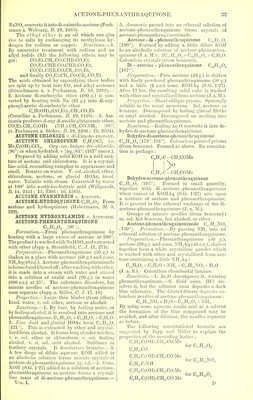
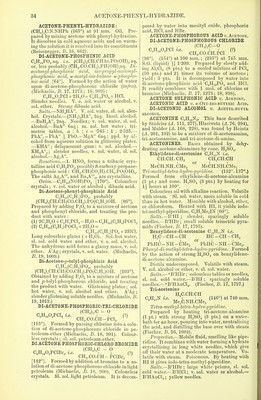
![NaNO, converts it into di-oximido-acetone (Pech- mann a. Wehsarg, B. 19, 2465). The ethyl ether is an oil which can give rise to salts by exchanging its methylenic hy- drogen for sodium or copper. Reactions.—1. By successive treatment with sodium and an alkyl iodide (KI) the following ethers may be got: C02Et.CH,.CO.CHR.CO,Et, C02Et.CHR.CO.CHR.c6.,Et, CO,Et.CHR,CO,CR.,.CO,Et, and finally C02Et.CR2.CO.CR2.C02Et. The acids obtained by saponifying these bodies are split up by heat into C02 and alkyl-acetones (Diinschmann a. v. Pechmann, B. 18, 2289).— 2. Acetone di-carboxylic ether (100 g.) is con- verted by heating with Na (21 g.) into di-oxy- phenyl-acetic di-carboxylic ether CdH(OH)2(CO.,Et).,CH.,CO,Et (Cornelius a. Pechmann, B. 19, 1446).—3. Am- monia produces /3-oxy-£-amido-glutaramic ether, CO.,Et.CH.,.C(OH) (NH,).CH2.CO.NH2 [86°] (v. Pechmann a. Stokes, B. 18, 2290 ; 19, 2094). ACETONE CHLORIDE v. ^-Chloeo-eeopanb. ACETONE CHLOROFORM C4H70C13 i.e. Me„C(OH).CCl3. Oxy - iso - butyro - tri - chloride. [96°] or when hydrated, + |aq, [81°] (167° uncor.). Prepared by adding solid KOH to a cold mix- ture of acetone and chloroform. It is a crystal- line solid, resembling camphor in appearance and smell. Rotates on water. V. sol. alcohol, ether, chloroform, acetone, or glacial HOAc, insol. water. Volatile with steam. Converted by water at 180° into a-oxy-iso-butyric acid (Willgerodt, B. 14, 2451; 15, 2305; 16, 1585). ACETONE CYANHYDRIN v. Acetone. ACETONE-HYDROQUINONE C9H12Cv From acetone and hydroquinone (Habermann, M. 5, 329). ACETONE HYDROXYLAMLDE v. Acetoxim. ACETONE-PHENANTHRAQUINONE C17H1403 [90°]. Formation.—From phenanthraquinone by heating with a large excess of acetone at 200°. The product is washed with NaHS03 and extracted with ether (Japp a. Streatfeild, C.J. 41, 274). Preparation.—Phenanthraquinone (50 g.) is shaken in a glass with acetone (60 g.) and cone. NH3Aq(40c.c). Acetone-phenanthraquinonimide is formed and filtered off; afterwashing with ether, it is made into a cream with water and stirred into a solution of oxalic acid (90 g.) in water (800 c.c.) at 25°. The substance dissolves, but minute needles of acetone-phenanthraquinone soon separate (Japp a. Miller, G. J. 47, 18). Properties.—Large thin blades (from ether). Insol. water, v. sol. ether, acetone or alcohol. Reactions.—1. By heat, by boiling water, or by boiling alcohol, it is resolved into acetone and phenanthraquinone: Ci;H, ,03 = C14H90, + C3H,;0. 2. Zinc dust and glacial HOAc form Cl7H120, [121°]. This is extracted by ether and crystal- lised from alcohol. It forms long slender needles, v. e. sol. ether or chloroform, v. sol. boiling alcohol, v. si. sol. cold alcohol. Sublimes in feathery crystals. It decolorises bromine.—3. A few drops of dilute aqueous KOH added to an alcoholic solution forms minute crystals of acetone-di-phenanthraquinone (q. v.).—4. Cone. KOH (S.G. 1-27) added to a solution of acetone- phenanthraquinone in acetone forms a crystal- line mass of di-acetone-phenanthraquinone.— Vol. I. 5. Ammonia passed into an ethereal solution of acetone-phenanthraquinone forms crystals of acetone-phenanthraquinonimide. Acetone - di - phenanthraquinone C31H.,.,0, [190°]. Formed by adding a little dilute KOH to an alcoholic solution of acetone-phenanthra- quinone (J. a. M.): 2C17HI403 = C31H2205 + OftO. Colourless crystals (from benzene). Di - acetone - phenanthraquinone C2(lH.,004 [187°]. Preparation.—Pure acetone (43 g.) is shaken with finely powdered phenanthraquinone (50 g.) and a little (2 c.c.) cone. KOHAq (S.G. 1-27). After 12 hrs. the resulting solid cake is washed with ether and crystallised from acetone (J. a. M.). Properties.—Short oblique prisms. Sparingly soluble in the usual menstrua. Sol. acetone or benzene. Decomposed by boiling glacial HOAc or amyl alcohol. Decomposed on melting into acetone and phenanthraquinone. Reactions.—Boiling Ac20 converts it into de- hydro-di-acetone-phenanthraquinone. Dehydro-di-acetone-phenanthraquinone C20H18O3 [179°-181°]. Colourless pointed prisms (from benzene). Formed as above. Its constitu- tion is perhaps : C6H4.C-CH.,COMe I l> C„H1.C-CH,COMe Dehydro-aeetone-phenanthraquinone C17Hl202 [195°]. Formed in small quantity, together with di-acetone-phenanthraquinone when excess of KOHAq (S.G. P27) acts upon a mixture of acetone and phenanthraquinone. It is present in the ethereal washings of the di- acetone-phenanthraquinone (J. a. M.). Groups of minute needles (from benzene): m. sol. hot benzene, hot alcohol, or ether. Acetone-phenanthraquinonimide C];H15N02 [130°]. Formation.—By passing NH3 into an ethereal solution of acetone-phenanthraquinone. Preparation.—Phenanthraquinone (50 g.), acetone (60 g.), and cone. NH3Aq (40 c.c), shaken together form a white crystalline powder which is washed with ether and crystallised from ace- tone containing a little NH3Aq : C14H802 + C3H„0 + NH3 = C17H15N02 + H20 (J. a. S.). Colourless rhoniboidal laminae. Reactions.—1. Ac20 decomposes it, forming phenanthraquinone.—2. Cold cone. HC1 dis- solves it, but the solution soon deposits a dark blue substance. The diluted filtrate deposits co- lourless needles of acetone-phenanthraquinone: C17Hl5N02 + H20 = C,7H14Os + NH3 By using cone, aqueous oxalic acid as a solvent the formation of the blue compound may be avoided, and after dilution, the needles separate as before. The following constitutional formula? are suggested by Japp and Miller to explain the properties of the preceding bodies : CuH4.C(OH).CH,.CO.Me i i - forC,.Hl403 C„H,.CO C(iH4.C(OH).CH,.CO.Me C6Hl.C:NH CsH4.C(OH).CH.2.CO.Me C^.qOHJ.CHj.CO.Me for C17H,5N02 for C20H20O4](https://iiif.wellcomecollection.org/image/b21995990_0001_0059.jp2/full/800%2C/0/default.jpg)
 No text description is available for this image
 No text description is available for this image
 No text description is available for this image