Volume 1
Watts' dictionary of chemistry / revised and entirely rewritten by H. Forster Morley and M.M. Pattison Muir ; assisted by eminent contributors.
- Date:
- 1888-1894
Licence: Public Domain Mark
Credit: Watts' dictionary of chemistry / revised and entirely rewritten by H. Forster Morley and M.M. Pattison Muir ; assisted by eminent contributors. Source: Wellcome Collection.
Provider: This material has been provided by the Royal College of Physicians of Edinburgh. The original may be consulted at the Royal College of Physicians of Edinburgh.
61/796 page 35
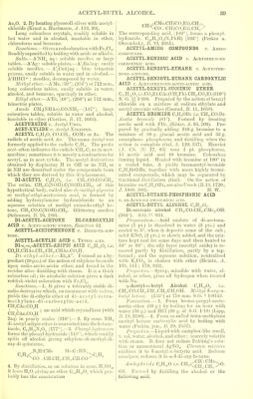
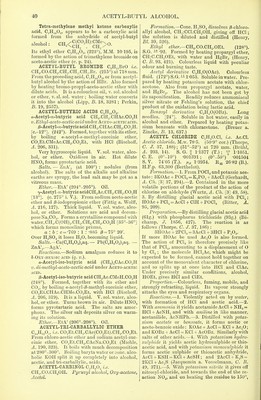
![Nitrosamine C9H1(iN(NO) : yellowish tables; v. sol. alcohol, ether, and benzene, nearly in- soluble in water ; volatile with steam; strong camphor-like smell. Methyl derivative C9H,cNMe : colourless oil very volatile with steam, sparingly soluble in water (Fischer, B. 17, 1789). ACETO-NITRANILIDE v. Nitro-anh/tne. ACETONITRILE G,H3N i.e. CH3.C = N. Methyl cyanide, methyl isocyanide. M.w. 41. (81-6°) at 760 mm. (Vincent a. Delachanal, Bl. 33, 405) ; (81-3°) (E. Schiff, B. 19, 567). 5. G. 2 -805 ; is -789 (V. a. D.). S.V. 57-23 (S.). H.F.p.-15,080. H.F.v.-16,260 (Thomsen). /j.d 1-3458 (V. a. D.). R^ 18-00 (Kanonnikoff, J. pr. [2] 31, 361). V.D. 1-45 (for 1-42). Occurrence.—In crude benzene (V. a. D.). Formation.—1. Dry KMeS04 is distilled with dry KCN and the distillate rectified over CaCL, (Frankland a. Kolbe, C. S. Mem. 3, 386; A. 65~ 288).—2. From Me2S04 and KCN, the product being distilled over HgO and then over P,0, (Dumas, Malaguti a. Leblanc, C. R. 25, 474).—3. By distilling NH,OAc with P.,0, (Dumas, C. R. 35, 383).—4. By distilling acetamide with P„05 (Buckton a. Hofmann, C. J. 9, 242).—5. By dis- tilling acetamide (5 mols.) with P.2S5 (1 mol.), washing the product with NaOHAq and digesting with PbO (Henry, A. 152, 149).—6. From aceta- mide by action of PC15 (Wallach, A. 184, 21). Preparation.—1. By boiling acetamide (500 g.) for a week with a little glacial acetic acid, the water produced being constantly allowed to distil off. The theoretical yield is got (De- marcay, Bl. [2] 33, 456). Properties.—Colourless liquid with a pleasant ethereal odour; burns with a reddish-bordered flame. Miscible with water, but separated by salts from the solution. Mixes with alcohol. The presence of a little alcohol lowers its boiling- point several degrees (D.). Reactions.—1. Hot aqueous KOH acts thus : CH:!.CN + H20 + KOH = CH3C02K + NH:i. 2. Chromic and nitric acids have no action.— 3. Heated with Na, it forms Cyanmetiiine (q. v.) and NaCN.—4. Glacial HOAc at 200° forms di- acetamide: CH3CN + CH3.CO.OH = (CH3.CO).,NH (Gautier, A. 150, 189).—5. Ac.,0, forms tri- acetamide: CH:!.CN + (CH.,.CO),6 = (CH3.CO)3N. 6. Combines with dry HBr, HI, and (with difficulty) with HC1 (Gautier, A. 142, 291).—7. Bromine forms the hydrobromide of the nitrile of Bromo-acetic acid (q. v.), CH.,Br.CH:NBr [65°]. Combinations.—C,H3N2HBf,orCH3.CH„.NBr2 [47°-50°] crystals; may be sublimed.—C2H3NPC]3 (72°): dissociated above its boiling point (Hencke, A. 106, 281).—C.,H,NSbCl3, formed with great rise of temperature; white crystals which may be sublimed (H.).—C.,H3NAuCl3: brownish-yellow powder (H.).—(C2H3N)2TiCl4: white crystalline crusts ; may be sublimed (H.).—(G.H3N)2SnCl4 : sublimes in arborescent formations (H.).— C,H,N2Hg(CN)2: white vitreous mass; decom- poses even over H..SO, (Hesse, A. 110, 202), CH3.C(NH2):NOH, formed by the union of aceto- , nitrile with hydroxylamine v. Etiienyl-ajiid-oxim. ACETONURAMIC ACID GH,„N.,0., i-e. NH2.CO.NH.CMe2.COOH. a-Uramido-is'o-butyric acid, di-mcthyl-hydantoic acid. Obtained, as barium salt (C5H8N202).,Ba(OH)2, by prolonged I boiling of a solution of di-methyl-hydantoin with | baryta-water. The acid itself appears to be very unstable (Urech, A. 164, 255). A more stable acid of the same composition is obtained by evaporating the mixed solutions of the sulphate of amido-isobutyric acid and potassium cyanate. It forms crystals, melting, with loss of water, at 160°, moderately soluble in hot water and alco- hol. Decomposed by prolonged heating at 130°-140° into water and di-methyl-hydantoin. C5HslAgN„03 crystallises in needles (Urech, A. 164, 274). H. W. ACETONYL-ACETO-ACETIC ETHER C„H1404, i.e. CH3.CO.CH2.CHAc.C02Et, a-0-di-acetyl pro- pionic ether. From aceto-acetic ether and chloro-acetone (Weltner, B. 17, 67). Liquid. Warm cone. HC1 changes it to pyrotritaric ether C,H,0.,Et. Water at 160° produces some acetonyl-acetone. ACET0NYL-ACET0NE C,H„,0, i.e. CH3.CO.CH2.CH.,CO.CH3. Di-mcthylethylene di- kctone. (188° uncor.) Formation.—(1) By heating pyrotritaric acid (di-methyl-furfurane-carboxylie acid) with water at 150°-160° ; yield nearly theoretical. (2) By heating acetonyl-aceto-aeetic ether with water at about 160° ; small yield. Properties.—Mobile liquid of peculiar smell. Miscible with water, alcohol, and ether, insol. cone. KOHAq, or K2C03Aq. Reactions.— P2SS, when heated with it, forms thioxene Ci;HsS.—Heating with alcoholic NH3 gives di-methyl-pyrrol (Paal, B. 18,2251); amines behave similarly (Paal a. Schneider, B. 19, 3156). Di-oxim CH3.C(NOH).CH2.CH2.C(NOH).CH3 [135°]. White glistening plates, v. sol. hot water, alcohol, or ether, v. si. sol. benzene. Di-phenyl-di-hydrazide C2H,(CMe:N2HPh)2 [120°]: plates, v. sol. alcohol, ether, or benzene, nearly insol. light petroleum (Paal, B. 18, 58). ACETONYL-CARBAMATE C.H^NO., [76°]. Formed by boiling acetonyl thiocarbamate (infra) with lead acetate or silver oxide. Crystallises from water in prisms, may be dis- tilled ; dissolves in water, alcohol, and ether, Decomposed by heating with strong hydrochloric acid or baryta-water, yielding C02, NH3, and a-oxy-iso-butyric acid. The salts GHAgNO.,, and AgNO./iC.H.NOj are crystalline (Urech, B. 11, 467 ; 13, 485). H. W. ACETONYL-PHOSPHINIC ACID C3H.P03 i.e. CH:i.CO.CH,.P(OH)2. Residue left after distilling acetone with I and P (v. Acetone-phosphorous acid under Acetone). Salt.—Ba(C3H,P03)2. Di-acetonyl phosphinic Acid v. Di-acetone- rHOSrHINIC ACID. Di-acetonyl-phosphorous Chloride v. Di-ace- TONE-PHOSPHOROUS CHLORIDE. ACETONYL-QUINOLINE C,.,HnNO i.e. XJH:CH C.H< I \N :C—CH,CO.CH3 Quinolyl-acctonc. [70°]. Prepared by reducing o-nitro-cinnamoyl-acetone in alcoholic solution withSnClj. Long yellow needles. Distils with- out decomposition. Sparingly volatile with steam. Insol. cold water, si. sol. hot water. Dyes wool and silk yellow. Heated with strong HC1 at 170° it gives (Py. 3)-methyl-quinoline (Fischer a. Kuzel, B. 16, 163). ACETONYL -THIO - CARBAMATE (so called) C.H.NSO.,. Thiacetonuramic acid. [152°]. P 2](https://iiif.wellcomecollection.org/image/b21995990_0001_0061.jp2/full/800%2C/0/default.jpg)
 No text description is available for this image
 No text description is available for this image
 No text description is available for this image