Volume 1
Watts' dictionary of chemistry / revised and entirely rewritten by H. Forster Morley and M.M. Pattison Muir ; assisted by eminent contributors.
- Date:
- 1888-1894
Licence: Public Domain Mark
Credit: Watts' dictionary of chemistry / revised and entirely rewritten by H. Forster Morley and M.M. Pattison Muir ; assisted by eminent contributors. Source: Wellcome Collection.
Provider: This material has been provided by the Royal College of Physicians of Edinburgh. The original may be consulted at the Royal College of Physicians of Edinburgh.
681/796 (page 655)
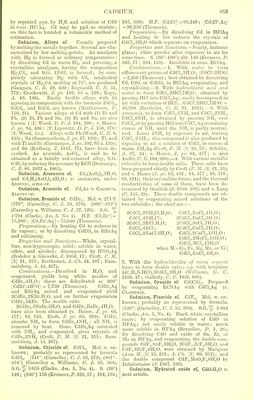
![by repeated ppn. by H.,S, and solution of CdS in cone. HClAq. Cd may be ppd. as oxalate; on this fact is founded a volumetric method of estimation. Cadmium, Alloys of. Usually prepared by melting the metals together. Several are cha- racterised by low melting-points. An amalgam with Hg is formed at ordinary temperatures : by dissolving Cd in warm Hg, and pressing, a crystalline amalgam, having the composition Hg5Cd2, and S.G. 12-62, is formed; by com- pletely saturating Hg with Cd, octahedral crystals of Hg2Cd, melting at 75°, are produced (Gaugain, C. B. 42, 430 ; Kegnauld, C. B. 51, 779; Crookewitt, J. pr. 102, 65 a. 129 ; Kopp, A. 40, 186). Easily fusible alloys with Bi agreeing in composition with the formulas BiCd„ BiCd.,, and BiCd, are known (Matthiessen, P. 110, 21). Various alloys of Cd with (1) Bi and Pb, (2) Bi, Pb and Sn, (3) Bi and Sn, are also known ([1] Wood, D. P. J. 164, 108; v. Hauer, J. pr. 94, 436 : [2] Lipowitz, D. P. J. 158, 376: [3] Wood, I.e.). AUoys with Pb (Wood, C. N. 6, 135); Na (Sonnenschein, J. pr. 67,169); Tl, and with Tl and Bi (Carstanjen, J.pr. 102, 65 a. 129); and Sn (Budberg, J. 1847, 71), have been de- scribed. An arsenide, AsCd3, is said to be obtained as a faintly red-coloured alloy, S.G. 6-26, by reducing the arsenate by KCN (Descamps, C. B. 86, 1022 a. 1065). Cadmium, Arsenates of. Cd3(As0.l)2.3HJ0, and Cd5H2(As04),.4H20; v. arsenates, under Arsenic, acids op. Cadmium, Arsenide of. Cd3As v. Cadmium, Alloys of. Cadmium, Bromide of. CdBr,. Mol.w. 271-2. [570°] (Carnelley, C. J. 33, 278). (806°-812°) (Carnelley a. Williams, C. J. 37, 126). S.G. 2-g 4-794 (Clarke, Am. 5. No. 4). H.F. [Cd.Br2] = 75,200; [Cd,Br-,Aq] = 75,640 (Thomsen). Preparation.—By heating Cd to redness in Br vapour; or by dissolving CdC03 in HBrAq and subliming. Properties and Beactions.—White, crystal- line, non-hygroscopic, solid; soluble in water, ether, and alcohol; decomposed by HNO,Aq (Bodeker a. Giesecke, J. 1860. 17 ; Croft, P. M. [3] 21, 355 ; Berthemot, A. Ch. 44, 387 ; Kam- melsberg, A. 44, 267). Combinations.—Dissolved in H20, and evaporated, yields long white needles of CdBr„.4H,0; these are dehydrated at 200° [CdBr-,4H-0] = 7,730 (Thomsen). CdBr.Aq and KBrAq mixed and evaporated yield 2CdBr,.2KBr.H,0, and on further evaporation CdBr2.4KBr. The double salts 2CdBr2.2NaBr.5H.,0, and CdBr.,.BaBr.,.4H,0, have also been obtained (v. Hauer, J. pr. 64, 477; 69, 121. Croft, J. pr. 68, 399). CdBr., absorbs NH3 to form CdBr2.4NH3; all NH3 is removed by heat. Cone. CdBr2Aq saturated with NH3, and evaporated, gives crystals of CdBr2.2NH3 (Croft, P. M. [3] 21, 355; Kam- melsberg, A. 44, 267). Cadmium, Chloride of. CdCl2. Mol. w. un- known ; probably as represented by formula CdCl2. [541°] (Carnelley, C. J. 33, 279). (861°- 954°) (Carnelley a. Williams, C. J. 35, 564). S.G. ^ 3-655 (Clarke, Am. 5, No. 4). S. (20°) 140 ; (100°) 150 (Kremers, P. 103,57 ; 104,133; 105, 360). H.F. [Cd,CP] = 93,240; [Cd,CP,Aq] = 96,250 (Thomsen). Preparation.—By dissolving Cd in HClAq and heating to low redness the crystals of CdCl2.2H,0 which sepjarate on evaporation. Properties and Beactions.—Pearly, lustrous plates; white powder after exposure to air for sometime. S. (20°-100°) abt. 140 (Kremers, P. 103, 57 ; 104, 133). Insoluble in cone. HClAq. Combinations. — 1. With water to form efflorescent prisms of CdCl.,.2H,0; [CdCl-,2H20] = 2,250 (Thomsen); best obtained by dissolving Cd, CdO, or CdCO, in HClAq, evaporating, and crystallising.—2. With hydrochloric acid and water to form CdCl2.2HC1.7H,0: obtained by passing HC1 into CdCLAq; easily decomposed in air with evolution of HC1; [CdCl-,2HCl,7H-'0] = 40,200 (Berthelot, C. B. 91, 1024).—3. With ammonia, to form CdCl.,.6NH3 and CdCl,,2NH3. CdCl2.6NH3 is obtained by passing NH3 over CdCl2,or by passing HC1 into CdCLAq containing excess of NH3 until the NH3 is partly neutral- ised. Loses 4NH3 by exposure to air, leaving CdCl,.2NH3; this compound is also produced by exposing to air a solution of CdCl2 in excess of warm NH3Aq (Croft, P. M. [3] 21, 55 ; Schuler, A. 87, 34; v. Hauer, J. pr. 64, 477 ; v. also Andre, C. B. 104,908).—4. With various metallic chlorides to form double salts. These salts have been prepared chiefly by Croft (P. M. [3] 21, 55), and v. Hauer (J. pr. 63, 432 ; 64, 477 ; 66, 176; 69,121); their crystalline forms, and the thermal conductivities of some of them, have been de- termined by Grailich (J. 1858. 182), and v. Lang (P. 135, 29). These double compounds are ob- tained by evaporating mixed solutions of the two chlorides; the chief are :— 2CdCl„.2NH,Cl.H.,0; CdCL,.BaCl,.4H,0 ; CdCL,.4NH4Cl; 2CdCl2.BaCl,.5H„0 ; 2CdCl„.2KCl.H,0; 2CdCl.,.SrCL,7H..O; CdCl..4KCl; 2CdCi;.CaCh.7H,0; CdCl2\2NaC1.3H,0; CdCl,.2CaCL.12H20 ; CdCl,.2MgCL,.12H.,0 ; CdCl,.MCl2.12H20 when M = Co, Fe, Rig, Mn, or Ni; CdCl2.CuCl2.4H20. 5. With the hydrochlorides of many organic bases to form double salts; e.g. with toluidine 4(C.H,N.HCl).3CdCl.,.2H20 (Williams, C. C. 1856. 47 ; Galletly, C. C. 1856. 606). Cadmium, Cyanide of. Cd(CN)2. Prepared by evaporating KCNAq with CdCl2Aq (v. Cyanides). Cadmium, Fluoride of. CdF2. Mol. w. un- known ; probably as represented by formula. [520°] (Carnelley, C. J. 33, 280). S.G.2^ 5-994 (Clarke, Am. 5, No. 4). Hard, white, crystalline mass; by evaporating solution of CdO in HFAq; not easily soluble in water; much more soluble in HFAq (Berzelius, P. 1, 26). By dissolving CdO and oxide of Sn, Zr, or Mo in HFAq, and evaporating, the double com- pounds CdF„.SnF2.6H20, 2CdF2.ZrF4.6H,0, and CdF„.2ZrFr6H.,0, were obtained by Marignac (Ann. M. [5] 15, 221; A. Ch. [3] 60, 257); and the double compound CdF2.Mo02F„.6H20 by Delafontaine (J. 1867. 236). Cadmium, Hydrated oxide of, CdO.H20 v. next article.](https://iiif.wellcomecollection.org/image/b21995990_0001_0681.jp2/full/800%2C/0/default.jpg)