Volume 1
Watts' dictionary of chemistry / revised and entirely rewritten by H. Forster Morley and M.M. Pattison Muir ; assisted by eminent contributors.
- Date:
- 1888-1894
Licence: Public Domain Mark
Credit: Watts' dictionary of chemistry / revised and entirely rewritten by H. Forster Morley and M.M. Pattison Muir ; assisted by eminent contributors. Source: Wellcome Collection.
Provider: This material has been provided by the Royal College of Physicians of Edinburgh. The original may be consulted at the Royal College of Physicians of Edinburgh.
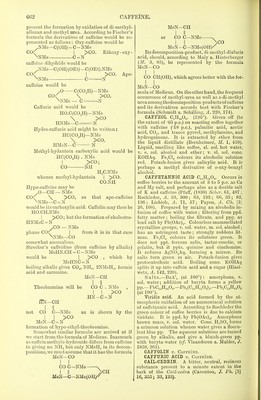
686/796 (page 660)
![(Blyth). SI. sol. cold water and alcohol, v. si. sol. ether. The crystals from alcohol and ether are anhydrous. Weak base; the salts being decomposed by water; does not affect red litmus. Tastes bitter. Produces tetanus and rigor in the voluntary muscles of frogs (Aubert; Brunton a. Cash, Pr. 42, 238). In men it in- creases the heart's action, excites the nervous system, and diminishes metabolism (?) (Leh- mann, A. 87, 205). Caffeine gives a yellow pp. with phosphomolybdic acid. Estimation.— The various methods of pre- paration may also be used for estimation (Stenhouse, A. 102, 126; Lieventhal, C. C. 1872, 631; Weyrick. Fr. 12, 104 ; Peligot, Rep. Pharm. 82, 340; Claus, J. 1803, 708, Zoller, J. 1871, 818 ; Mulder, J. pr. 15, 280 ; Commaille, Bl. [2] 25, 261 ; Paul a. Cownley, Ph. [3] 17, 565). Colour Test.—Evaporate with chlorine-water on platinum-foil. A yellowish residue is left, which on further heating becomes red, and is turned purple by ammonia (Schwarzenbach, J. 1861,871; 1865,730). Xanthine, theobromine and uric acid also give this test. Caffeine evaporated with cone. HN03 gives a yellow residue (amalic acid) which is also turned purple (murexide) by ammonia (Kochleder, A. 69, 120). Reactions.—1. Gaseous chlorine or HC1 and KC103 give in the first place di-methyl-alloxan and methyl-urea (E. Fischer, A. 215, 257): C8H10N4O2 + 02 + 2H,0 = CftNA + C2H6N20. Part of the di-methyl-alloxan becomes amalic acid. Chloro-caffeine,methylamine, and cyano- gen chloride are also formed, and, if the reaction is prolonged, di-methyl-parabanic acid (choles- trophane). Bromine and water at 100° act similarly (Maly a. Hinterberger, M. 3, 85).—2. Cold HN03 attacks it slowly, giving off C02 (1 vol.) and N20 (about 2 vols.) (Franchimont, R. T. C. 6, 223).—3. Hot dilute HN03 gives di- methyl-parabanic acid (Stenhouse, A. 45, 366; 46, 227; Eochleder, A. 69, 120; 71, 1).—3. Chromic acid gives di methyl-parabanic acid, NH3, methylamine, and C02 (Maly a. Hinter- berger, M. 2, 87).—4. Boiling baryta water splits up caffeine into caffei'dine and C02; the caffei- dine then breaks up into C02, NH3, methylamine, formic acid, and methyl-amido-acetic acid (sarcosine) (Kosengarten a. Strecker, A. 157, 1). 5. With cone. HC1 at 250° it forms ammonia, methylamine, sarcosine, formic acid and C02 (E. Schmidt, A. 217, 270). The volume of NH3 is to that of NMeH2 as 1:2. Below 200°, HC1 has no action. Hence there are three NMe groups in caffeine, C8H10N4O., +6H,0 = 2C02 + 2NMeH2 + NH3 + CH202 + C.,H7N02. Salts.—(E. Schmidt, A. 217, 282; Herzog, A. 26, 344; 29, 171; Biedermann, Ar. Ph. [3] 21, 175 ; Tilden, C. J. 18, 99; 19, 145.) B'HCl.—B'HCl 2aq : monoclinic ; decomposed by moist air into HC1 and caffeine.—B'2HC1.— B'4HCL—B'„H2PtCl„ (at 100°).-B'HAuCl4 2aq: glittering plates.—B'HBr 2aq.—B'HI.—B'2HI. —B'HI3 l|aq (Tilden). — B'HCICII : [175°]; yellow needles converted by NH3 into a greenish- black pp. (Tilden, Z. 1866, 350 ; Ostermayer, B. 18, 2298).—B'HN03aq.—B'H.,S04.—B'H„S04aq. Formate B'H2C0.,.—Acetate B'2HOAc— B u t y r a t e B'C4H802.—I s o v a 1 e r a t e B'C;>H1(J02. —Citrate: prepared by adding a solution of citric acid (1 pt.) in alcohol (7\ pts.) to one of caffeine (lpt.) in chloroform (14|pts.) and evapo- rating. Semi-crystalline powder, decomposed by most solvents (Lloyd, Ph. [3] 11, 760). According to Tanret (J. Ph. [5] 5, 591) the last five salts are merely mixtures. — Caffeate B'C,,Hs04 2aq (Hlasiwetz, A. 142, 226). Combinations.— B'HgCl, (Nicholson, A. 62, 78; Hinterberger, A. 82, 316).— B'HgCy., (Kohl a. Swoboda, A. 83, 341).—B'AgN03. Methylo ■ chloride B'MeCl aq. At 200° it splits up into MeCl and caffeine.— (B'MeCl)2PtCl4. Sparingly soluble. Methylo-iodide B'Melaq (Tilden, J. pr. 94, 374 ; E. Schmidt, A. 217, 286; E. Schmitt a. E. Schilling, A. 228, 141). From caffeine and Mel at 130°. At 100° it loses aq, at 190° it splits up into caffeine and Mel. Triclinic: a:6x = -6962:l:-4161; a = 91°24'; 0 = 74°; 7 = 88°. —B'MeI3. Met'hylo-hydroxideB'MeOB.a.q [91°], and B'MeOH [138°]. From the methyloiodide and Ag20 (Schmitt a. Schilling, A. 228, 143). Crystals. V. sol. water, alcohol, and chloroform, v. si. sol. ether or light petroleum. Its solutions are neutral. It is not poisonous. Heated at 200° in the dry state it gives off methylamine while caffeine is also formed. HC1 or dilute H,S04 convert only part of it into the corre- sponding salt, the rest gives methylamine, formic acid and dimethyldialuric acid, the latter being converted by atmospheric oxygen into amalic acid. When HC1 is used, caffeine methylochloride is one of the products. With water at 200° it gives sarcosine, methylamine, formic acid, and CO.,. Chromic acid forms cho- lestrophane, methylamine, formic acid and C02. Ethylo-triiodide B'EtI3. From caffeine and EtI at 130° (Tilden, C. J. 18, 99 ; 19, 145).— B'„Et2PtCl6. Chloro-caffeine C8H9C1N402. [188°]. Formed by passing chlorine into dry caffeine in dry CHC13. Crystallised from water. V. si. sol. cold water and ether, v. sol. strong acids but j5pd. by water. Beduced to caffeine by zinc-dust and HC1 (Fischer, A. 215, 262; 221, 336). Bromo-caffeine v. p. 561. Amido-caffeine C8H„(NH2)N402. [above 360°]. From bromo-caffeine (2 pts.) and alcoholic NH3 (20 pts.) by heating for 7 hours at 130° (Fischer, A. 215, 265). Slender needles; may be distilled. V. si. sol. water and alcohol; sol. cone. HOAc; sol. cone. HClAq, but reppd. by water, being apparently less basic than caffeine. Oxy-caffeine C8H,(OH)N402. [c. 345°]. From ethoxy-caffeine by heating with dilute HC1 (Fischer, A. 215, 268). Mass of white needles (from water). V. si. sol. alcohol, ether, or cold water. Sol. cone. HC1 but reppd. by water. Oxy-caffeine is an acid.—NaA' 3aq. Needles.— BaA'2 3aq. Reactions.—1. The silver salt with EtI at 100° gives ethoxy-caffeine.—2. PC15 in POCl3 gives chloro-caffeine.—3. CI at a high temperature gives di-methyl-alloxan.—4. CI gas at 0° in a solution of oxy-caffeine in HC1 gives apo- and hypo-caffeine.—5. Dry bromine forma an addition compound C8H0(OH)N4O2Br2(?) as a red mass, decomposed by water or alcohol, the latter giving diethoxy-oxy-caffeine dihydride. Ethoxy - caffeine C8H,(OEt)N402. [140°]. From bromo-caffeine and alcoholic KOH (Fis-](https://iiif.wellcomecollection.org/image/b21995990_0001_0686.jp2/full/800%2C/0/default.jpg)