Volume 1
Watts' dictionary of chemistry / revised and entirely rewritten by H. Forster Morley and M.M. Pattison Muir ; assisted by eminent contributors.
- Date:
- 1888-1894
Licence: Public Domain Mark
Credit: Watts' dictionary of chemistry / revised and entirely rewritten by H. Forster Morley and M.M. Pattison Muir ; assisted by eminent contributors. Source: Wellcome Collection.
Provider: This material has been provided by the Royal College of Physicians of Edinburgh. The original may be consulted at the Royal College of Physicians of Edinburgh.
687/796 (page 661)
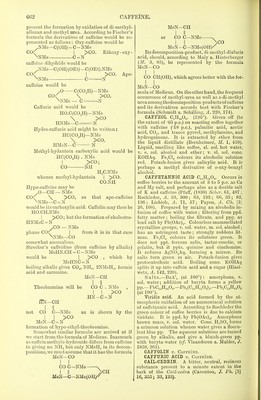
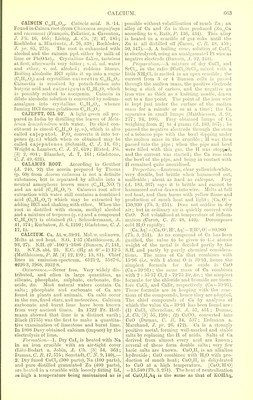
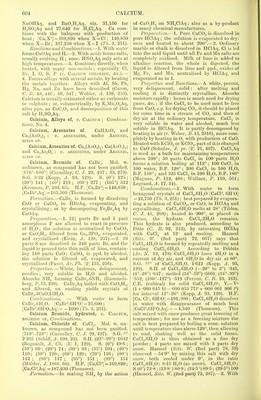
![cher, A. 215, 266). White needles (from water). SI. sol. cold alcohol or ether, v. e. sol. hot alco- hol. Melts in boiling water, partly dissolving. Sol. dilute HC1 and reppd. by KOH. Di-methoxy-oxy-caffe'ine dihydride CsH,,N40,(OMe)„OH. [179°]. Prepared by the action of methyl alcohol on oxy-caffeine bromide. Colourless crystals. Sol. water and alcohol. By HC1 it is decomposed into methyl alcohol, methylamine and apo-caft'eine (Fischer, B. 14, 642). Di-ethoxy-oxy-caffe'ine dihydride CsH,(OEt),(OH)N40, Di-ethyl derivative of tri- oxy-caffeine dihydride. [195°-205°]. From oxy- caffeine, Br, and alcohol, as above. Warmed with HC1 it gives alcohol, methylamine, apo- caffei'ne, and hypo-caffeine. Fuming HI or HI gas passed into chloroform solution reduces it to oxy-caffeine. With phosphorus oxychloridc it forms a crystalline substance that appears to be CsH9N40,(OH)(OEt)Cl. This body is recon- verted by alcohol into diethoxy-oxy-caffeine di- hydride, but it is decomposed by water, one of the products being di-methyl-alloxan, although this is not formed from diethoxy-oxy-caffeine dihydride by water or acids (Fischer a. Reese, A. 221, 337). Allo-cafMne C8HnN305. [198°]. A by-pro- duct obtained in the preparation of the preced- ing body from oxy-caffeine, bromine and alco- hol, especially when the latter is wet (92 p.a). Sandy powder. V. si. sol. water, si. sol. boiling alcohol. Decomposed by boiling HC1 (Fischer, A. 215, 276). Apo-caffeine C;H,N305. [148°]. Formation.—1. From di-ethoxy-oxy-caffeine dihydride (5 g.) by evaporating with (20 g.) di- lute (20 p.c.) HC1 at 100° (Fischer, A. 215, 277); the equation is: C8H,(OH)N40,(OEt).,+ 2H,0 = C7H7N30:, + MeNH2 + 2HOEt.— 2. From oxy- caffeine and aqueous CI at —10°.— 3. From caffeine, HC1 and KCIO., (Maly a. Andreasch, M. 3, 100). Properties. — Monoclinie crystals (from water). a:b:c = -8025:1: -6976. V. sol. hot water, alcohol or chloroform, si. sol. cold water, benz- ene or CS,. Boiling water decomposes it into CO,, hypo-caffeine and caffuric acid (q. v.). Hypo-caffeine C0H;N3O:1. [182°]. Formation.—-1. Formed along with apo- caffeine by warming the di-ethyl derivative of tri-oxy-caffeine dihydride with hydrochloric acid, thus: CKH9(OH)N,0.,(OEt)2 + 2H„0 = CBH;N.,0., + 2HOEt + NH„Me + CO.,. — 2. From oxy-caffeine, HC1 and CI (Fischer, A. 215, 288). Properties. — Crystallised from water. V. sol. hot water or alcohol, si. sol. cold water. May be distilled with but slight decomposition. Ba(C„H6N303),C(.H,N.,03: v. sol. water. Reactions.—Not affected by boiling fuming HNO„ chlorine- or bromine-water, K,Cr,0; and dilute H,SO„ HMnO„ cone. HC1, fuming HI, Sn and HC1, Ac,0 or POCl3 and PC15. Water at 150° completely destroys it. Boiled with baryta it gives caffolin (q. v.). Caffolin C5H9Ns02. [194°-1960]. Formed by boiling hypo-caffeine with lead sub - acetate (Fischer, A. 215, 292). Slender needles (from alcohol) or long prisms (from warm water). V. e. sol. warm water. SI. sol. alcohol. Does not combine with acids. It is but a feeble [ acid, for its barium compound is decomposed by C02. Boiled with Ag,0, it forms a crystalline silver compound. Reactions.—1. Cone. HC1 at 100° splits it up into CO,, NH3, NMeH, etc.—2. Cone. HI forms methyl-urea.—3. K.jFeCy,; gives methyl-oxamic acid and methyl-urea : CrH9N.,0, + 6 + H„0 = MeNH.CO.CO.H + MeNH.CO.NH,. — 4. KMnO, and KOH give di-methyl-oxamide and ammonia, according to the reaction: C,H<,N30, + O + H.,0 = MeNH.CO.CO.NHMe + C0.2 + NH3.—5. Potas- sium bichromate and H,S04 give cholestrophane : C5H„N30, + O = C5H6N.20:1 + NH3. — 6. Nitrous acid completely destroys it.—7. Boiled with Ac.,0 it forms the acetyl derivative of acecaffin C0H„1AcN.,O.,. Acecaffin C„HnN30,. [110°-112°]. From its acetyl derivative by evaporating with fuming HC1 at 100° and decomposing the resulting hydrochloride by Ag,0 (Fischer, A. 215, 300). Trimetric crystals (from benzene). a:b:c = •6707:1:F2445. May be distilled undecomposed. V. e. sol. water or alcohol. Acetyl derivative C.HlAcN.O,. [106°-107°]. From caffolin by boiling with Ac20 as long as CO, comes off (12 hours). Monoclinie tables (from chloroform mixed with ether). Caffuric acid C„H,N30,. [210°-220°]. From apo-caffeine by boiling water (Fischer, A. 215, 280). C;H7N3Or, + H,0 = 0^^0,4-CO.,. Trans- parent tables (from alcohol). V. sol. water, si. sol. cold alcohol, chloroform or ether. Feeble acid, its barium salt being decomposed by CO,. Salt.—AgA'. Tables, si. sol. water. Reactions.—1. Not affected by chlorine- or bromine-ivater.—2. HI converts it into hydro- caffuric acid.—3. Warmed with lead sub-acetate it gives mesoxalic acid, methyl-urea and methyl- amine.—4. Hot KOH gives off NH.Me. Hydro-caffuric acid C„H,,N303. [240°-248°]. From caffuric acid, fuming HI and PH,I (Fischer, A. 215, 285). Colourless prisms (from water). V. sol. hot water, si. sol. cold water. Reactions.—1. Gives no pp. when boiled with lead sub-acetate (unlike caffuric acid).—2. Gives with ammoniacal AgNO., a mirror in the cold.— 4. Chlorine-water oxidises it to caffuric acid.— 3. Hot KOH gives off methylamine.—5. Warmed with baryta it forms methylamine and methyl- hydantoin carboxylic acid, the latter splitting up into CO, and methyl-hydantoin. Methyl-caffuric acid C.HuN^,. [167°]. From allocaffeine by boiling with water (Schmidt a. Schilling, A. 228, 172). Needles (from water). V. sol. water, alcohol, and chloroform. Basic lead acetate converts it into mesoxalic acid, methylamine and dimethyl urea. Amalic acid v. p. 149. Constitution of Caffeine.—Medieus (A. 175, MeN-CO I J 250) proposed the formula CO C—NMe I II >CH MeN—C—N while Emil Fischer (A. 215, 314) proposed Me.N—CH I II CO C. NCH3 . Both formulae readily re- I I >co Me.N—C = N](https://iiif.wellcomecollection.org/image/b21995990_0001_0687.jp2/full/800%2C/0/default.jpg)