Volume 1
Watts' dictionary of chemistry / revised and entirely rewritten by H. Forster Morley and M.M. Pattison Muir ; assisted by eminent contributors.
- Date:
- 1888-1894
Licence: Public Domain Mark
Credit: Watts' dictionary of chemistry / revised and entirely rewritten by H. Forster Morley and M.M. Pattison Muir ; assisted by eminent contributors. Source: Wellcome Collection.
Provider: This material has been provided by the Royal College of Physicians of Edinburgh. The original may be consulted at the Royal College of Physicians of Edinburgh.
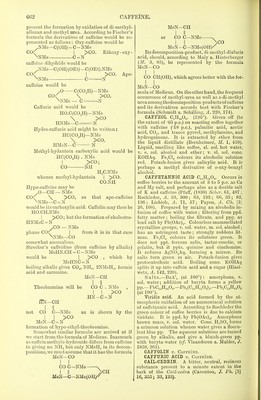
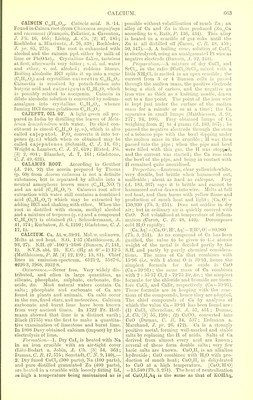
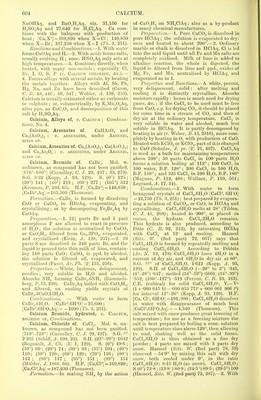
688/796 (page 662)
![present the formation by oxidation of di-methyl- alloxan and methyl urea. According to Fischer's formula the derivatives of caffeine would be re- presented as follows : Oxy-eaffeine would be ^NMe—C(OH) = C - NMe CO \ NMe- -C = N >CO. Ethoxy-oxy- caffeine dihydride would be „NMe—0(OH)(OEt)—C(OEt).NMe CO NMe- >CO. Apo- -N caffeine would be X) C(CO.H)- co< \ \NMe — 0= -NMe >C0. -N Caffuric acid would be HO.C(C02H)- HNMe—C^= -NMe >C0 ^N so that apo-caffeine Hydro-caffuric acid might be written : HC(C02H)—NMe \ >C0. HMeN—C N Methyl-hydantoin carboxylic acid would be HC(C02H) . NMe I >C0; CO NH H2C.NMe whence methyl-hydantoin | >C0. CO.NH Hypo-caffeine may be .0—CH—NMe C0< \ >C0, \NMe—C=N would be its carboxylic acid. Caffolin may then be HO.CH.NMe >C0; but the formation of cholestro- HNMeC = N .CO — NMe phane CO^ from it is in that case \NMe-CO somewhat anomalous. Strecker's caffeidine (from caffeine by alkalis) MeHN.CH = C — NMe would be | >C0 , which by MeHNC = N boiling alkalis gives C02, NH3, 2NMeH2, formic acid and sarcosine. MeN—CH Theobromine will be 3N—CH CO C . NMe I I >co HN-C=N as is shown by the not CO C—NMe I I >co MeN—C = N formation of hypo-ethyl-theobromine. Somewhat similar formula are arrived at if we start from the formula of Medicus. Inasmuch as caffeinmethylo-hydroxide differs from caffeine in giving no NH3 but only NMeH2 in its decom- positions, we must assume that it has the formula MeN—CO CO C—NMe MeN—C—NMe(OH) CH MeN—CH I II or CO C—NMe- MeN—C—NMe(OH)' Its decomposition-product, di-methyl-dialurio acid, should, according to Maly a. Hinterberger (M. 3, 85), be represented by the formula MeN—CO I I CO CH(OH), which agrees better with the for- MeN—CO mula of Medicus. On the otherhand, the frequent occurrence of methyl-urea as well as s-di-methyl urea among thedecomposition-products of caffeine and its derivatives accords best with Fischer's formula (Schmidt a. Schilling, A. 228, 174). CAFFEOL CsH1002. (196°). Given off (to the extent of -05 p.c.) on soasting coffee together with caffeine (-18 p.c), palmitic acid, acetic acid, CO,, and traces pyrrol, methylamine, and hydroquinone. It is extracted by ether from the liquid distillate (Bernheimer, M. 1, 459). Liquid, smelling like coffee, si. sol. hot water, v. e. sol. alcohol and ether; v. si. sol. cone. KOHAq. Fe2Cl(. colours its alcoholic solution red. Potash-fusion gives salicylic acid. It is perhaps a methyl derivative of o-oxy-benzy] alcohol. CAFFETANNIC ACID C15Hl808. Occurs in coffee berries to the amount of 3 to 5 p.c. as Ca and Mg salt, and perhaps also as a double salt of K and caffeine (Pfaff, (1830) Scher. 61, 487 ; Kochleder, A. 59, 300; 63, 193; 66, 35 ; 82, 196; Liebich, A. 71, 57; Payen, A. Ch. [3] 26, 108). Prepared by mixing an alcoholic in- fusion of coffee with water; filtering from ppd. fatty matter; boiling the filtrate, and ppg. as lead salt by Pb(OAc)2. Colourless mammellated crystalline groups, v. sol. water, m. sol. alcohol; has an astringent taste; strongly reddens lit- mus. Fe2Cl6 colours its solutions green. It does not ppt. ferrous salts, tartar-emetic, or gelatin, but it ppts. quinine and cinchonine. It reduces AgN03Aq, forming a mirror. Its salts turn green in air. Potash-fusion gives protocatechuic acid. Boiling cone. KOHAq splits it up into caffeic acid and a sugar (Hlasi- wetz, A. 142, 220). Salts.—BaA'2 (at 100°): amorphous, v. sol. water; addition of baryta forms a yellow pp.-PbC15H1608.-Pb3(C15H1508)2.-Pb2C15HH08 (at 100°). Viridic acid. An acid formed by the at- mospheric oxidation of an ammpniaeal solution of caffetannic acid. According to Kochleder the green colour of coffee berries is due to calcium viridate. It is ppd. by Pb(OAc)2. Amorphous brown mass, v. sol. water. Cone. H2SO, forms a crimson solution whence water gives a fioccu- lent blue pp. The aqueous solutions are turned green by alkalis, and give a bluish-green pp. with baryta-water icf. Vlaanderen a. Mulder, J. 1858, 261). CAFFOLIN v. Caffeine. CAFFURIC ACID v. Caffeine. CAIL-CEDRIN. A bitter, neutral, resinous substance present to a minute extent in the bark of the Gail-cedra (Caventou, /. Ph. [3] 16, 355; 33, 123).](https://iiif.wellcomecollection.org/image/b21995990_0001_0688.jp2/full/800%2C/0/default.jpg)