Volume 1
Watts' dictionary of chemistry / revised and entirely rewritten by H. Forster Morley and M.M. Pattison Muir ; assisted by eminent contributors.
- Date:
- 1888-1894
Licence: Public Domain Mark
Credit: Watts' dictionary of chemistry / revised and entirely rewritten by H. Forster Morley and M.M. Pattison Muir ; assisted by eminent contributors. Source: Wellcome Collection.
Provider: This material has been provided by the Royal College of Physicians of Edinburgh. The original may be consulted at the Royal College of Physicians of Edinburgh.
699/796 (page 673)
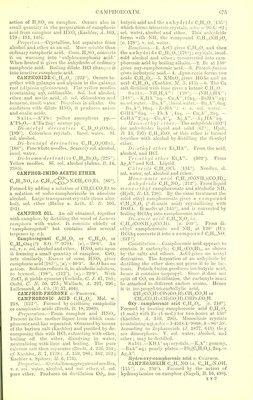
![on its solution in CHC13, forms C22HMOs [265°]. 3. PC15 forms C22H.,SC18 [45°] which separates from ether-alcohol in triclinic crystals a:b:c = 1: -804: -47. Salts.—NaA'.—BaA',.—PbA',. Ethyl ether EtA': (27G5 uncor.); S.G. 15- 1-052 ; colourless fluid (Koser, B. 18, 3113). Nitrile C^H^CyO. Cyano-camphor. [128°]. (250°). Formed by passing cyanogen into a mixture of camphor and sodium-camphor dis- solved in hot toluene; extracted by shaking with aqueous NaOH and ppg. by HOAc. Rect- angular prisms (from ether); sol. alcohol, ether, and HOAc. Contains an atom of hydrogen displaceable by Na or K, forming unstable salts. Cone. HC1 at 100° converts it into camphor carboxylic acid. Oxidising agents give HCyand camphoric acid. Alcoholic NaOH slowly con- verts it into the ether of camphor carboxylic acid (Haller, C. R. 87, 843 ; 93, 72 ; 102, 1477). Chloro-camphor carboxylic acid C,,H15C103. Formed by passing CI into a solution of sodium camphor, carboxylate (Schiff a. Puliti, B. 16, 887). Flocculent pp.; decomposes on fusion into CO.. and chloro-camphor. Bromo-camphor carboxylic acid C|,HlyBr0.t. [110°]. From camphor carboxylic acid and Br (Silva, B. 6, 1092). Both the acid and its salts readily decompose into CO., and bromo-cam- phor.—Ba A'.„—Ag A'. Oxy - camphor carboxylic acid C„H1H04- [160°]. [o]„ = 59°. Formed by boiling the nitrile of camphor carboxylic acid with aqueous KOH (Haller, C. R. 87, 929). Nodules (from ether).—CaA 6aq.—BaA 6aq. CAMPHOR DICHLORIDE C1()HI6C12. [155°]. Prepared by the action of PCI, on camphor in the cold: C10HuO + PCI, = POCl3 + C10H„.C1.. (Spitzer, B. 11, 363, 1819; M. 1, 319). Formed also by chlorinating bornyl chloride (Kachler a. Spitzer, A. 200,361). Feathery trimetric needles; a:b:c = -917:1:1-686. Easily soluble in alcohol and ether. Easily splits off HC1. CAMPHORIC ACID Cl0H1(jO, i.e. CH„—CPr—CO.H C8HH(CO,H)2 or I I (Schiff) CH.,—CMe-CO.,H or Pr.CH(CO.,H).CH,CH:CMe.CO,H (W. Boser, A. 220, 278). Mol.w. 200. [186°]. S.G. 1-19. S. -625 at 12°. R ^ 83-14 (in a 1 p.c. aqueous solution) (Kanonnikoff, J. pr. [2] 31, 349). [a]D = 46°. Formed by boiling camphor or cam- pholic acid with cone. HN03 (Kosegarten (1785); Laurent, A. Ch. 63, 207; Malaguti, A. Ch. 04, 151; A. 22, 50; Wreden, A. 163, 323; V. Meyer, B. 3,116; Kachler, A. 162, 262). It is best to use the mixture of camphor and borneol obtained by the action of Na on camphor (Maissen, G. 10, 280). Formed also by the oxidation of chloro- or bromo- camphor with alkaline permanganate (Balbiano, G. 17, 240). Monoclinic crystals; the rotation in alkaline solution has been studied by Thomsen (J. pr. [2] 35, 157). The refractive power indicates a double union, which does not agree with Schiff's formula. Reactions.—1. Heat splits it up into water and an anhydride.—2. Water at 180° changes it into meso-camphoric acid.—3. Fuming HC1 at 200° forms C9HI4 and CSH16 (Wreden, A. 187, 169).—4. Cone. HIAq at 200° gives xylene tetra- Vol. I. hydride and hexahydride (W.).—5. By the action of ZnCl., xylene tetrahydride C8H,, is produced : C„Hl4(CO,H), = C8H,4 + C02 + CO + H20. The same hydrocarbon is produced by the action of ZnCl, on ammonium camphoramic acid: C,0H14O,(NH„) (ONH4) + ZnCl.. + HO = 2NH4C1 + ZnO + CO + CO, + C8H,, (Ballo, B. 12, 324).—6. The ammonium salt distilled with P,0, gives a terpene C,0H.(2 (Ballo, A. 197, 322). 7. Cone. H,S04 forms CO and ' sulphocam- phoric acid.'—8. Cone. HN03 gives campho- ronic acid.—9. Potash-fusion gives pimelic acid Pr.CH(CO,H).CH,.C0.2H and an acid C]„Hl„05 (Hlasiwetz a. Grabowsky, A. 145, 205). — 10. Distillation with soda-lime gives camphoric anhydride and phorone C,,HM0 (Meyer, B. 3, 117). Distillation of camphorates gives similar results. Salts.—(Kemper, At. Ph. [2] 110, 100; 117, 23). NH4HA xaq.—(NH,),A.—Li2A.— Na .A.—K„A: deliquescent.—MgA 7 !aq. S. 40 at 20°.— MgA12aq.—Mgk13Hq.—CaH.A,.— CaA 4iaq. — CaA 7aq. — Ca,H,A4 8aq. — BaH.A'2aq.—BaA aq : needles and feathers (Kingzett, C. J. 45, 93).—BaA4\aq.—Z11A.— PbA.—CuA.—Ag,A. Ethyl-ammonium salt (NH3Et),A: small needles (from alcohol). Converted by PCL into camphoric di-ethyl-irnidine. Mono-methyl ether MeHA. [68°]. [a]j=51-4°. Trimetric prisms (from ether); gives camphoric anhydride when distilled. V. si. sol. water (Loir, A. Ch. [3] 38, 483). Mono-ethyl ether EtHA. S.G. — 1-095. Syrup. Di-ethyl ether Et,A. (286°). S.G.^1-029. Formed, together with camphoric anhydride, by the distillation of the mono-ethyl ether (Mala- guti, A. Ch. [2] 64, 152; 70, 360; Meyer, B. 3, 118). Liquid. Chlorine produces a tetra- chloro- derivative (C,H3C1,).2A. S.G. 1± 1-386. Chloride CloHl40,CL. Heavy oil, decom- posing at 200° (Moitessiei-; A. 120, 252). Anhydride C,0H14O3. [217°]. (above 270°). S.G. ^ 1-194. [o]„ = - 7-7° (in benzene). Formed by heating camphoric acid or its salts (Bouillon-Lagrange, A. Ch. 23, 153 ; Laurent, A. Ch. 63, 207; Malaguti, A. Ch. 64, 151; Blumenau, A. 67, 119; Monoyer, J. Ph. [3] 45, 177). Formed also from camphoric acid by the action of (1 mol. of) PC15 (Gerhardt a. Chiozza, A. 87, 294), of cone. H,SO„ of Ac20, or of AcCl (Anschutz, B. 10, 1881). Long trimetric prisms (from alcohol) (Montgolfier, A. Ch. [5] 14, 5). V. si. sol. water, v. sol. alcohol, v. e. sol. ether. Slowly converted by boiling water into cam- phoric acid. The statement of Brodie (Pr. 9, 361; 12, 655) that barium peroxide formed camphoric peroxide has been denied by Kingzett (C. J. 45, 93). Amide CfiHn(CONH.,),. Amorphous mass (Moitessier, A. 120, 253). Imide C,H,,:C.,0,:NH. [180°] (in sealed tubes, Ballo, A. 197, 332). Formed by heating ammonium camphoramate at 160° (Laurent, Compt. chim. 1845, 147; A. 60, 327). Lamina?. May be distilled. Ethylimide CsH14:C..O,,:NEt. [50°]. (275°). Colourless crystals. Prepared by dis- XX](https://iiif.wellcomecollection.org/image/b21995990_0001_0699.jp2/full/800%2C/0/default.jpg)