Volume 1
Watts' dictionary of chemistry / revised and entirely rewritten by H. Forster Morley and M.M. Pattison Muir ; assisted by eminent contributors.
- Date:
- 1888-1894
Licence: Public Domain Mark
Credit: Watts' dictionary of chemistry / revised and entirely rewritten by H. Forster Morley and M.M. Pattison Muir ; assisted by eminent contributors. Source: Wellcome Collection.
Provider: This material has been provided by the Royal College of Physicians of Edinburgh. The original may be consulted at the Royal College of Physicians of Edinburgh.
701/796 (page 675)
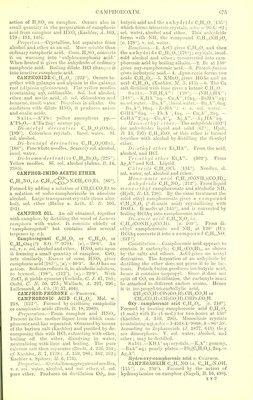
![action of H.^SO^ on camphor. Occurs also in small quantity in the preparation of camphoric acid from camphor and HN03 (Kachler, A. 169, 179; 191, 146). Properties.—Crystalline, but separates from alcohol and ether as an oil. More soluble than ordinary camphoric acid. Cone. H,SO, converts it on warming into ' sulphocamphoric acid.' When heated it gives the anhydride of ordinary camphoric acid. Boiling dilute HC1 changes it into inactive camphoric acid. CAMPHORIDE C16H1206. [222°]. Occurs to- gether with galangin and alpinin in the galanga root (Alpinia officinarum). Flat, yellow needles (containing aq), sublimable. Sol. hot alcohol, ether, and acetic acid, si. sol. chloroform and benzene, insol. water. Dissolves in alkalis. On oxidation with dilute HN03 it produces anisic and oxalic acids. Salts.—APb : yellow amorphous pp.— APb20.—ABa 2aq : orange pp. Di-acetyl derivative C^HmO^OAe).,. [189°]. Colourless crystals. Insol. water. SI. sol. alcohol. Di-benzoyl derivative Cl(iHI0O4(OBz)2. [186°]. Fine white needles. Scarcely sol. alcohol, insol. water. Di-bromo-derivative C]6H,„Br.,06. [225°]. Yellow needles. SI. sol. alcohol (Jahns, B. 14, 2385). CAMPHOR-IMIDO-ACETIC ETHER CnH^NO.i.e. C8H14<^Q>N.CH,.C0,Et. [86°]. Formed by adding a solution of CHXl.CO.jEt to a solution of sodio-camphorimide in absolute alcohol. Large transparent crystals (from alco- hol), sol. ether (Haller a. Arth, C. B. 105, 281). CAMPHOR OIL. An oil obtained, together with camphor, by distilling the wood of Laurus camphora with water. It consists chiefly of ' camphorogenol' but contains also several terpenes (q. v.). Camphorogenol C1(1H1(.0, or CloH,80., or C„,H16Oaq(?) S.G. ^.9794. [o]< = 29-6°. An oil, v. e. sol. alcohol and ether. HNO., acts upon it forming a small quantity of camphor. Cr03 acts similarly. Excess of cone. HN03 gives camphoric acid [185°], [a]j - 40-3°. Ac,0 has no action. Sodium reduces it, in alcoholic solution, to borneol, [198°], (212°), [ajj = 22-9°. With ZnCL, it yields cymene (Yoshida, C. J. 47, 785 ; OishL C. N. 50, 275; Wallach, A. 227, 296; Lallemand, A. Ch. [3] 57, 404). CAMPHOR-PHORONE v. Phorone. CAMPHORONIC ACID CflHuOa. Mol. w. 218. [137°]. Formed by oxidising eampholic or camphanic acids (Bredt, B. 18, 2989). Preparation.—From camphor and HN03. Present in the mother liquor from which cam- phoronic acid has separated. Obtained by means of the barium salt (Kachler) and purified by de- composing this with HC1, extracting with ether, boiling off the ether, dissolving in water, neutralising with lime and boiling. The pure calcium salt then separates (Bredt, A. 226, 251; cf. Kachler, B. 7, 1728; A. 159, 286; 162, 262 ; Kachler a. Spitzer, M. 6, 173). Properties.—Crystallineaggregates of needles, v. e. sol. water, alcohol, and wet ether, si. sol. pure ether. Produces on distillation C02, iso- butyric acid and the anhydride C„HuOs [135°] which forms trimetric crystals, a:b:c = 96:1: -82 ; sol. water, alcohol and ether. This anhydride forms with NH, the compound C,,Hn(NH,)0. [c. 128°], v. sol. water. Reactions.—1. AcCl gives CH^Oj and then the anhydride C^H^O, [176°]; crystals, insol. cold alcohol and ether; reconverted into cam- phoronic acid by boiling alkalis.—2. Br at 130° gives oxy-camphoronic acid.—3. Potash-fusion gives isobutyric acid.—4. Aqua-rcaia forms two acids C,H,204.—5. KMnO, gives HOAc and an acid CsH,,0, (Kachler, M. 5, 415).-6. The Ca salt distilled with lime gives a ketone C.H,.,0. Salts.—NH,H„A': [128°]. — (NH,).,HA;: [148°].—K,HA' aq.—Ca.(A', 12aq.—BaHA'aq : m.sol.water.—Ba.,A'.,: insol.water.—BasA'26aq. —Ba3A'..10aq.—ZnHA': v. e. sol. water.— CdHA'6aq. — Pb A '.,4aq. — Cu3A'., 2aq. — CuHA'2.laq.-Cu3As. - Ag.,A'.—Ag,HA'aq. Mo no-ethyl cthe r.—The anhydride (302°) (or anhydrides liquid and solid [67°], Hjelt, B. 13, 797) C,HuEtOa of this ether is formed together with alcohol by distilling the di-ethyl ether. Di-ethyl ether Et2HA'. From the acid, alcohol, and HC1. Tri-ethyl ether Et3A'. (302°). From AgjA' and EtI. Liquid. Chloride 09H„OC1. [131°]. Needles, si. sol. water, sol. alcohol and ether. Mono-amic acid C„Hll(CONH,)(CO..H).,. Anhydride C9H,sN04. [212°]. Fromliquid mono-ethyl camphoronate and alcoholic NH3 (Hjelt, B. 13, 798). By the same treatment the solid ethyl camphoronate gives a compound C„HlsN204 ('? di-amic acid) crystallising with HOEt. It melts at [145°], and is converted by boiling HClAq into camphoronic acid. Di-amic acid C,,H,0N.,O4 i.e. C, .Hn(CONH,).,(CO,H).' [o. 160°]. From di- ethyl camphoronate and NH3 at 120° (H.). HClAq converts it into a compound C„H,,,NO- [212°]. Constitution.—Camphoronic acid appears to contain 3 carboxyls: C()Hn(CO.,H)3, as shown by the salts and ethers. AcCl gives no acetyl derivative. The formation of an anhydride by distilling the ether does not prove it to be lac- tonic. Potash-fusion produces iso-butyric acid, hence it contains isopropyl. Since it does not split off CO., on distillation, the carboxyls must be attached to different carbon atoms. Hence it is iso-propyl-tri-carballylic acid, CH.,(CO.,H).CPr(CO.,H).CH,.CO.,H or CH;(CO',H).CH(CO,,H).CHPr.CO,H. Oxy - camphoronic acid C9H1206. [c. 210°]. Formed by heating camphoronic acid C,jHnOri (1 mol.) with Br (1 mol.) for two hours at 130° (Kachler, A. 159, 296). Monoclinic crystals (containing aq), a:b:c = P4918:l:-9808; /3 = 86° 50'. According to Zepharovich (J. 1877, 641) they are dimorphous. V. sol. water, alcohol, and ether ; may be distilled. Salts.—KHA aq: crystals.— K,A: gummy. —BaAaq: pearly plates.—Pb3(C9Hp06)„ 2aq.— Ag.,A. Hydro-oxj'-camphoronie acid v. Camphor. CAMPHOROXIM C.^NO i.e. C„,Hl6:N.OH. [115°]. (c. 250°). Formed by the action of hydroxylamine on camphor (Niigeli, B. 16, 498). %%2](https://iiif.wellcomecollection.org/image/b21995990_0001_0701.jp2/full/800%2C/0/default.jpg)