Volume 1
Watts' dictionary of chemistry / revised and entirely rewritten by H. Forster Morley and M.M. Pattison Muir ; assisted by eminent contributors.
- Date:
- 1888-1894
Licence: Public Domain Mark
Credit: Watts' dictionary of chemistry / revised and entirely rewritten by H. Forster Morley and M.M. Pattison Muir ; assisted by eminent contributors. Source: Wellcome Collection.
Provider: This material has been provided by the Royal College of Physicians of Edinburgh. The original may be consulted at the Royal College of Physicians of Edinburgh.
707/796 (page 681)
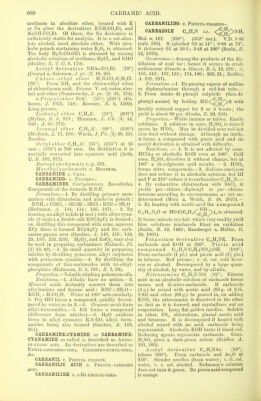
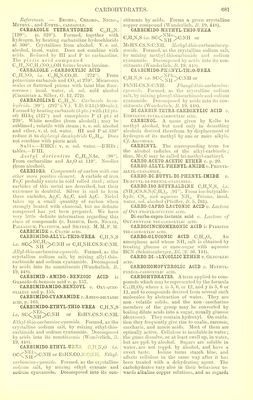
![References. — Bromo-, Chloro-, Nitro-, Methyl-, and Ethyl-, carbazole. CARBAZOLE TETRAHYDRIDE C12H13N. [120°]. (c. 328°). Formed, together with hydrogen, by heating earbazoline hydrochloride at 300°. Crystallises from alcohol. V. e. sol. alcohol, insol. water. Does not combine with acids. Reduced by HI and P to earbazoline. The picric acid compound C1.,HnNC„H„(NO..)3OH forms brown lamina. CARBAZOLE y-CARBOXYLIC ACID C13H9N02 i.e. C,.,H8N.CO,H. [272°]. From potassium carbazole and CO., at 270°. Micaceous scales or flattened prisms with faint blue fluor- escence : insol. water, si. sol. cold alcohol (Ciamician a. Silber, G. 12, 272). CARBAZOLINE C,.,H,.N. Carbazole hexa- hydride. [99°]. (297°i.V.). V.D. 6-13 (5-99 calc). Formed by heating carbazole (3 pts.) with (12 pts. of) HIAq (127°) and amorphous P (1 pt.) at 220°. White needles (from alcohol) ; may be sublimed; volatile with steam; v. e. sol. alcohol and ether, v. si. sol. water. HI and P at 330° reduce it to dvphenyl decahydride C^H^. Does not combine with picric acid. Salts.—B'HCl: v. e. sol. water.—B'HBr : tables.—B'HI. Acetyl derivative C,.,H]4NAc. [98°]. From earbazoline and AcX) at 110°. Needles (from alcohol). CARBIDES. Compounds of carbon with one other more positive element. A carbide of iron Fe;jC probably exists in cold rolled steel; other carbides of this metal are described, but their existence is doubtful. Silver is said to form three carbides, Ag4C, Ag.C, and AgC. Nickel takes up a small quantity of carbon when strongly heated with charcoal, but no definite compound has yet been prepared. We have very little definite information regarding this class of compounds (v. Iridium, Iron, Nickel, Palladium, Platinum, and Silver). M. M. P. M. CARBIMIDE v. Cyanic acid. CARBIMIDO-ALLYL-THIO-UREA C3H;N3S i.e. SC<N£A>C:NH or C3H5NH.CS.N:C:NH. Allyl-thio-carbamine-cyamide. Formed, as the crystalline sodium salt, by mixing allyl-thio- carbimide and sodium cyanamide. Decomposed by acids into its constituents (Wunderlich, B. 19, 448). CARBIMID - AMIDO - BENZOIC ACID is Guanido-di-benzoic acid v. p. 157. CARBIMIDAMIDO-BENZOYL v. Oxy-quin- oxaline and p. 155. CARBIMIDO-CYANAMIDE v. Amido-dicyanic acid, p. 163. CARBIMIDO-ETHYL-THIO-UREA C,H;N3S i.e. SC<^>C:NH or EtHN.CS.N:C:NH. Ethyl-thio-carbamine-cyamide. Formed, as the crystalline sodium salt, by mixing ethyl-thio- carbimide and sodium cyanamide. Decomposed by acids into its constituents (Wunderlich, B. 19, 448). CARBIMIDO-ETHYL-UREA C.H.N^O i.e. OC<^>C:NH or EtHN.CO.N:C:NH. Ethyl- carbamine-cyamide. Formed, as the crystalline sodium salt, by mixing ethyl cyanate and sodium cyanamide. Decomposed into its con- stituents by acids. Forms a green crystalline copper compound (Wunderlich, B. 19, 448). CARBIMIDO-METHYL-THIO-UREA C3H5N3S i.e. SC<™e>C:NH or MeHN.CS.N:C:NH. Methyl-thio-carbamine-cy- amide. Formed, as the crystalline sodium salt, by mixing methyl-thiocarbimide and sodium cyanamide. Decomposed by acids into its con- stituents (Wunderlich, B. 19, 448). CARBIMIDO-PKENYL-THiO-UEEA C8H;N3S i.e. SC<^>C:NH or PhNH.CS.N:C:NH. Phenyl-thio-carbamine- cyamide. Formed, as the crystalline sodium salt, by mixing phenyl-thiocarbimideand sodium cyanamide. Decomposed by acids into its con- stituents (Wunderlich, B. 19, 448). DI-CARBIN-TETRA-CARBOXYLIC ACID v. Ethylene-tetra-carboxylic acid. CARBINOL. A name given by Kolbe to methyl alcohol, but used only in describing alcohols derived therefrom by displacement of hydrogen of its methyl by one or more alkyls. Cf. Alcohols. CARBINYL. The corresponding term for the alcohol radicles of the alkyl-carbinols; thus, Me(C may be called tri-methyl-carbinyl. CARBO-ACETO-ACETIC ETHER v. p. 20. CARBO-ALLYL-PHENYL-AMIDE v. Phenyl- allyl-cyanamide. CARBO-DI-BUTYL-DI-PHENYL-IMIDE v. Di-butyl-di-phenyl-cyanamide. CARBO-ISO-BUTYRALDINE C.,HSN.,S., i.e. (NH,,)CS.S.N(C,HS),. [91°]. From iso-butyralde- hyde, CS„, and aqueous NH3. Prisms, insol. water, soL alcohol (Pfeiffer, B. 5, 701). CARBO-CAPRO-LACTONIC ACID v. Lactone Of OxY-PROPYL-SUCCINIC ACID. Di-carbo-capro-lactonic acid v. Lactone of Oxy-pentane tri-carboxylic ACID. CARBOCINCHOMERONIC ACID is Pyridine tri-carboxylic acid. CARBO-GLUCONIC ACID C;H,,08. An amorphous acid whose NH, salt is obtained by treating glucose or cane-sugar with aqueous HCN (Schiitzenberger, Bl. [2] 36, 144). CARBO DI-uLYCOLLIC ETHER v. Glycollic acid. CARBOHOMOPYRROLIC ACID v. Methyl- PYRROL-CARBOXYLIC ACID. CARBOHYDRATES. A term applied to com- pounds which may be represented by the formula Cx(H,0)y where x is 5, 6, or 12, and y is 5, 6 or 11, and to compounds derived from several such molecules by abstraction of water. They are non - volatile solids, and the non - saccharine members of the group may be converted by boiling dilute acids into a sugar, usually glucose (dextrose). They contain hydroxyl. On oxida- tion they frequently give rise to oxalic, racemic, saccharic, and mucic acids. Most of them are optically active. Cellulose is insoluble in wafer; the gums dissolve, or at least swell up, in water, but are ppd. by alcohol. Sugars are soluble in water, are not reppd. by alcohol, and have a sweet taste. Iodine turns starch blue, and affects cellulose in the same way after it has been treated with a dehydrating agent. The carbohydrates vary also in their behaviour to- wards alkaline copper solutions, and as regards](https://iiif.wellcomecollection.org/image/b21995990_0001_0707.jp2/full/800%2C/0/default.jpg)