Volume 1
Watts' dictionary of chemistry / revised and entirely rewritten by H. Forster Morley and M.M. Pattison Muir ; assisted by eminent contributors.
- Date:
- 1888-1894
Licence: Public Domain Mark
Credit: Watts' dictionary of chemistry / revised and entirely rewritten by H. Forster Morley and M.M. Pattison Muir ; assisted by eminent contributors. Source: Wellcome Collection.
Provider: This material has been provided by the Royal College of Physicians of Edinburgh. The original may be consulted at the Royal College of Physicians of Edinburgh.
708/796 (page 682)
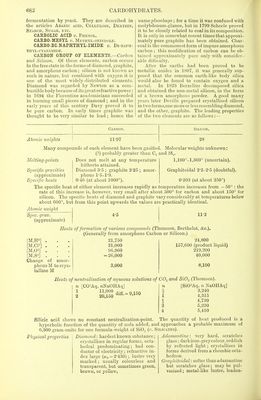
![fermentation by yeast. They are described in the articles Arabic acid, Cellulose, Dextrin, Starch, Sugar, etc. CARBOLIC ACID v. Phenol. CARBO-MESYL v. Methyl-oxindole. CARBO-DI-NAPHTHYL-IMIDE v. Di-naph- thyl-cyanamide. CARBON GROUP OP ELEMENTS.—Carbon and Silicon. Of these elements, carbon occurs in the free state in the forms of diamond, graphite, and amorphous carbon; silicon is not known as such in nature, but combined with oxygen it is one of the most widely-distributed elements. Diamond was regarded by Newton as a com- bustible body because of its great refractive power: in 1694 the Florentine academicians succeeded in burning small pieces of diamond; and in the early years of this century Davy proved it to be pure carbon. In early times graphite was thought to be very similar to lead ; hence the name plumbago ; for a time it was confused with molybdenum-glance, but in 1799 Scheele proved it to be closely related to coal in its composition. It is only in somewhat recent times that approxi- mately pure graphite has been obtained. Char- coal is the commonest form of impure amorphous carbon ; this modification of carbon can be ob- tained approximately pure only with consider- able difficulty. After the earths had been jsroved to be metallic oxides in 1807, it was generally sup- posed that the common earth-like body silica would also be found to contain oxygen and a metal. In 1823 Berzelius decomposed silica and obtained the non-metal silicon, in the form of a brown amorphous powder. A good many years later Deville prepared crystallised silicon in two forms,one more or less resembling diamond, and the other, graphite. The leading properties of the two elements are as follows:— Carbon. Silicon. Atomic weights 11-97 28 Many compounds of each element have been gasified. Molecular weights unknown: (?) probably greater than C2 and Slr Melting-points Specific gravities (approximate) Specific heats Does not melt at any temperature hitherto attained. Diamond 3-5 ; graphite 2-25 ; amor- phous 1-5-P9. 0-46 (at about 1000°). 1,100°-1,300° (uncertain). Graphitoidal 2-2-2-5 (doubtful). 0-203 (at about 250°) The specific heat of either element increases rapidly as temperature increases from — 50° : the rate of this increase is, however, very small after about 500° for carbon and about 150° for silicon. The specific heats of diamond and graphite vary considerably at temperatures below about 600°, but from this point upwards the values are practically identical. Atomic weight Spec. grav. (approximate) 4-5 11-2 Heats of formation of various compounds (Thomsen, Berthelot, &c). (Generally from amorphous Carbon or Silicon.) [M,H<] . [M,C14] . [M,02] . [M,S2] . Change of amor- phous M to crys- talline M 21,750 21,000 96,960 -26,000 3,000 24,800 157,600 (product liquid) 219,200 40,000 8,100 Heats of neutralisation of aqueous solutions of C02 and Si02 (Thomsen). n [CO-Aq, wNaOHAq] 1 11,000 2 20,150 a 9,150 [Si02Aq, n NaOHAq] 3,240 4,315 4,730 5,230 5,410 Silicic acid shows no constant neutralisation-point. The quantity of heat produced is a hyperbolic function of the quantity of soda added, and approaches a probable maximum of 6,300 gram-units for one formula-weight of Si02 (v. Silicates). Physical properties Diamond: hardest known substance; crystallises in regular forms, octa- hedral predominating; bad con- ductor of electricity; refractive in- dex large (/uD = 2-430) ; lustre very marked; usually colourless and transparent, but sometimes green, brown, or yellow, Adamantine: very hard, scratches glass; darkiron-greycolour,reddish by reflected light; crystallises in forms derived from a rhombic octa- hedron. Graphitoidal: softer than adamantine but scratches glass; may be pul- verised ; metal-like lustre, leaden-](https://iiif.wellcomecollection.org/image/b21995990_0001_0708.jp2/full/800%2C/0/default.jpg)