Volume 1
Watts' dictionary of chemistry / revised and entirely rewritten by H. Forster Morley and M.M. Pattison Muir ; assisted by eminent contributors.
- Date:
- 1888-1894
Licence: Public Domain Mark
Credit: Watts' dictionary of chemistry / revised and entirely rewritten by H. Forster Morley and M.M. Pattison Muir ; assisted by eminent contributors. Source: Wellcome Collection.
Provider: This material has been provided by the Royal College of Physicians of Edinburgh. The original may be consulted at the Royal College of Physicians of Edinburgh.
717/796 (page 691)
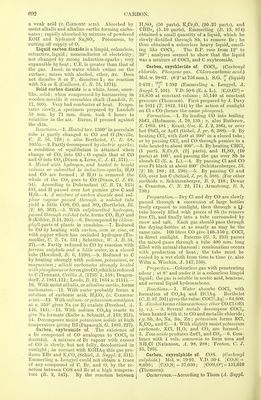
![2. With chlorine or bromine in sunlight, to form COCio, or COBr., (v. Carbon, oxtchlobide, and oxybromide, of).—3. With sulphur to form COS (v. Carbon, oxysulphide of).—4. Withplatinic chloride to form C.,03PtCl4 and C,0.,PtCl2 (Schiitzenberger, A. Ch. [4] 21, 350).—5. CO is absorbed by anhydrous HCN (Bdttinger, B. 10, 1122) ; by several metals, e.g. Fe, Ag, Au; by carbon.—6. CO does not combine with cyano- gen, nor does it react with Hg(CN)2. Estimation.—CO in a gaseous mixture is absorbed by Cu2Cl2 solution. Thomas (G. N. 37, 6) prepares the solution by filling a vessel of 120 c.c. capacity % full of Cu turnings, adding 6 g. crystallised CuCl., and 20 c.c. cone. HCIAq, and shaking until solution of the CuCl2 is effected; he then adds 30 c.c. water and shakes briskly for some time, and then adds 30 c.c. water. Carbon dioxide. C02. (Carbonic anhydride, often called carbonic acid.) Mol. w. 43-89. S.G. gas 1-53; S.G. liquid 1-057 at -34°; 1-016 at -25°; -966 at -11-5°; -91 at -1-6°; -84 at + 11°; -726 at +22-2° (Cailletet a. Mathias, C. R. 102,1202). S.G. solid (hammered) slightly underl-2 (Landolt,23. 17,309) [-65°] (Mitchell); [-57°] (Faraday); [-78-2°] (Regnault, A. Ch. [3] 26, 257). V.D. 22; 22-42 at 800°; 21-2 at 1180D (Meyer a. Goldschmidt, B. 15, 1105). S.H.v. -33 (equal vol. of air = 1), -2169 (equal weight of air = 1) (Regnault, C. R. 36, 676, &c.; v. also Wiedemann, P. 157, 24). §S?■ = 1-29 ; S.H.v. to 1-305 (Amagat, Rontgen, C. R. 71, 336 ; 77, 1325). C.E. -0037 (Regnault, Magnus, Joly). — = 1-00722 (Regnault, C. R. 20, 975). At P V 200° CO., obeys Boyle's law (Amagat, C. R. 68, 1170; 73, 183). C.E. liquid CO., very large, 120 vols, at -20° become 150 vols, at +30, (Thilorier, A. Ch. 60, 427). Critical tempera- ture = 30-9° (Andrews, T. 1809. 575). Vapour- pressure of liquid CO., (Regnault) in atmospheres: - 25°, 171; - 5°, 30 9 ; 0 , 35 4 ; + 5°, 40-5 ; 15°, 52-2; 25°, 66; 35°, 82-2; 45°, 100-4. Vapour-pressure of solid CO., (Faraday) in atmos.: -57°, 5-33; - 70 5°, 2-2 ;- 99-4°, 1-14. B.P. of solid C02—i.e. temp, at which vapour-pressure = 760 mm.— is much lower than the M.P.; Regnault (and Pouillet) found -78° to -79° (P. 77, 107); Thilorier, -95° to -98°; and Faraday, as shown by values for vapour-pressure, under - 99°. By evaporation of solid C02 mixed with ether, temp, is c. —100°. S. CO., gas (Bunsen, A. 93, 1) : At 0° 1-7967 At 11° 1-1416 1 1-7207 12 1-1018 2 1-6481 13 1-0653 3 1-5787 14 1-0321 4 1-5126 15 1-0020 5 1-4497 16 0-9753 6 1-3901 17 0-9519 7 1-3339 18 0-9318 8 1-2809 19 0-9150 9 1-2311 20 0-9014 10 1-1847 Absorption-coefficient = 1-7967 - -07761* + -001642 U2. S. CO.. gas in alcohol (Bunsen) At 3-2° 4-0442 6-8 3-7374 10-4 3-4875 At 14-2° 18 22-6 3-2357 3-0391 2-8277 Absorption-coefficient = 4-32955 - -09395i + -001 24<-. Mo = 1-000395, me = 1-000456, juG = 1-000496 (Croullebois, A. Ch. [4] 20, 136 ; v. also Chap- puis a. Riviere, C. R. 103, 37). H.F.p. [C,0'] = 96,960 ; TCO.O] = 67,960. H.F.v. [C.O-] = 96,960; [CO.O] = 67,670. [C,0 ,Aq] = 102,840. [CO,0,Aq] = 73,840. [CO;,Aq] = 5,880. [CO Aq,nNaOHAq] ; »=1 = H,016 ; W=2 = 20,184; n = 4 =20,592 (Thomsen). Carbon dioxide has been known for cen- turies. The identity of the gases produced during fermentation and by the action of acids, on chalk was established by Black. Bergmann recognised the same gas in the atmosphere. Cavendish proved that the same gas was pro- duced by burning charcoal. Lavoisier estab- lished the composition of the gas. Faraday liquefied, and Thilorier solidified, carbon di- oxide. Occurrence.—In the atmosphere (v. Atmo- sphere) ; in mineral waters ; issues from the earth indifferent places; sometimes found liquid in cavities in quartz, &c. Produced by the breathing of animals, by the decay of organic matter, by the combustion of coal, charcoal, &c. In combination as carbonate, of calcium, magne- sium, &C., c&C. Formation.—1. By burning C in air or O.— 2. By oxidation of most C-compounds.—3. By burning CO.—4. By reducing many metallic oxides by C.—5. By heating together H,0 and CO.—6. By the reaction between red hot C and steam.—7. By the action of steam on CaCO., at red heat.—8. By heating a mixture of K2Cr20, with NaXOs.—9. By heating several carbonates. 10. During fermentation.— 11. By reaction be- tween acids and carbonates. Preparation.—CaC03 or MgC03 in lumps is treated with dilute HCIAq at the ordinary tem- perature ; the gas is passed through NaHCO,Aq (to remove HC1 which may have passed over), and is then dried by CaCL. Bunsen recom- mends the use of finely powdered chalk and cone. H.,S04, and addition of a very little water. Liquid carbon dioxide was obtained by Faraday by decomposing (NH,)2COa by H2S04Aq in one limb of closed glass tube bent at an obtuse angle. Thilorier (A. Ch. 60, 247) decom- poses NaHCO, by dilute H.jSO^q in an iron vessel connected with an iron cylinder in which the CO., is liquefied by its own pressure. Natterer (/. pr. 35, 169) compresses C02 by a specially constructed air-pump (v. also Gore, T. 1861. 63). Solid carbon dioxide is obtained by allow- ing the liquid to escape into a tin vessel; part of the liquid becomes gas and part is solidified. Landolt allows the liquid to evaporate freely into conical woollen bags ; he then compresses the solid C02in conical moulds of hard wood by wooden pistons (B. 17, 309). Properties.—A hea\y, colourless, gas; in- combustible ; non-sup, or er of ordinary com- bustion, but strongly heated K or Na, or brightly burning Mg, burns in C02. Absorbed by water, solution colours litmus wine-red and reacts as Y y 2](https://iiif.wellcomecollection.org/image/b21995990_0001_0717.jp2/full/800%2C/0/default.jpg)