Volume 1
Watts' dictionary of chemistry / revised and entirely rewritten by H. Forster Morley and M.M. Pattison Muir ; assisted by eminent contributors.
- Date:
- 1888-1894
Licence: Public Domain Mark
Credit: Watts' dictionary of chemistry / revised and entirely rewritten by H. Forster Morley and M.M. Pattison Muir ; assisted by eminent contributors. Source: Wellcome Collection.
Provider: This material has been provided by the Royal College of Physicians of Edinburgh. The original may be consulted at the Royal College of Physicians of Edinburgh.
725/796 (page 699)
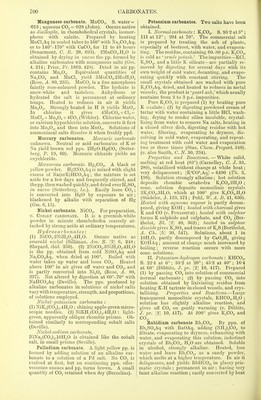
![The carbonate obtained by ppn. forms a white gelatinous mass which changes to shining crystalline scales. 2LaJ(CO.i)3.15H.J0 ; ppd. by NaXO-jAq from La.,3SO|Aq, and dried at ordinary temperature. Micaceous scales with silky lustre (Hermann, J.pr. 82, 385). Lead carbonate. PbCO.,. Occurs native in trimetric crystals as white lead ore or cerusite. Has also been found on bronze objects from Pompeii (Luca, C. R. 84, 1457). Prepared by ppg. Pb(NO.,).Aq with excess of alkaline car- bonates in the cold (Berzelius ; Lefort, J. Ph. [3] 15, 26). According to Eose (A. 80, 235) these pps. are all hydrocarbonates, the ratio of hydrate to carbonate increasing with the temp, and dilution of the solutions. Bodies of the same composition are formed by dirpct action of CO., on Pb(HO).,, but differ in being amorphous and opaque, instead of consisting of minute transparent crystalline grains. White lead is a hydrocarbonate present- ing varieties of composition represented by (1) 2PbCO:,.PbO.,H, ; (2) 5PbCO,.3PbO.,H, ; (3) 3PbCO,.PbO.,H, (Mulder, A. 33, 242) ; (4) 5PbC03.PbO.,H, (Phillips, C. J. 4, 165). Prepared by (1) Dutch method. Thin lead sheets are placed over gallipots containing weak acetic acid (2| p.c.); the pots are em- bedded in fermenting tan at a temp, of 60°-65°. The metal disappears in a few weeks. Oxide of lead is first formed, and dissolved by the acetic acid, forming a basic acetate, and this is decomposed by the CO., evolved from the tan. (2) PbO is mixed with water and about 1 p.c. of Pb acetate, and CO., is passed over it. Pb(N03)., has been used instead of acetate. Nearly insol. in sat. CO.Aq even under pressure (Wagner). The ppd. carbonate has S. = -05 in sat. CO.Aq. Lead - sodium carbonate. 4PbC03.Na.,C03 (Berzelius, P. 47, 199). Lcad-chloro-carbonate. A compound of the chloride and carbonate of lead is obtained as a pp. by the action of CO., under pressure on PbCl, (Miller, C. J. [2] 8, 37). Lithium carbonate. Li.,C03. S. (0°) = 1-539; (50°) = 1-181; (100°) = -728 (Bevade, Bl. [2] 43, 123). Found in many mineral waters. Pre- pared by dissolving an excess of (NH4).,C03 in cone. LiClAq, and washing resulting pp. with alcohol, or by strongly heating Li acetate. Not decomposed by heat. Melts at low red heat, and solidities to a vitreous mass on cooling. The solution is alkaline and decom- poses NH, salts, but is decomposed by Ba(HO)., and Ca(HO)„. By slow evaporation the solution deposits salt in small prisms. Water saturated with CO., dissolves it more readily than pure water. Magnesium carbonate. MgC03. Occurs native as magncsite, in rhomboln dral crystals isomorphous with calcspar ; infusible ; dissolves slowly in acids. Prepared (1) By suspending in water the washed pp. obtained by adding solu- tion of an alkaline carbonate to solution of a Mg salt (which always contains MgO.H,), passing CO., through the liquid till pp. is dissolved, and evaporating by heat (Rose, P. 42, 366) ; (2) By heating MgSO,Aq with Na.,C03Aq to 160° in a sealed tube; (3) By inclosing a soluble Mg salt with an alkaline-hydrogen carbonate, super- saturated with CO,,, in a strong vessel closed by a cork through which the CO, can slowly escape (Senarmont, C. E. 28, 693); (4) By carefully heating MgCO,.KHCO.,. 4aq to 200°, and extract- ing with water (Engel, Bl. [2] 44, 355). A white crystalline powder, ismorphous with arragonite by method (1); obtained in rhombo- hedra by (3); isodimorphous with CaCO:i. When moist it is alkaline to litmus. CaSO,Aq par- tially decomposes it, especially in presence of NaClAq (Fleischer, J. pr. [2] 6, 273). Soluble in cold solutions of alkaline borates, ppd. on heating, but redissolved on cooling (Wittstein, Ar. Ph. [3] 6, 40). Hydrates (a) MgC03.3H.,0. Hexagonal prisms obtained by spontaneous evaporation of a solution of MgC03 in excess of CO.Aq. They lose water in dry air but retain their form. (/3) MgC03.5H,0. Transparent oblique prismatic crystals obtained by exposure of above solution at a low temp. Converted into (a) by exposure to air &c. Boiled, they yield 4MgCO.,. MgH.,0.,4aq (Fritzsche ; v. also Engel, C.Ii. 101, 814). Hydrocarbonates. As in the case of lead, the composition of pp. formed by adding an alka- line carbonate to solution of a Mg salt depends on proportions, strength, and temp., of solutions. A variable mixture of hydrocarbonates is known as magnesia alba ; (a) 4MgCO.,.MgH.i02. 4aq ; a white granular powder (for preparation v. Bose, A. 80, 234). (/3) 3MgC03.Mg(HO).,. 3aq, occurs native as hydromagncsitc in small white mono- clinic crystals (Dana). Prepared artificially (Berzelius, Fritzsche) it is a white, slightly soluble powder forming alkaline solutions. Dried at 100° in air it yields a (Rose). (7) 3Mg0.2C02. 3aq(?) (Fritzsche, P. 37, 310). Denied by Rose. Magncsiumhydrogcn carbonate. Mg.H._,(C03)o (Soubeiran). Obtained by shaking up magnesia alba with CO.Aq. The sol. has a bitter taste and alkaline reaction; becomes turbid at 75° but clears on cooling. Heated to 50', or eva- porated in vacuo, it yields hydrate a (v. supra) (Berzelius ; Fritzsche). Magnesium-ammonium carbonate. Mg.(NH,),(C03).,.4H.,0. Translucent rhombo- hedra, from a mixture of cold MgCLAq, or MgSOjAq, and NH, sesquicarbonate solution. Magnesium - potassium carbonates: (1) Mg(KH).(CO.,)._,.4aq. In large crystals from cold aqueous mixture of MgCL, or Mg(N03)., with excess of KHCO.,. The crystals at 100° become opaque, and lose water. Decomposed by water, leaving a residue 0MgCO,.MgH.,O,. 6aq (Ber- zelius) ; also obtained in oblique rhombic prisms (Deville, A. Ch. 33, 75) ; (2) MgK,(C03),4aq by digesting magnesia alba at 60°-70° for 12 to 15 hours with KHC03Aq (Deville, I.e.). Magnesium-sodium carbonate MgNa,(CO.,)„. Prepared in anhydrous microscopic crystals as the corresponding K salt. On solubility of MgC03 in CO.Aq under pressure v. Merkel (J. 1867. 136) and Wagner (J. pr. 102, 233). On solubility of MgCO:, and CaC03 in solutions of calcium and magnesium salts, and the reactions of dolomite or gypsum and magnesite in presence of water containing CO., v. Hunt (Am. S. [2] 42, 49). For reactions of basic MgC03 and gypsum with C02Aq v. Gossmann (Am. 8. [2] 42, 217, 308).](https://iiif.wellcomecollection.org/image/b21995990_0001_0725.jp2/full/800%2C/0/default.jpg)