Volume 1
Watts' dictionary of chemistry / revised and entirely rewritten by H. Forster Morley and M.M. Pattison Muir ; assisted by eminent contributors.
- Date:
- 1888-1894
Licence: Public Domain Mark
Credit: Watts' dictionary of chemistry / revised and entirely rewritten by H. Forster Morley and M.M. Pattison Muir ; assisted by eminent contributors. Source: Wellcome Collection.
Provider: This material has been provided by the Royal College of Physicians of Edinburgh. The original may be consulted at the Royal College of Physicians of Edinburgh.
728/796 (page 702)
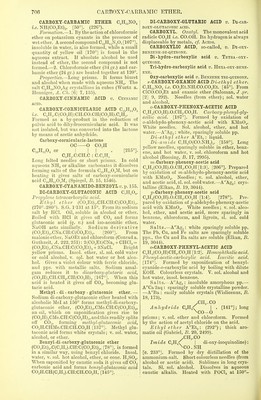
![rating solutions of NaHC03 in vacuo over H,S04; (3) by melting together the two carbon- ates, in the ratio Na,CO3.10H2O:2NaHCO3, and standing in air till mass becomes crystalline, when it contains crystals of the sesquicarbonate; (4) by pouring alcohol on to a mixture of Na,C03Aq and NaHC03, the salt separates in fine needles (Winkler, B. P. 48, 215). Mono- clinic crystals ; non-efflorescent in air, goes to Na„C03 at red heat; aqueous solution in vacuo over H,S04 gives Na,C03 and NaHC03 (Eose, P. 34,100). S. 12-03 at 6° ; 41-59 at 100° (Poggiale). IV. Double Salts. Sodium-potassium carbonates. (1) NaKC03.GH,0; monoclinic crystals, unchanged in dry air, effloresces in moist air; by evaporating solution of equal equivalents of the constituent salts, and crystallising from K„C03Aq. At 100° loses 0H,O. S. 185 at 15° (Marignac, C. R. 45, 050; Marguerite, A. 50, 220 ; Stolba, Bl. [2] 4, 192, 7, 241). (2) 2Na2C03.K,C03.18H,0 ; from mother- liquor from which K.,Fe(CN)8has crystallised out. Maybe crystallised from K,C03Aq (Marguerite). Sodium-calcium caebonate : Na2C03.CaC03.5H,0; occurs native as Gay- Lussite; obtained, in microscopic monoclinic crystals, by reaction between freshly ppd. CaC03 and cone. Na,C03Aq at ordinary temperature. When dry this compound is decomposed by water (Fritzsche, J. jpr. 93, 339; Boussingault, P. 7, 97 ; H. Eose, P. 93, 000). Strontium carbonate. SrC03. S.G. (pp.) = 3-02. S. (cold or hot)= -0003 (Bineau, C.B. 41, 509). S. (cold) = -005 (Fresenius) solubility diminished by NH.Aq or (NH,),C03Aq. S. (10° in satd. CO.Aq) = -12 (Lassaigne). Occurs native as strontianite. Crystals of trimetric system, isomor- phouswith arragonite andwitherite. Prepared by ppn.with an alkaline carbonate as a smooth white substance ; in form of strontianite, by crystal- lising amorphous carbonate from fused KC1 and NaCl (Bourgeois, Bl. [2] 37, 447). Heated in closed vessel C02 given off only at about white heat, but in aqueous vapour SrH,0, is formed at a much lower temp. Alkaline sulphates in solution do not decompose it at any temperature (Eose, P. 95, 284). Ammonium chloride solu- tion boiled with it converts it into SrCl2. Thallium carbonate T1.,C03. S.G. (fused) 7-00 (Lamy). S. (15-5°) = 4-02 ; (00°) = 11-7; (100°) = 2721. M.P. c. 272° (Carnelley, C.J. 33, 275). Formed by exposure of Tl in a saturated solution of T120 to air. Prepared by allowing granulated metal to oxidise in warm air, boiling with water containing excess (NH,),C03 and filtering. T12C03 is deposited in groups of prisms (Miller, Pr. 14, 555), which are brilliant, highly refractive, very heavy, anhydrous, colourless; melting, undecomposed, much below redness to clear liquid which solidifies to dark-grey mass, and at red heat decomposes evolving C02. Taste mildly caustic and metallic. Solution has alka- line reaction not completely removed by super- saturation with CO, (Crookes ; Werther, J. 1804. 249). Thorium carbonate. Th(C0.1),.3ThHJ0.,.2H,0. Alkaline carbonates throw down a basic salt with evolution of C02. Moist ThH,0, absorbs C02 from air. Th02 is not sol. in water containing C02 (Berzelius). Salt of above formula obtained as an amorphous pp. by treating hydrate sus- pended in water with C02, or by ppg. solution of ThCl4 with an alkaline carbonate. Tin carbonates. SnC03.SnO; by adding solid SnCl2to cone. Na2C03Aq in absence of air : very unstable. If (NH,)„C03Aq is used, hexa- gonal prisms of (NHl),6.2Sn0.3CO,.3H20 are said to be formed (Devifle, A. Ch. [3]*35, 448). Uranium carbonates have not been isolated. Alkaline carbonates ppt. uranous hydrate from UClj, a basic sulphate from U(S04)2, and double carbonates from uranic salts. Uranyl-ammonium carbonate. (UO,)C03.2(NH,1)2C03. S. = 5 at 15° ; increased by (NHj^CO,. Prepared, in small yellow trans- parent crystals, by digesting in (NH^COijAq at 00°-80° the pp. produced by NH3Aq or (NH,),C03Aq from uranic salts, filtering, and allowing to cool. Decomposed slowly at ordinary, more quickly at higher, temps, leaving U03; solution boiled evolves NH3 and CO,, and deposits yellow pp., containing uranium, of doubt- ful composition (Arfredson, Peligot; Ebelmen, A. Ch. [3] 5, 189; Delffs, P. 55, 229). Uranyl-potassium carbonate. (U0,)CO3.2K2C03. S. = 7-4 at 15°; insol. in alco- hol. Prepared, as a bright yellow crystalline crust, by dissolving in KHC03Aq the pp. formed from uranic salts by K,C03Aq, and evaporating. At 300° evolves C02; at red heat leaves mixture of K uranate and carbonate. KOHAq pps. all the U as K uranate, even in presence of excess of K,C03. Uranyl-sodium carbonate. (U02)CO:j.2Na2C03. Preparation and properties similar to K salt. Two Ca salts, (1) (UO,)CO3.CaCO3.10H2O; (2) (Ud2)C03.CaC03.5H2b; occur native (Smith, A. 00, 253). Yttrium carbonate. Y,(C03)3. Na,C03Aq pps. it from yttrium salts with 12H,0 in the cold, and 2H,0 at 100°. Not easily decomposed by heat; sparingly soluble in water containing C02. Solution in (NH,),C03Aq, if concentrated, deposits a white crystalline double salt which does not redissolve in (NH.,),C03Aq ; also soluble in K,C03 and Na,C03Aq (Berzeiius). Zinc carboriate. ZnC03. Occurs as calam- ine. Not obtained by precipitation. Pp. formed by KHC03Aq in ZnS04Aq is 2ZnCO,.3Zn0,H2 (Berzelius). ZnC03 unaltered at 200° ; slowly evolves C02 at 300° (Eose). Hydrocarbonatcs. Native hydrocar- bonates are (1) zinc bloom ZnO.ZnC03.3ZnH202 (Berzelius), or ZnC03.2ZnH20,4aq (Smithson a. Borndorff, Cm. 0, 15). (2) Auricalcite or green calamine 2ZnC03.3ZnH,02, in which Zn is partly replaced by Cu. (3) Buratite, a hydro- carbonate containing Cu and Ca. The pps. formed by alkaline carbonates in solutions of zinc salts all appear to contain water, and to vary in composition with strength, temperature, and proportions, of solutions. For results obtained under varying conditions, v. Eose (P. 85, 107), Schindler a. Boussingault (Gin. 1, 15). They all evolve C02 and H20 at 200°, yielding ZnO (Eose). Ammonio-carbonate of zinc (NH3Zn)C03. Deposited in crystals from a solution of ppd. zinc carbonate in cone. (NH,,)2C03Aq (Favre, TraiUde Chimie,Pelouze etFremy, 2nded. 3,47).](https://iiif.wellcomecollection.org/image/b21995990_0001_0728.jp2/full/800%2C/0/default.jpg)