Volume 1
Watts' dictionary of chemistry / revised and entirely rewritten by H. Forster Morley and M.M. Pattison Muir ; assisted by eminent contributors.
- Date:
- 1888-1894
Licence: Public Domain Mark
Credit: Watts' dictionary of chemistry / revised and entirely rewritten by H. Forster Morley and M.M. Pattison Muir ; assisted by eminent contributors. Source: Wellcome Collection.
Provider: This material has been provided by the Royal College of Physicians of Edinburgh. The original may be consulted at the Royal College of Physicians of Edinburgh.
729/796 (page 703)
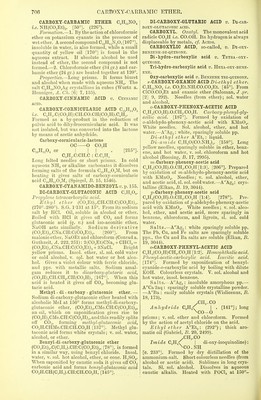
![Zinc-potassium carbonate 8ZnC03.3K„C03.7H,0 (?). Crystallises from a solution of ZnCl, mixed with K sesquicarbonate (Deville, A. Ch. [3] 32, 75). Zinc and sodium ca.rbonate 8ZnC03.3Na2C03 (?). Small crystals, obtained as potassium salt (Deville). Zirconium carbonate. Excess of alkaline carbonate solution produces a pp. in solutions of Zr salts, soluble in Na,(orK,)C03Aq. Com- position seems to be variable (Hermann, Klap- roth, Vauquelin). Thio-cabbonic acid. H,CS3. Mol. w. un- known. A dark yellow very strongly smelling oil; obtained by adding cold dilute HClAq to K,CS3 or Na„CS3; very easily decomposed, by heating, to CS, andH„S (Zeise, S. 41, 105; Ber- zelius, P. 6, 450). Thio-caebonates. These salts have the composition M.,CS3, or MCS,, when M2 = Na2 &c, and M = Ca &e. A few basic salts are also known. The composition of the salts of the alkali and alkaline earth metals has been de- termined ; several other thio-carbonates seem to be produced in the reactions between solu- tions of metallic salts and K2CS3Aq or Na2CS3Aq, but the composition of very few of these thio-carbonates of the heavy metals has been determined. Thio-carbonates are formed by reactions between CS, and aqueous solutions of the monosulphides of the alkali and alkaline earth metals, M,S and MS. By using MOHAq and CS2, thio-carbonates and carbonates are formed simultaneously; with MO,H,Aq and CS, (M = Ca,Ba,Sr) basic thio-carbonates are formed, e.g. CaCS3.2CaO„H„.6H„0. NH:!Aq reacts with CS, to form (NH,),CS? and (NHJCNS (Gelis, J. 1861. 340). The thio-carbonates are yellow, red-yellow, brown, or black, solids; the hydrated salts are yellow. The salts of the alkali and alkaline earth metals are soluble in water; those of the heavy metals are more or less solu- ble in excess of M,CS3Aq (M = Na &c). The thio-carbonates are not very stable ; those of the heavy metals easily decompose to metallic sulphide and CS,; cone, solutions of the alkali salts change to H,S and alkali carbonates when boiled, dilute solutions decompose by standing in air to carbonates and S. Heated alone, most of them give metallic sulphide and CS,; K,CS3 gives K,S3 and C. The thio-carbonates have been chiefly investigated by Zeise (S. 41,105) ; Berzelius (P. 6, 450); Walker (C. N. 30, 28); Sestini (G. 1871. 473 ; B. 5, 327); Gelis (J. Ph. [3] 39, 95 ; C. B. 81, 282); P. Thenard (G. B. 79, 673); Husemann (A. 123, 67); Mermet (C. B. 81, 344). Ammonium thiocarbonate (NH,),CS3. Pre- pared by mixing a saturated alcoholic solution of NH3 with ± its vol. CS2, cooling after the liquid has become brown, pouring off liquid, and washing the crystals several times with alcohol, then with ether, and pressing between paper (Zeise). Yellow crystals, v. sol. in water, insol. in alcohol or ether; may be sublimed in dry air by gentle warming ; very hygroscopic. Aqueous solution heated to 90°-100° evolves ELS, and NH.CNSAq remains (Gelis). Barium thiocarbonate BaCS3. By shaking BaSAq with CS2, washing with alcohol, and drying in vacuo. Calcium thiocarbonate. CaCS3. By digesting CaS with excess of CS2, and evaporating in vacuo. Citron-yellow ; sol. in alcohol or water ; milk of lime shaken with CS, gives an orange-red pp. of CaCS3.2CaO,H,.6H„6, and this at 30° gives red liquid from which red crystals of CaCS3.3CaO,H2.7H,0 separate (Walker; Sestini). Potassium thiocarbonate. K,CS3. When K,SAq is digested with CS, at 30° in a closed vessel, or CS, is dissolved in a cone, alcoholic solution of K,S, yellow deliquescent crystals separate; dried at 60°-80° these give K,CS3, a red-brown solid; v. sol. in water, si. sol. in alcohol. The other thiocarbonates which have been fairly well examined and analysed are those of Lithium, Magnesium, Sodium, and Strontium. Thiocarbonates of Bi, Cd, Cr, Co, Au, Pe, Pb, Ma, Hg, Ni, Pt, Ag, Sn, Zn, seem also to be formed by adding the solution of an alkali thio- carbonate to a solution of a salt of each of these metals. M. M. P. M. CARBONIC ANHYDRIDE CO, v. Cabbon, OXIDES OF. CARBON TETRA-CHLORIDE v. supra and Tetba-chloeo-methane. CARBONIC ETHERS. There are three classes of carbonic ethers: viz. acid ethers CO(OR)(OH), normal ethers CO(OR)2, and ethers of ortho-carbonic acid C(OR)4. In these formulas R may be any alkyl. They are de- scribed as salts of the alkyl: e.g. Ethyl car- bonate, Methyl carbonate, Phenyl carbonate, &c. Orthocarbonic ethers are formed by the action of sodium alcoholates on chloropicrin (Williamson a. Basset, A. 132, 54). They are converted by ammonia into guanidine. Normal carbonic ethers. Formation. — 1. From alkyl iodides and silver carbonate (de Clermont, A. 91, 375).— 2. By the action of Na, K, solid NaOEt (\ mol.) or KOEt (£ mol.), upon alkyl oxalates (1 mol.) (Ettling, A. 19, 17; Lowig a. Weidmann, A. 36, 301; Geuther, Z. 1868, 656; Cranston a. Ditt- mar, Z. 1870, 4).—3. By the action of alkyl chloroformates upon sodium alcoholates, e.g.: Cl.CO.OEt + NaOMe = NaCl + MeO.CO.OEt (Roese, A. 205, 240). The mixed ether prepared from ethyl chloroformate and sodium methylate is identical with that from methyl chloroformate and sodium ethylate.—4. From COC1, and sodium alcoholates. Properties.—The boiling-points and specific gravities of the fatty carbonic ethers are as follows (Roese, A. 205, 244):— Ether Boiling-point S.G. Me,C03 90-6° 1-005 at 17° MeEtC03 109-2J 1-00 at 27° Et„C03 125° ■97 MePrCO, 130-8° •98 at 27° Pr.,C03 168-2° •95 at 17° Me(PrCH,)CO, 143-6° •95 at 27° Et(PrCH,)C03 160-1° •93 at 27° (PrCH,),C03 190-3^ •92 at 15° Et(GHn)C03 182-3° •92 at 27°' (C5H„)2C03 228-7° •91 at 15°](https://iiif.wellcomecollection.org/image/b21995990_0001_0729.jp2/full/800%2C/0/default.jpg)