Volume 1
Watts' dictionary of chemistry / revised and entirely rewritten by H. Forster Morley and M.M. Pattison Muir ; assisted by eminent contributors.
- Date:
- 1888-1894
Licence: Public Domain Mark
Credit: Watts' dictionary of chemistry / revised and entirely rewritten by H. Forster Morley and M.M. Pattison Muir ; assisted by eminent contributors. Source: Wellcome Collection.
Provider: This material has been provided by the Royal College of Physicians of Edinburgh. The original may be consulted at the Royal College of Physicians of Edinburgh.
730/796 (page 704)
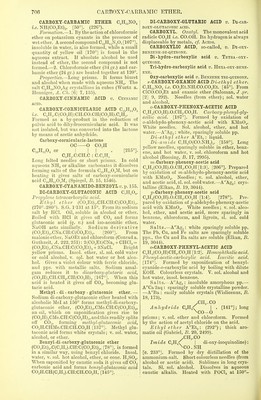
![Reactions.—1. Ammonia converts the ethers R2C03 into carbarnic ethers, and finally into urea.—2. PC15 forms chloroformic ethers. In mixed ethers RR'C03 the alkyl which is con- verted into chloride is the smaller of the two: Et(C5H,,)COs + PC15 = EtCl + C1C02C5HU + POOL, The amides of the chloroformates, which may be regarded as half chloride half amide of carbonic acid (carbarnic chlorides), are obtained by the action of COCl., upon the hydrochlorides of amines, e.g. COCl2 + NEtH, = COCl(NEtH) + HC1 (Gattermann a. Schmidt, B. 20, 118) cf. Chloro- formic acid. — 3. When an alkyl carbonate is heated with an alcohol containing a heavier alkyl, the heavy alkyl displaces the light one (R.). Chloro - imido - carbonic ethers C1N:C(0R)2. These are formed by leading chlorine into a cooled solution of NaOH and KCN in an alcohol (Sandmeyer, B. 19, 862). They are crystalline, and converted by dilute acids or by aqueous H,S into the corresponding carbonic ethers. Aqueous potassium arsenite reduces them to imido-carbonic ethers (cf. Chloro-imido- CABBONIC ETHERS). Imido-carbonic ethers HN:C(OR)2. Prepared as above, are alkaline liquids, readily decom- posed by aqueous acids into NH3 and carbonic ethers (cf. Imido-carbonio ethers). CARBO-DI-NICOTINIC ACID v. Pyridine TRI-CARBOXYLIC ACID. CARBONIC OXIDE. Name usually given to CO, v. Carbon, oxides of. CARBONIC - OXIDE - POTASSIUM v. po- tassium salt of Hexa-oxy-benzene. CARBONOUS OXIDE CO, v. Carbon, oxides of. CARBON TETRA-IODIDE v. Tetra-iodo- methane. CARBONPIMELIC ACID v. mo-Pentane tri- carboxylic ACID. CARBONYL. The divalent radicle C:0. When attached to two carbon atoms the product is a ketone, when attached to one carbon atom and to hydroxy! the compound is a carboxylic acid ; when attached to one carbon atom and to one hydrogen atom the product is an aldehyde. Two or three carbonyls attached to CH render the hydrogen displaceable by metals. Many carbonyl derivatives of amido- compounds are described under the amido- compounds from which they are formed by the action of COCl.,. CARBONYL - DI - m - AMIDO - DI - BENZOIC ACID V. Dl-PHENYL-UREA-DI-711-CARBOXYLIC ACID. CARBONYL - AMIDO - PHENOL v. Anlvy- dride of Oxy-phenyl-carbamic acid. CARBONYL BROMIDE v. Carbon, oxy-bro- MIDE OF. CARBONYL DI-BIURET v. Biuret. CARBON YL-CARBAMIC ETHER C,H.N03 i.e. CO:N.CO.OEt or (C.,H5N03)3. Carboxethyl cyanate or cyanurate. [119°]. Formed by the action of chloroformic ether on potassium cyanate. If dry ether be present a second com- pound C10H15N3O5 [107°] is also formed. Rhom- bic plates, si. sol. cold alcohol, v. sol. CHC13. When heated with water to 100° it loses C02 forming cyanuric ether. Its formula should therefore possibly be trebled. The compound C,„H,5N305 when distilled with water behaves similarly (Wurtz a. Henniger, C. R. 100, 1419; A. Ch. [6] 7, 132). Compounds with cyanic ether (a) C10H15N3O5 or (CO:NCO,Et)(CO.NEt)2 [107°]. Formed as above, or together with car- boxy-carbamic (imido-diformic) ether [50°], (226°) when the ether is wet. Needles, which lose CO„ on heating, yielding cyanuric ether (W. a. H.). (6) C„H15N307 i.e. (CO.N.C02Et)2(CONEt). [123°j. Formed together with imido-diformic ether when KCNO acts on an aqueous ethereal solution of chloroformic ether for a long time. On distilling it forms cyanuric ether (W. a. H.). CARBONYL CHLORIDE v. Carbon, oxychlo- RIDE OF. CARBONYL-GUANIDINE v. Amido-dicyanic ACID. CARBONYL DI-PHENYLENE v. Diphenyl- ENE KETONE. CARBONYL-DI-PHENYL OXIDE v. Di- PHENYLENE KETONE OXIDE. CARBONYL-PYRROLE CaH8N20 i.e. 0C<CnCH4' Di-tetrol-iirea. [63°]. (c. 238°). Formed, together with di-pyrryl-ketone, by the action of carbonyl chloride upon pyrrol- potassium (Ciamician a. Magnaghi, B. 18, 414 ; 1829). Large monoclinic crystals, a:b:c = 1-1688:1: -7189. V. sol. alcohol and ether, insol. water. By heating to 250° it is trans- formed into a mixture of pyrroyl-pyrrol C,H,N.CO.C,H3NH and di-pyrryl - ketone CO(C,H3NH)„. CARBONYL SULPHIDE v. Carbon, oxysul- PHIDE OF. CARBONYL-UREA v. Urea. CARBOPETROCENE v. Petrocene. CARBO - DIPHENYLENE v. Diphenylene KETONE. CARBO-DIPHENYLIMIDE v. Di-phenyl- CYANAMIDE. CARBO-TRI-PHENYL-TRIAMINE v. Di- PHENYL-AMIDO-BENZAMIDINE. CARBO-PHENYL-TOLYL-IMIDE v. Phenyl TOLYL CYANAMIDE. CARBO-DI-PROPYL-DI-PHENYL-IMIDE v. Dl-PROPYL-DI-PHENYL-CYANAMIDE. CARBO - PYRIDENIC ACIDS v. Pyridine CARBOXYLIC ACIDS. CARBO-PYROTRITARIC ACID v. Di-methyl- FDRFtfRANE CARBOXYLIC ACID. CARBO-PYRROLIC ACID v. Pyrrol-car- BOXYLIC ACID. CARBO-PYRROLYL-FORMIC ACID v. Pyrryl-glyoxylic ACID. .CH:CH CARBOSTYRIL C9H;NO i.e. CCH,< | or \STH.CO C,H,<; . Lactam or lactim of o- \N = C(OH) / amido-cinnamic acid. (Py-B)-Oxy-quinoline. [199°]. Formation.—1. By boiling o-amido-cinnamic acid with HClAq (Chiozza, C. R. 34, 598 ; A. 83, 117; Tiemann a. Oppermann, B. 13, 2070).—2. Obtained by reducing tri-chloro-oxy-quinoline with HI (Rotheit, J.pr. [2] 29, 300). Preparation. — o - Nitro-cinnamie ether is heated with alcoholic (NH4)2S to 100 under pressure, the solution is evaporated to dryness, taken up with NaOH and the carbostyril ppd.](https://iiif.wellcomecollection.org/image/b21995990_0001_0730.jp2/full/800%2C/0/default.jpg)