Volume 1
Watts' dictionary of chemistry / revised and entirely rewritten by H. Forster Morley and M.M. Pattison Muir ; assisted by eminent contributors.
- Date:
- 1888-1894
Licence: Public Domain Mark
Credit: Watts' dictionary of chemistry / revised and entirely rewritten by H. Forster Morley and M.M. Pattison Muir ; assisted by eminent contributors. Source: Wellcome Collection.
Provider: This material has been provided by the Royal College of Physicians of Edinburgh. The original may be consulted at the Royal College of Physicians of Edinburgh.
731/796 (page 705)
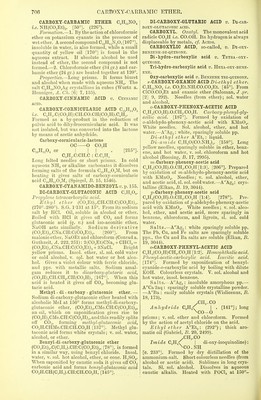
![by CO, (Friedlander a. Ostermeyer, B. 14, 1916). Properties.—Prisms (from alcohol); or long thin threads (containing aq) from dilute aqueous solution. May be sublimed. V. si. sol. cold, v. sol. hot, water. Sol. alcohol and etber. Alkaline KMnO , oxidises it to isatin and oxal- oxyl-amido-benzoic acid (carbostyrilic acid). CO,H.C6H4.NH.C(OH),.CO,H [200°]. Salts.—The K and Na salts form easily soluble plates. The barium salt A'2Ba: spar- ingly soluble plates. Methyl ether : (247° uncor.). Colourless liquid. Smells of oranges. Ethyl ether: [below 0°]. (256°). Prepared by the action of ethyl iodide on sodium-car - bostyril, or of alcoholic KOH on chloro-quino- line. Volatile with steam. Colourless liquid. Sweet smell.—B'HCl: hygroscopic crystals. Phenyl ether: [69°]. Sublimable. Glis- tening plates. Sol. ordinary solvents (Fried- lander a. Ostermayer, B. 15, 335). Reference.—Amido-carbostyril, Bromo-car- bostyril, &c. Hydrocarbostyril is described under Amido-phenyl-propionic acid. Ethyl- pseudo-carbostyril is described as (Py. 3, 4)-Oxy- ETHYL-QUINOLINE. CARBOSTYRIL-CARBOXYLIC ACID v. Oxy- QDINOLINE-CARBOXYLIC ACID. CARBOTHIALDINE CTI.^S,,. Crystals which separate on adding CS2 to an alcoholic solution of aldehyde-ammonia (Redtenbacher a. Liebig, A. 65, 43). Also from aldehyde and ammonic thio-carbaniate (Mulder, A. 168, 235). Insol. water. Sol. acids. Reactions.—1. HC1 splits it up into aldehyde, NH:i and CS2.—2. KMn04forrns H.,SO.„CO„KCy, and acetic acid.—3. HC1 and Fe.,Cl,. forms NH4C1, aldehyde, and NH.,.CS.S,.CS.NH, (Guareschi, G. 8, 246 ; B. 11, 1383). CARBO-TRI-THIO-HEXABROMIDE v. Hexa- BltOJIO-DI-METHYL TRI-SULPHIDE. CARBO - TOLYLENE-DI - PHENYL - TETRA- MINE V. Dl - PHENYL - TOLYLENE - TETRA - AMIDO- METHAKE. CARBO-DI-TOLYL-IMIDE v. Di-tolyl-cyan- AMIDE. DICARBOTHIONIC ETHER S(CO,Et).,. (180°). From ClC02Et and alcoholic Na2S. Oil; decomposed by baryta-water or alcoholic KOH into Et,S and CO., (V. Meyer, B. 2, 298). CARBO-VALERTHIALDINE CUH22N2S2. [109°]. (G.); [117°] (S.). V.D. 60. From iso- valeric aldehyde (5g.), CS2 (3g.) and aqueous NH, (Schroder, B. 4, 469). From isovaleric alde- hyde and ammonium thio-carbamate (Mulder, A. 168, 237). Colourless needles (from alcohol). Fe.,Cl(i on warming gives the sulphocyanide re- action. KMn04 forms HCN, H2S04 and valeric acid. Fe2Cl6 and HC1 form in the cold a yellow powder (S.CSNH,)2. Carbovaleraldine may there- fore be dithiocarbamate of di-valerylidene am- monium H.1N.CS.SN(CH.CH.,.CHMe„), (Guares- chi, A. 222, 310; G. 13, 500). CARBOVINIC ACID is Hydrogen Ethyl CARBONATE (q. V.). CARBOXAMIDO - BENZOIC ACID v. Di- PHENYL-DREA DI-CARBOXYLIC ACID. CARBOXAMIDO - CARBIMIDAMIDO - BEN- ZOIC ACID v. p. 157. Vol. I. CARBOXAMIDO - CYANAMIDO - BENZOYL v. p. 155. CARBOXAMIDO-HIPPURIC ACID v. p. 164. CARBOXAMIDO-o-OXY-BENZOIC ACID C,5Hl2N.,07. A product of the action of urea on amido-salicylic acid at 200° (Griess, -pr. [2] 1, 235). Minute needles, v. si. sol. most sol- vents. CARBOXETHYL CYANATE or CYANURATE V. CARBONYL-CARBAMIC ETHER. CARBOXY - ACETO - GLUTARIC ACID v. Methyl propyl ketone tri-carboxylic acid. v - CARBOXY - o - AMIDO - BENZOIC ACID v. Isatoic acid. v-Carboxy-m-amido-benzoic ether v. p. 157. CARBOXY-BENZENE PHOSPHONIC ACID CO.,H.C„H4.PO(OH)2. [above 300°]. Prepared by the oxidation of £>-toluene phosphonic acid C„H,(CH,).PO(OH)2 with KMn04. Needles or tables. V. sol. water, m. sol. aqueous HC1 or alcohol. On heating to 300° it decomposes, giving metaphosphoric and benzoic acids. Salts. — A'Ag:i : slightly soluble pp.— A'H2Kaq: fine needles sol. water, si. sol. alco- hol.—A'2H5K : long prisms si. sol. water. Chloride C6H4(C0C1)(P0C1,). [83°]. (315°). Colourless crystals. Heated with PCI, it gives 2>-chlorobenzoyl chloride PC13 and POC1.,. Trimethyl ether A'Me.,: thick liquid (Mi- chaelis a. Panek, B. 14, 405). CARBOXY-BENZOYL-ACETIC ACID v. Ace- tophenone di-carboxylic acid, p. 37. CARBOXY - BENZOYL - AMIDO - BENZOIC ACID t>. Phthaloxyl-amido-benzoic acid. CARBOXY-BENZOYL-ETHENYL TRICAR- BOXYLIC ACID v. Phenyl-ethyl-ketone tetra- carboxylic acid. CARBOXY-BENZOYL PROPIONIC ACID CnH.A i.e. C02H.CsH4.CO.C.,H,.CO,H. The free acid is unstable, but its Na salt is formed by dissolving phthalyl-propionic acid in NaOHAq (Gabriel a. Michael, B. 11, 1680). o - CARBOXY - BENZYL - ACETO - ACETIC ETHER C,(H1605 i.e. CO.,H.C„H,.CH...CHAc.CO.,Et. [92°]. Formed by reducing phthalyl-aceto- acetic ether with zinc-dust in glacial acetic acid (Billow, A. 236, 190). Needles; v. sol. hot water, alcohol, ether, and HO Ac. The ammo- nium salt melts at [121°]. Boiling baryta- water converts it into benzyl-acetone o-car- boxylic acid. Phenyl hydrazide C2„H2,N,04. [235°]. Decomposes slowly, forming alcohol and C HlrN„03 [229°]. 16 o-CARBOXY-BENZYL-MALONIC ACID HO.,C.C6H4CH2.CH(C02H)2. Formed by saponify- ing o-carboxy-benzyl-malonic ether (Wislicenus, A. 242, 37). Prisms. V. sol. hot, si. sol. cold, water. Heated to 190° gives off C02 and forms o-carboxy-phenyl-propionic acid [166°]. Salt.—A'Ag.,. V. si. sol. hot water. Di-ethyl ether CO.,H.C(iH4.CH,.CH(CO.,Et)2. [86°]. S. -045 at 17°. Formed by reducing phthalyl malonic ether with acetic acid and zinc (Wislicenus, A. 242, 32). Fine needles. V. e. sol. ether and hot alcohol, si. sol. hot water. Salts.—A'Ag: white needles.—A'Na: deli- quescent needles. V. sol. alcohol, insol. ether. Tri-ethyl-ether A'Et3. (250°) at 45 mm. Z Z](https://iiif.wellcomecollection.org/image/b21995990_0001_0731.jp2/full/800%2C/0/default.jpg)