Volume 1
Watts' dictionary of chemistry / revised and entirely rewritten by H. Forster Morley and M.M. Pattison Muir ; assisted by eminent contributors.
- Date:
- 1888-1894
Licence: Public Domain Mark
Credit: Watts' dictionary of chemistry / revised and entirely rewritten by H. Forster Morley and M.M. Pattison Muir ; assisted by eminent contributors. Source: Wellcome Collection.
Provider: This material has been provided by the Royal College of Physicians of Edinburgh. The original may be consulted at the Royal College of Physicians of Edinburgh.
734/796 (page 708)
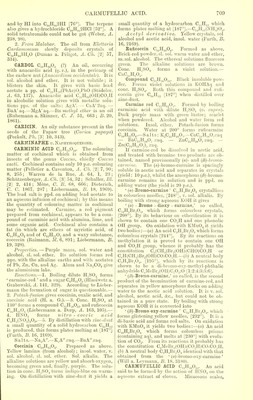
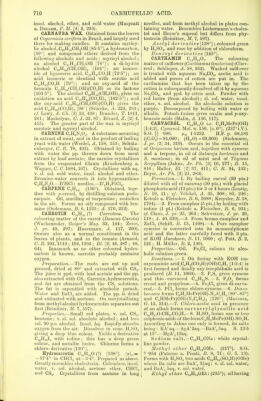
![Mono-ethyl ether C,H,(CO.>H).NH.CO.CO,Et. Ethyl-oxalyl-an- thranilic acid. [181°]. Felted needles. Formed by oxidation of indoxylic ether or indoxanthie ether with Cr03 (Baeyer, B. 15, 777). m-Carboxy-phenyl-oxamic acid C02H.CO.NH.C6H4.C02H. Oxaloxyl-amido-ben- soic acid. Formation.—1. By boiling an aqueous solu- tion of the barium salt of cyano-earbimido- amido-benzoic acid.—2. By heating (equal mols. of) ra-amido-benzoic acid and anhydrous oxalic acid for an hour at 180° (Griess, B. 16, 336; 18, 2412). Properties.—Small white plates. V. sol. hot water, m. sol. alcohol, insol. ether.—BaA 2aq. Mono-ethyl ether C0.2Et.CO.NH.C,H4.CO.,H(ethoxal-benzamicacid) [225°]. Formed by boiling m-amido-benzoic acid with oxalic ether (Sehiff, A. 232, 132; B. 17, 402 ; G. 15, 534). Silky needles (from water or alcohol). When heated above 225° it splits up into oxalic ether and carboxy-phenyl-oxamide. Amide-ether CO,Et.CO.NH.C6H4.CONH2. [1915°]. Got by heating m-amido-benzamide with oxalic ether. Gives with aniline the amide- anilide CO(NHPh)CO.NH.CfiH,CO.NH2 [c. 310°]. Anilide-ether C0.2Et.CO.NH.C(lH4.CONPhH [180°]. From w-amido-benzanilide and oxalic ether. Satiny needles. Amic acid CO(NH2)CO.NH.CuH,.C02H v. Phenyl-oxamide oakboxylic acid. CARBOXY-PHENYL-OXAMIDE v. Phenyl- OXAMIDE CARBOXYLIC ACID. CARBOXY-PHENYL-OXY-ACETIC ACID v. Cabboxy-phenoxy-acetic acid. o-CARBOXY - PHENYL PHENYL - CARBA - MATE C,iH,(C0.2H).O.CO.NHCdH5. Methyl ether C6HJ(C02Me).O.CO.NHC(iH5. [238°]; long needles ; sublimable. Formed by heating methyl salicylate with phenylcyanate (Snape, B. 18, 2431). ra-CARBOXY-PHENYL-PHOSPHORIC ACID C„HJ(C02H).O.PO(OH)2. [201°]. From its chlo- ride and water. Scales, v. sol. water, alcohol, and ether. Water at 160° decomposes it into phosphoric and m-oxy-benzoic acid (Anschiitz a. Moore, A. 239, 333). Chloride C7H,C13P03 i.e. C6H4(COCl).O.PO.Cl2. (170°) at 12mm. S.G. 2?° 1-548. From w-oxy-benzoie acid (1 mol.) and PC15 (1% mols.). Further treatment with PC15 (1 mol.) produces G.H4C15P02 (178°) at 11 mm. This is probably C6H4(C0C1).0.PC14, and is con- verted by water into C6H4(C02H).O.PO(OH)2. A further quantity of PC15 converts C7H1C15P0, into C6H,C1.CC13. o-CARBOXY-0-PHENYL-PROPIONIC ACID H02C.C6H1.CH2.CH2.CO,H. [166°]. Formed by heating o-carboxy-benzyl-malonic acid to 190° (Wislicenus, A. 242, 39, cf. Gabriel a. Michael, B. 10, 2204). Prisms, v. sol. hot, si. sol. cold, water. CARBOXY-PHENYL-SEBACAMIC ACID C02H.C8H16.CO.NH.C6H4.C02H. [193°]. From its ether by saponification. Prisms. Mono-ethyl ether C0.2Et.C8H16.CO.NH.C6H4.C02H. [146°]. From sebacic ether and m-amido-benzoic acid (Pelliz- zari, A. 232, 146 ; B. 18, 215 ; G. 15, 550). m-CARBOXY-PHENYL-SUCCINAMIC ACID C2H2(C02H)CO.NH.C6H4.C02H. Benzamsuccinic acid. [223°]. Colourless prisms. Its ethyl- ether is formed, together with di-phenyl-succin- amide di-carboxylic acid, by boiling amido- benzoic acid with an alcoholic solution of suc- cinic ether. On heating to its melting-point it loses H20 and is converted into succinyl-amido- benzoic acid C2H2<^>N.CuHl.C02H [235°]. Ethyl ether C2H2(C02Et)CO.NH.C6H4.C02H [174°]; glisten- ing plates from water. Amide C.,H,(CONH,)CO.NH.C6H 4.C02H [229°]. Anilide C2H.,(CONHPh)CO.NH.C6H4.CO.,H [252°] (Pellizzari, A. 232, 146 ; B. 18, 214 ; G. 15, 550 ; Muretoff, J. B. 4, 298). !>Carboxy-phenyl-succinamic acid [4:1] C6H4(C02H).NH.CO.CH,.CH,.C02H. [226°]. From 2>-tolyl-succinimicle and dilute aqueous KMn04 (Michael, B. 10, 577). Needles, si. sol. cold water and cold alcohol. Boiling cone. HClAq gives succinic and ^-amido-benzoic acids.—AgHA. o-CARBOXY-PHENYL-SULPHURIC ACID C02H.C6H4.O.S02.OH. Salicyl-sulphuric acid. Prepared by the action of K2S207 on a solution of salicylic acid in strong KOH. By heating the K salt to 190° it gives K2SO.( and salicylide. —AK2. Colourless spikes. Readily decomposed by dilute acids into salicylic acid and KHS04 (Baumann, B. 11, 1914). m-Carboxy-phenyl-sulphuric acid [3:1] C02H.C6H4.O.S02.OH. Prepared by the action of K,S207 on a solution of m-oxybenzoic acid in strong KOH.—AK2: [220°-225° with decomposition]; needles, more stable towards dilute acids than the ortho- compound ; is de- composed however at 100°. jp-Carboxy-phenyl-sulphuric acid [4:1] C02H.C6H4.O.S02.OH. Prepared by the action of K,S207 on a solution of p-oxybenzoie acid in strong KOH.—AK2: leaflets or tables. Does not decompose till heated to 250°. CARB0XY-PR0P XL-ACETIC ACID v. Ethyl- SUCCINIC ACID. CARBOXY - PYRRYL - GLYOXYLIC ACID C1NH3(C02H).CO.C02H. Formed by the oxida- tion of pyrrylene - di - methyl - di - ketone (CH3.CO)2C.4H2NH, or of pyrryl-methyl-ketone carboxylic acid, with alkaline KMn04. Crystal- line ; sol. ether, alcohol, and boiling water, insol. benzene.—AAg2: yellow pp. Di-methyl ether AMe2: [145°]; long colourless needles; m. sol. hot alcohol, si. sol. ether and benzene. Potash-fusion gives pyrrol di-carboxylic acid (Ciamician a. Silber, B. 19, 1412, 1957; G. 16, 373, 379). CARBOXY-TARTRONIC ACID v. Di-oxy- TAETAEIC ACID. CARBYLO-DIACETONAMINE v. p. 27. CARBYLAMINES v. Caebamines. CARDAMOMS, OIL OF. Employed in medi- cine as a carminative. 1. From Ceylon. The seeds of Elettaria major contain 3'5 p.c. of an essential oil which consists of a terpene (170°-178°), terpinene, a solid substance [61°], and terpineol CI0HI8O (205°-220°). The latter is converted by HC1 into di-pentene hydrochloride, C40H162HC1 [52°]](https://iiif.wellcomecollection.org/image/b21995990_0001_0734.jp2/full/800%2C/0/default.jpg)