Volume 1
Watts' dictionary of chemistry / revised and entirely rewritten by H. Forster Morley and M.M. Pattison Muir ; assisted by eminent contributors.
- Date:
- 1888-1894
Licence: Public Domain Mark
Credit: Watts' dictionary of chemistry / revised and entirely rewritten by H. Forster Morley and M.M. Pattison Muir ; assisted by eminent contributors. Source: Wellcome Collection.
Provider: This material has been provided by the Royal College of Physicians of Edinburgh. The original may be consulted at the Royal College of Physicians of Edinburgh.
739/796 (page 713)
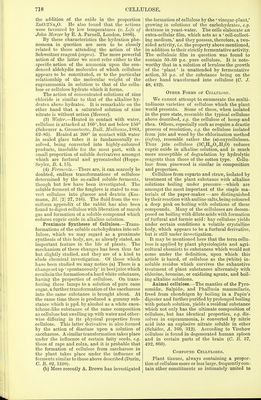
![cholesterin, a resin, proteids, CaCO.„ and in- organic salts (Valenciennes, J. 1861, 803). CASTOR OIL. A fatty oil obtained by pressure from the seeds of Ricinus communis. It solidifies at about —18°, has S.G. about -969 at 12°, and is dextro-rotatory, [a] = 12° (Popp, Ar. Ph. [2] 145,233). Castor oil consists chiefly of glycerides of stearic and ricinoleic acids. It is completely dissolved by 5 vols, of 90 p.c. alcohol (Hager, C. C. 1876, 389). Dry distilla- tion gives acrolein, cenanthol (heptoic aldehyde) and an acid (CnH.,0O„),. (Bnssy a. Lecanu, J. Ph. 13, 57 ; Stanek, J. pr. 63, 138; Leeds, B. 16, 290; Krafft a. Brunner, B. 17, 2985). HNO:l oxidises it to heptoic, oxalic, azelaic, suberic, and (/3)-pimelic acids (Arppe, A. 120, 288). The products obtained by saponifying castor-oil and distilling the resulting alkaline ricinoleate alone or with NaOH are methyl hexyl ketone, scc-octyl alcohol, and sebacic acid (Neison, C. J. 27, 507, 837). Cone. H,S04 converts castor oil into ricinyl - sulphuric acid C18H3302OS03H, which by the addition of water breaks up into ricinoleic acid and H2S04. From the fatty acids derived from the Turkey-red oil prepared, from castor oil, crystals of a di-oxy-stearic acid sepa- rate after some time (Benedikt a. Ulzer, M. 8, 217). CATALPIC ACID C14H1406. [206°]. Ex- tracted by ether from decoctions of the siliqua- ceous capsule of the Bignonia Catalpa. It may be isomeric with hydrocardenic acid (Sardo, O. 14, 134). Large white crystals, v. si. sol. water, sol. alcohol and ether. —BaC14Hl206 6aq : white glistening laminae.—Ag.A: a white pp. CATALYSIS v. Chemical change. CATECHINS C^H^OsSaq (Hlasiwetz; Cross a. Bevan, C. J. 41, 92); C18H]sOs (Etti, M. 2, 547); C.,,H.,„09 (Liebermann a. Tauchert, B. 13, 694); C4llH38016 and Gl2H380I6 (Gautier, G. R. 86, 668). This name has been given to various compounds contained in catechu or Terra japo- nica which is extracted by boiling water from the fruits or twigs of a variety of plants : Bom- bay catechu from the fruit of Areca Catechu, Bengal catechu from twigs and unripe pods of Acacia (or Mimosa) Catechu, Gambir catechu from Nauclea (Uncaria) Gambir, and Nubian catechu from some Acacia. Catechu is used in dyeing. Catechin C21H1808 (Gautier, C. R. 85, 752); Ol.,HlsO, 3aq (C. a. B.); C.^O, 5aq (L. a. T.). [217°]. S. (alcohol) 20 at 15°; S. (ether) -8 at 15° (Wackenroder, A. 37, 311). Obtained from Bombay catechu by washing with water and crystallising from acetic ether (L. a. T.; Lowe, Fr. 13, 113 ; Zwenger, A. 37, 320 ; Neubauer, A. 96, 337; Kraut a. Van Delden, A. 128, 285; Hlasiwetz a. Malin, A. 134, 118; Etti, A. 186, 337 ; Sehiitzenberger, Bl. [2] 4, 5; Sacc, C. R. 53, 1102). Properties.—Small needles (from water). V. si. sol. cold water, v. sol. hot water and acetic ether. The aqueous solution is coloured green by Fe2Cl6. The solution in KOHAq ab- sorbs oxygen, turning brown. Lead acetate gives in aqueous solution a pp. of (C21H2„0,j)23PbO (?) Catechin solutions are ppd. by albumen, but not by gelatin. Reactions.—1. Boiling dilute H2S04 forms catechuretin. - 2. With HC1 and KC103 it gives C20H,,JC140I2 ? (Cross a. Bevan, C. J. 41, 92) which is turned crimson by Na2S03. Catechu- tannic acid does the same.—3. Br gives bromo- catechuretin C21HsBr,0;?, a red insoluble powder. 4. Water and PI3 give C21H20O8, an elastic insoluble mass. — 5. HOAc and Ba02 give C..|H.,„Oi0 a colourless powder which melts below 100° (Schiitzenberger a. Back, Bl. 4, 8).— 6. Aqueous K2Cr207 forms C21H]4OI0, a brown insoluble powder.—7. Potash-fusion gives phlo- roglucin and protocatechuic acid (Hlasiwetz, ..4. 134, 118).—8. Dry distillation gives pyrocate- chin.—9. Boiling dilute H,SO, forms insoluble C.H^O, (Neubauer, A. 96, 356), or C38H3()012 (Etti).—10. Boiling dilute KOH forms C2lH1(i68 (?) a brown powder, sol. alcohol and alkalis.—11. HI gives iodoform and other products (G.). Di-acetyl derivative C2,H180;(OAc)2: [131°] ; needles or prisms. Soluble in ordinary solvents except water and ligroin (L. a. T.). Di - benzoyl derivative C2|Hls03(OBz)2. Flocculent brown substance (S. a. B.). Diacetyl-dichloro-catechin C21Hli;Cl.,(OAc)20,: [169°]; needles. Sol. al- cohol, si. sol. ether. Diacetyl-bromo-catechin C21H17Br(OAc)207; [120°]. White needles. Sol. alcohol, si. sol. ether. Catechuretin C42H:!„0136aq(?) or C3sH,s012. Formed by passing HC1 into a boiling alcoholic solution of catechin (Kraut a. Delden, A. 128, 291). Formed also by heating catechin with cone. HC1 at 170°. Dark reddish-brown in- soluble powder. Not changed at 190°. Di-benzoyl derivative C21HMBz20,(?) Formed, together with di-benzoyl-catechin by heating catechin with BzCl at 190°. Brown mass. Catechin C40H38O16 2aq. [205°]. S. 9-9 at 50°. Occurs according to Gautier (C. R. 86, 668) in Gambir-catechu together with the two following catechins ; they are extracted by alco- hol and crystallise after evaporation with exclu- sion of air. Monoclinic prisms. Catechin C42H38016aq. [177°]. Minute needles (v. supra). Catechin Cl0H38O1(iaq. [163°]. S. 5-3 at 50°. Minute needles (v. supra). Catechin C]sH19Osaq. According to Etti (M. 2, 547) this is the formula of the catechin in Gambir and Pegu catechins. At lOO3 it becomes ClsHlsOs, at 160° catechutannic acid C36H310H and at 180° C36H32014. The latter is also got by heating catechin for some time with dilute H2S04. Reactions.—1. Diazobenzene chloride gives (C{H5N,)2C|SH]liO((, a red crystalline pp. sol. alco- hol and ether; it dyes wool golden-brown.— 2. Dilute H2S04 (1:8) at 140° gives phloroglucin and pyrocatechin. Catechin C.,.,H34Ol6. [165°J. In mahogany (Acajou) (Gautier, Bl. [2J 30, 568). Latour a. Cazeneuve (Bl. [2] 24, 119) give this catechin the formula C^H.,,,0,,. Catechin C^H^O,,,. [140°]. In brown cate- chu (G.). CATECHOL v. Pxeocatechin. CATECHUIC ACID v. Catechin and Peoto- CATECHUIC ACID. CATECHUTANNIC ACID C.,1HlsOK(?) or C38H31015(?) Extracted by water from catechu.](https://iiif.wellcomecollection.org/image/b21995990_0001_0739.jp2/full/800%2C/0/default.jpg)