Volume 1
Watts' dictionary of chemistry / revised and entirely rewritten by H. Forster Morley and M.M. Pattison Muir ; assisted by eminent contributors.
- Date:
- 1888-1894
Licence: Public Domain Mark
Credit: Watts' dictionary of chemistry / revised and entirely rewritten by H. Forster Morley and M.M. Pattison Muir ; assisted by eminent contributors. Source: Wellcome Collection.
Provider: This material has been provided by the Royal College of Physicians of Edinburgh. The original may be consulted at the Royal College of Physicians of Edinburgh.
745/796 (page 719)
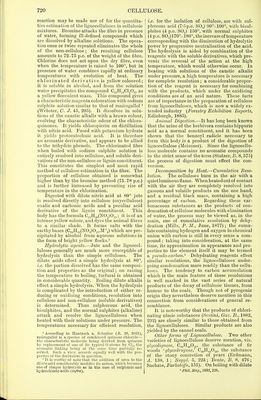
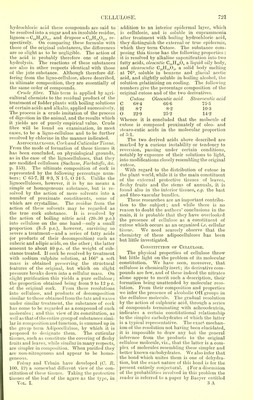
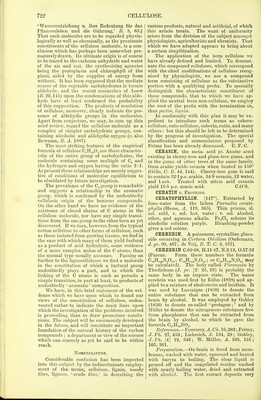
![the cellulose as to mask its reactions. From the circumstances of their occurrence and formation it is not to be expected that the line can be sharply drawn between mixtures and combina- tions of cellulose with non-cellulose constituents of either fibres or tissues. Fremy (Ann. Agro- nomigues, 9, 529) recognises the existence of the following compounds distinguished from cellu- lose chiefly by their different behaviour to hydro- lytic reagents and euprammonia; (1) Fibrose, constituting the membranes of wood cells; (2) Paracellulose, constituting the membrane of the pith and medullary rays, and (3) Vasculose constituting the membranes of the vessels. The value of this somewhat arbitrary classi- fication is questionable (Sachsse, Farbstoffe, Kolilehydrate, &c, p. 150), and the distinctions which it seeks to establish have not been gene- rally recognised. On the other hand, there are certain groups of substances widely distributed throughout the plant world, which, while they have certain features in common with the cel- luloses, are sufficiently distinct to admit of che- mical classification apart from them. Generally speaking, these substances are made up of a cellulose and a non-cellulose portion, the latter conferring the special features of distinction. The compound cellulose thus constituted is re- solved, by treatment with reagents according to the methods to be described, into cellulose or a cellulose residue on the one hand, and soluble derivatives of the non-cellulose on the other. Of these groups we shall consider typical members. The following are the compound celluloses sufficiently characterised to warrant special de- scription under class names : the nomenclature of these compounds is explained by their cha- racteristic resolutions. Pectocelluloses Eesolved by hydrolysis (alkalis) into / \ Pectic acid and cellulose. Type: Eaw flax (Kolb, Bull. Mulh. 1868, A. Ch. [4] 14, 348). Lignocelluloses Eesolved by chlorination into / \ Chlorinated derivs.: \ Aromatic [ and cellulose. Soluble in alkalis ) Type: Jute (Cross a. Bevan, C. J. 41, 90). Adipocelluloscs Eesolved by oxidation (Nitric acid) into / \ Similar derivs.: \ as by the oxidation [ and cellulose, of the fats. ' Type: Cuticular tissue of leaves and fruits (Fremy, C. B. 48, 667; Sachsse, Farbstoffe, &c). Pectocelluloses.—The purified bast of a Eus- sian flax investigated by Kolb was found to have the aggregate composition: C 43-7 H 5-9 0 50-4. The non-cellulose constituent is therefore a substance of lower carbon percentage than cellu- lose. From its yielding pectic acid on boiling with alkalis, it is obviously a substance allied to pectin. Since the fibre yields about 20 p.c. of its weight of the acid derivative we infer inde- pendently that it is a substance containing approximately 41 p.c. carbon, which confirms the view of its constitution above expressed. Many other plant fibres are made up of or con- tain pectocelluloses (Webster, C. J. 43, 23); pectic derivatives were identified by Schunck in the products of the action of boiling alkaline solutions upon raw cotton (Proc. Manchester Lit. Phil. [3] vol. iv ). The cellular tissue of a large number of fruits, e.g., the apple and pear, and roots, e.g., turi^s and carrots, is composed of pecto-cellu- loses. Lignocelluloses.—The course of lignification in plants is marked by profound alterations in the physical properties of the tissues undergoing this modification ; the tissues lose their elas- ticity, become coloured from grey to brown, and the substance of the tissues manifests the chemical properties about to be described. Jute.—Aggregate percentage composition : C. 47-0-48-0, H. 5-9-5-7, 0. 47-1-46-3 (C^H^O,,),,. It may be regarded as composed of Non-cellulose(Lignin)C18H.,1Oil) (55-5 p.c. C) 25'p.c. and Cellulose C18H3(,0]5 (44-4 „ ) 75 „ though the cellulose isolated from the fibre by chemical resolution differs in composition as already stated from normal cellulose, appearing rather as an oxycellulose. The mineral con- stituents of the raw fibre (purified) vary from 0-5 to 2 p.c. of its weight; the hygroscopic moisture from 10-12. Attacked by concentrated solutions of the alkalis similarly to cotton; freely soluble in euprammonia, but is incom- pletely precipitated on acidifying; the body re- maining in solution gives the reactions of the original substance, and may, therefore, be re- garded as a hydrated modification. Jute com- bines freely with the organic astringents (tan- nins) and the majority of aromatic colouring matters. It is coloured a bright yellow by solutions of salts of aniline and other aromatic bases. This reaction is probably due to a pro- duct of oxidation, since it does not take place with jute which has been boiled for some time in solutions of sulphites. It is coloured brown by iodine solutions. Moistened with a solution of phloroglucin and treated afterwards with hydrochloric acid it gives a deep red colouration; with pyrrol also in presence of hydrochloric acid it gives a deep carmine colour. A mixture of sulphuric and nitric acids nitrates the fibre, the gain in weight being ap- proximately equal to that of cellulose under the same conditions. The products are orange- coloured and are soluble in acetone. Like the cellulose nitrates, they give no aniido-derivatives on reduction. Iodine is absorbed by the fibre, the quantity taken up being constant under constant conditions ; the resulting compound is not more stable than the iodide of starch. This](https://iiif.wellcomecollection.org/image/b21995990_0001_0745.jp2/full/800%2C/0/default.jpg)