Volume 1
Watts' dictionary of chemistry / revised and entirely rewritten by H. Forster Morley and M.M. Pattison Muir ; assisted by eminent contributors.
- Date:
- 1888-1894
Licence: Public Domain Mark
Credit: Watts' dictionary of chemistry / revised and entirely rewritten by H. Forster Morley and M.M. Pattison Muir ; assisted by eminent contributors. Source: Wellcome Collection.
Provider: This material has been provided by the Royal College of Physicians of Edinburgh. The original may be consulted at the Royal College of Physicians of Edinburgh.
755/796 (page 729)
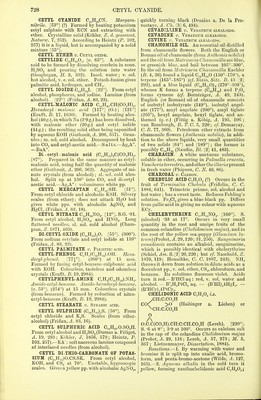
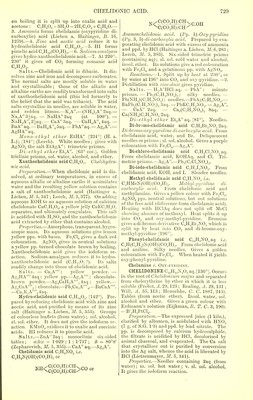
![On boiling it is split up into oxalic acid and acetone : C7H ,06 + 3H,0 = 2H,C,04 + C3H60.— 3. Ammonia forms chelidamic (oxypyricline di- carboxylic) acid (Lieben a. Haitinger, B. 16, 1259).—4. Zinc and acetic acid reduce it to hydrochelidonic acid C,H10O5.—5. HI forms pimelic acid C5Hl(,(CO,H)2.—6. Sodium a malgam gives hydro-xanthochelidonic acid.—7. At 220°- 230° it gives off C0.2 forming comanic acid C6H,04. Salts.—Chelidonic acid is dibasic. It dis- solves zinc and iron and decomposes carbonates. The normal salts are mostly soluble in water and crystallisable; those of the alkalis and alkaline earths are readily transformed into salts of xanthochelidonic acid (this led formerly to the belief that the acid was tribasic). The acid salts crystallise in needles, are soluble in water, and redden litmus.—K.,A.—(NH,).A2aq.— Na.A3iaq. — NaHA2aq (at 100°). — NaH,AV2iaq. — CaA3aq. — CaH0A,4aq. — BaA aq. — BaHtiA4 5aq. — PbA aq. — Ag.,A. — AgHAaq. Mono-ethyl ether EtHA [224°] (H. a. L.); [184°] (Lerch). White needles; gives with AgNO, the salt EtAgA: trimetric prisms. Di-ethyl etherMA. [63° cor.]. Golden triclinic prisms, sol. water, alcohol, and ether. Xanthochelidonic acid 0,11^0;. Chelihydro- nic acid. Preparation.—When chelidonic acid is dis- solved, at ordinary temperatures, in excess of aqueous alkalis or alkaline earths it assimilates water and the resulting yellow solution contains a salt of xanthochelidonic acid (Haitinger a. Lieben, M. 5, 347 ; Lerch, M. 5,377). On adding aqueous KOH to an aqueous solution of calcium chelidonate CaC;H,06, a yellow jelly CaKC7H30, separates, and ultimately coagulates. This salt is acidified with H2S04 and the xanthochelidonic acid extracted by ether that contains alcohol. Properties.—Amorphous, transparent, hygro- scopic mass. Its aqueous solutions give lemon yellow pps. with bases. FeoCl6 gives a dark red colouration. AgN03 gives in neutral solutions a yellow pp. turned chocolate brown by boiling. Xanthochelidonic acid gives the iodoform re- action. Sodium-amalgam reduces it to hydro- xanthochelidonic acid (C7H,„07 ?). Its salts readily change into those of chelidonic acid. Salts. — Ca.A: yellow powder. — Ag3HA4aq: yellow pp.—Ag4A : chocolate- brown powder.—Ag,CaH.,A., 4aq : yellow.— Ag„CaA,: chocolate.—PbsCajA.,.—BaCaA. —Ca.,K.,A24aq. Hydro-chelidonic acid CjH,,^. [142°]. Pre- pared by reducing chelidonic acid with zinc and acetic acid, and purified by means of its zinc salt (Haitinger a. Lieben, M. 5, 353). Groups of colourless leaflets (from water); sol. alcohol, si. sol. ether. It does not give the iodoform re- action. KMnO, oxidises it to oxalic and succinic acids. HI reduces it to pimelic acid. Salts.—ZnA''2aq: monoclinic six-sided tables; a:b:c = 1-029 : 1 : 1-737 ; 13 = 80°8' (Zepharovich, M. 5, 355).—CaA aq.—Ag.A. Chelidamic acid C.H5NOr i.e. C5H2N(OH)(CO.,H)2 or NH<cSco:g!;CH>COor N^C(C02H}1CH\c 0H N)(C02H):CH^ Ammonchelidonic acid. (Py. \)-Oxy-pyridine (Py. 3, 5)-di-carboxylic acid. Prepared by eva- porating chelidonic acid with excess of ammonia and ppd. by HC1 (Haitinger a. Lieben, M. 6, 283 ; Lerch, M. 5, 383). Six-sided trimetric prisms (containing aq); si. sol. cold water and alcohol, insol. ether. Its solutions give a red colouration with Fe2Clu and a gelatinous pp. with AgN03. Reactions.—1. Split up by heat at 230°, or by water at 196° into CO., and oxy-pyridine.—2. Distillation with zinc-dust gives pyridine. Salts. — H.AHC1 aq. — PbA'': minute prisms. — Pb.,(CJH„NO,).,: silky needles. — Pb(NH,)(C7H,NO..): need'les.—PbAgC-H.,N05.— BaPb.,(C.H.,Nb-)2 3aq. — PbKC;H,NOr. — Ag.A.. — CaA 2aq. Ca,(C,H.,NO;i), 8aq. — Ca(NH4)C;H.,N05 2aq. Di-ethyl ether Et.,Aaq. [81°]. Needles. Di-bromo-chelidamic acid CjH.jBroNO^aq. Di-bromo-oxy-pyridine di-carboxylic acid. From chelidamic acid, water, and Br. Deliquescent needles or prisms ; si. sol. alcohol. Gives a purple colouration with Fe2CLj.—Ag.A. Di-chloro-chelidamic acid C;H3Cl.,NOr> aq. From chelidamic acid, KOHAq, and CI. Tri- metric prisms.—Ag.A.—Pb3(C;CLJN05)2. Di-iodo-chelidamic acid C3H,I.,N05. From chelidamic acid, KOH, and I. Slender needles. Methylchelidamie acid CsH.N05 i.e. C-HMeN(0H)(C02H)2. Methyl-pyridine di- carboxylic acid. From chelidonic acid and methylamine. Gives a yellow colour with Fe2Cl,,. AgN03 pps. neutral solutions, but not solutions of the free acid (difference from chelidamic acid). Heating with HClAq does not split off MeCl showing absence of methoxyl. Heat splits it up into C0.2 and oxy-methyi-pyridine. Bromine gives adi-bromo-derivative CsH5Br._,N05 which is split up by heat into C02 and di-bromo-oxy- methyl-pyridine [196°]. Phenyl-chelidamic acid Cl3H,,NOr aq i.e. C;,H(C„H,)N(OH)(C02H)2. From chelidonic acid and aniline. Silky needles. Gives a golden colouration with FeXl,;. When heated it yields oxy-phenyl-pyridine. Chelamine v. Oxy-pyridine. CHELIDONINE C,„H1„N303 aq. [136°]. Occurs in the root of Chelidonium majus and separated from chelerythrine by ether in which it is less soluble (Probst, A. 29,123 ; Rearing, A. 29, 131; Will, A. 35, 113 ; Henschke, C. C. 1887, 243). Tables (from acetic ether). Insol. water, sol. alcohol and ether. Gives a green colour with Erdmann's solution (Eijkman, R. T. C. 3, 190). —B'2H,PtCl6. Preparation.—The expressed juice (1 kilo.), clarified by albumen, is acidulated with HN03 (7 g. of S.G. 1-3) and ppd. by lead nitrate. The pp. is decomposed by calcium hydrosulphide, the filtrate is acidified by HC1, decolorised by animal charcoal, and evaporated. The Ca salt that crystallises out is purified by conversion into the Ag salt, whence the acid is liberated by HC1 (Lietzenmayer, M. 5, 341). Properties.—Needles containing 2aq (from water); m. sol. hot water; v. si. sol. alcohol. It gives the iodoform reaction.](https://iiif.wellcomecollection.org/image/b21995990_0001_0755.jp2/full/800%2C/0/default.jpg)