Gout : its pathology, forms, diagnosis and treatment / Originally founded on the Goulstonian lectures on "The chemistry and pathology of gout," delivered by the author before the Royal College of Physicians of London in 1897.
- Arthur P. Luff
- Date:
- 1907
Licence: Public Domain Mark
Credit: Gout : its pathology, forms, diagnosis and treatment / Originally founded on the Goulstonian lectures on "The chemistry and pathology of gout," delivered by the author before the Royal College of Physicians of London in 1897. Source: Wellcome Collection.
Provider: This material has been provided by the Augustus C. Long Health Sciences Library at Columbia University and Columbia University Libraries/Information Services, through the Medical Heritage Library. The original may be consulted at the the Augustus C. Long Health Sciences Library at Columbia University and Columbia University.
47/310 (page 33)
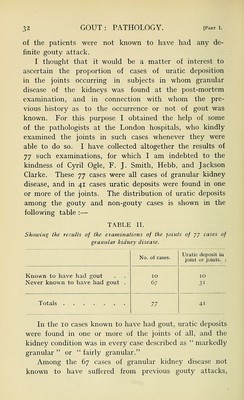
![uratic deposits were found in one or more of the joints of 31—that is, in 46 per cent, of the cases, which closely agrees with the 47 per cent, found under similar conditions by Norman Moore. In these 67 cases are included all cases which showed the existence of any granular kidney disease, but several of the cases in which no uratic deposits were found were described as only slightly granular or faintly granular. If from the 67 cases a selection is made of those described as markedly granular or as typical granular kidneys, then the proportion of cases in which uratic deposits were found in the joints appears as follows :— No. of cases. Uratic deposit in joint or joints. Marked granular kidney disease 26 Thus it is seen that among the cases of marked granular disease of the kidneys occurring in persons who were never known to have suffered from ostensible gout during life, uratic deposits were found in the joints of ']'] per cent. These results, taken in conjunction with those of Norman Moore and of Levison, show that kidney disease exercises a powerful influence in causing an accumulation of uric acid in the blood, and consequently in producing uratic deposits in the joints. Gouty afPeetions of the kidneys not always re- vealed clinically.—It has been urged that if kidney dis- ease, with the consequent diminished excretion of uric acid, be the primary factor in the causation of gout, signs of kidney mischief would always manifest themselves prior to an attack of gout, and that very few such cases « have ever been recorded. But, in the first place, it must be remembered that such signs are not usually looked for, and, in the second place, they need not necessarily](https://iiif.wellcomecollection.org/image/b21214256_0047.jp2/full/800%2C/0/default.jpg)