Final report of Her Majesty's Commissioners appointed to inquire into the operation and administration of the laws relating to the sale of intoxicating liquors.
- Great Britain. Royal Commission on the Liquor Licensing Laws
- Date:
- 1899
Licence: Public Domain Mark
Credit: Final report of Her Majesty's Commissioners appointed to inquire into the operation and administration of the laws relating to the sale of intoxicating liquors. Source: Wellcome Collection.
Provider: This material has been provided by London School of Hygiene & Tropical Medicine Library & Archives Service. The original may be consulted at London School of Hygiene & Tropical Medicine Library & Archives Service.
118/406 (page 100)
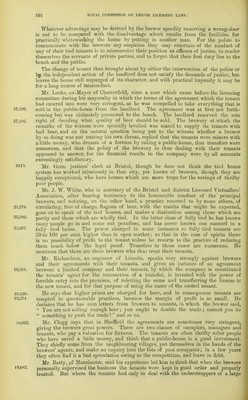
![tenancy ; some of tliem are tied, not only for beer, but for everything, including mineral water and tobacco. Tbey are compelled to sign a blank application form for transfer, so that they are liable at any moment to eviction. They pay heavily for bad articles. Their position is illustrated by the great number of transfers, 300 to 400 in number, a year. In 10 years, 135 houses were transferred 6 times. 83 ,, more than 6 times, 53 ,, „ 7 ,, 36 ,, „ 8 „ 20 „ „ 9 „ 11 „ „ 10 „ 4 „ „ 11 „ This frequency of transfers proves either that the houses are not required, or that for some other reason the tenants cannot get on. If one bad tenant is removed by Shackles, transfer, another equally bad takes his place; for a livelihood cannot be had in these houses, so poor and numerous are they. He would abolish the tie absolutely. *' It is not for the public good, and I should abolish it. 20,122. Mr. Chorley, a Wesleyan minister, stationed at Portsmouth for the full term of three 20 2%' years permitted by his Church, ] 893-6 (in Portsmouth, as we have already seen, the houses are practically all tied, the bulk belonging to three firms) describes how retired warrant officers after 21 years' service in the Navy invest all their savings in these houses, and how, after a few months or a little longer, in a very large number of cases, they leave the houses with their money gone. The tenants sign blank applications for transfer; their rent is merely nominal, but the conditions of the life are so hard that the tenancy soon comes to an end. The system acts very injuriously upon them. Transfers are very numerous; are granted as a matter of course, subject to police investigation as to the character of the new applicant, but without inquiry as to why the preceding tenant had left. Anson. The Chief Constable of Staffordshire strongly objects to the tied house system. It 7003. interferes with the course of justice, as the imposition of proper penalties is prevented, and the character of the house is supposed to be purged by the transfer from the 7397. offending licensee ; and, although, from the point of view of public order, it is an advantage that a good man should be substituted for a bad, still the fact that the house has been badly conducted for a certain time is entirely lost sight of by the process. And even when a conviction has been obtained, a transfer takes place 6969. and the thing is practically wiped out. Transfers increase as the system spreads, 7008. and there is no stability among the holders of licenses. In East London Mr. Martineau, Chairman of the Licensing Justices for the Tower Division, expresses for himself and his colleagues dislike to the tied house system. 10,298- The system led to an undue pushing of the sale of drink; the tenant, unlike a free 10,331. man, was under continual compulsion to sell, or he must go if he did not sell enough. It also made it very difficult to fix the responsibility for offences, as the licensee was so easily turned out. It was an evil that the tenancies were terminable at such short notices. In some parts of East London the liquor supplied was not quite so good, Unless there was keen competition, there was a strong temptation to the brewer to get rid of inferior liquor. In some districts one firm had an entire monopoly. The system operated injuriously upon the tenant; he was so tied that he had no separate existence; he was completely in the hands of his chief. The justices sometimes inspected agreements and leases, &c, but did not attach much weight to them. 21,600. Roundel! has also a strong objection to the system, though there are brewers and 91515 brewers. The present ease of transfer puts the tenant at the mercy of the brewers. 21'646.' There was often a clause in agreements giving the brewer immediate right of re-entry, 21,910. in Case the tenant did or permitted anything which might lead to a conviction. The tenant was thus no longer responsible to the justices, but only to the brewer. The tied tenant was charged sometimes 6s. to 10s. a barrel more for his beer; and, so handicapped, he had a tendency to resort to all sorts of means to obtain a living. Lower rent did not compensate for the higher prices. The brewer thus encouraged the tenant to sell more beer, and took himself the benefit of the excessive charge. The lower rent tended to lower the assessment. At Crewe, in consequence of the strong action of the justices in insisting on bond fide tenants and fair terms, the](https://iiif.wellcomecollection.org/image/b21365027_0118.jp2/full/800%2C/0/default.jpg)