Final report of Her Majesty's Commissioners appointed to inquire into the operation and administration of the laws relating to the sale of intoxicating liquors.
- Great Britain. Royal Commission on the Liquor Licensing Laws
- Date:
- 1899
Licence: Public Domain Mark
Credit: Final report of Her Majesty's Commissioners appointed to inquire into the operation and administration of the laws relating to the sale of intoxicating liquors. Source: Wellcome Collection.
Provider: This material has been provided by London School of Hygiene & Tropical Medicine Library & Archives Service. The original may be consulted at London School of Hygiene & Tropical Medicine Library & Archives Service.
120/406 (page 102)
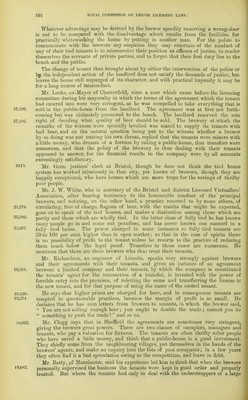
![Whatever advantage may be derived by the brewer speedily removing a wrong-doer is not to bo compared with the disadvantage which results from the facilities for practically whitewashing the house by putting in another man. For the police to communicate with the brewers any suspicion they may entertain of the conduct of any of their tied tenants is to misconceive their position as officers of justice, to render themselves the servants of private parties, and to forget that their first duty lies to the bench and the public. The change of tenant thus brought about by either the intervention of the police or by the independent action of the landlord does not satisfy the demands of justice, but leaves the house still unpurged of its character, and with practical impunity it may be for a lone: course of misconduct. Mr. Locke, ex-Mayor of Chesterfield, cites a case which came before the licensing committee during his mayoralty in which the terms of the agreement which the tenant had entered into were very stringent, as he was compelled to take everything that is 27.192. sold in the public-house from the landlord. The agreement was at first not forth- coming but was ultimately presented to the bench. The landlord reserved the sole 27,195. right of deciding what quality of beer should be sold. The brewery at which the remarks of the witness were specially levelled was stated to supply its tenants with bad beer, and on the natural question being put to the witness whether a brewer by so doing was not cutting his own throat, replied that the tenants were miners with a little money, who dreamt of a fortune by taking a public-house, that transfers were numerous, and that the policy of the brewery in thus dealing with their tenants appeared to answer, for the financial results to the company were by all accounts exceedingly satisfactory. 9313. ]y[r> Gore, justices' clerk at Bristol, though he does not think the tied house system has worked injuriously in that city, yet knows of brewers, though they are happily exceptional, who have houses which are mere traps for the savings of thrifty poor people. Mr. J. W. White, who is secretary of the Bristol and district Licensed Victuallers' Association, after bearing testimony to the honourable conduct of the principal brewers, and noticing, on the other hand, a practice resorted to by some others, of 23,278. circulating, free of charge, flagons of beer, with the results that might be expected* goes on to speak of the tied houses, and makes a distinction among those which are 23,293. partly and those which are wholly tied. In the latter class of fully tied he has known many people go in and come out penniless, and has never known one succeed in a 23,297. fully tied house. The prices charged in some instances to fully tied tenants are 50 to 100 per cent, higher than in open market; so that in the case of spirits there is no possibility of profit to the tenant unless he resorts to the practice of reducing them much below the legal proof. Transfers in these cases are numerous. He mentions that there are three brewers who thus treat their tenants. Mr. Richardson, an engineer of Lincoln, speaks very strongly against brewers and their agreements with their tenants, and gives an instance of an agreement 19,391. between a limited company and their tenants, by which the company is constituted the tenants' agent for the transaction of a transfer, is invested with the power of forcible entry into the premises, of reletting the same and transferring the license tc the new tenant, and for that purpose of using the name of the ousted tenant. 19.359- He says that higher prices are charged for beer, and in consequence tenants are 19,374. tempted to questionable practices, because the margin of profit is so small. He declares that he has seen letters from brewers to tenants, in which the brewer said, You are not selling enough beer; you ought to double the trade ; cannot you do something to push the trade ? and so on. 18,022, Mr. CI egg says that in Sheffield the agreements a.re sometimes very stringent, giving the brewers great powers. There are two classes of occupiers, managers and tenants, who pay a valuation for fixtures. The tenants are often thrifty sober people who have saved a little money, and think that a public-house is a good investment. They chiefly come from the neighbouring villages, put themselves in the hands of the brewers' agents, and make no inquiry into the fate of past occupants; in a few years they often find it a bad speculation owing to the competition, and leave in debt. Mr. Batty, of Manchester, said his experience led him to think that when the brewers 19,682. personally supervised the business the tenants were kept in good order and properly treated. But where the tenants had only to deal with the understrappers of a large](https://iiif.wellcomecollection.org/image/b21365027_0120.jp2/full/800%2C/0/default.jpg)