Final report of Her Majesty's Commissioners appointed to inquire into the operation and administration of the laws relating to the sale of intoxicating liquors.
- Great Britain. Royal Commission on the Liquor Licensing Laws
- Date:
- 1899
Licence: Public Domain Mark
Credit: Final report of Her Majesty's Commissioners appointed to inquire into the operation and administration of the laws relating to the sale of intoxicating liquors. Source: Wellcome Collection.
Provider: This material has been provided by London School of Hygiene & Tropical Medicine Library & Archives Service. The original may be consulted at London School of Hygiene & Tropical Medicine Library & Archives Service.
77/406 (page 59)
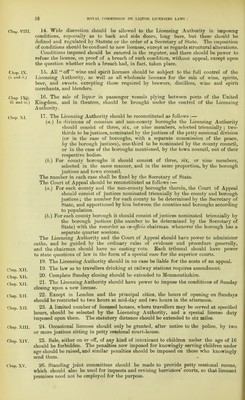
![27. Licenses should not be granted to common lodging-houses. Especially in sea Cbap. xv. ports a byplaw should be adopted under section 214 of the Merchant Shipping Act of 1894, so as to prevent public-houses being used as lodging-houses for seamen. 28. No public music or dancing should be permitted without a license from the ch xv Licensing Authority. The adoption of Part IV. of the Public Health Act should be made compulsory. 29 (a.) The same disqualifications should apply to members of a watch committee Chap. XVI. as now apply to the members of the Licensing Authority; and, further, any person acting as solicitor or valuer for any brewing company or trade organisation should also be disqualified. (b.) The chief or head constable should not be removable, except with the sanction of the Secretary of State. 30. Legal assistance should be provided for the police in proceedings under the chap. XV]. licensing laws. 31. A general course of instructions should be issued to the police as to dealing Chap. XVI]. with drunkenness, &c. 32. There should, be a general power of arrest for simple drunkenness, apart Chap. XVIT. from disorder. 33. (a.) No constable in uniform, whether on or off duty, should be served with chap. XVII. intoxicating liquor without an order from a superior officer. (b.) The practice of testimonials to retiring inspectors should be prohibited. 34. The Licensing Authorities in each county should have a certain number of Chap. XVI]. officers of high rank as inspectors to report upon the general condition of the houses. 35. (a.) In some cases of offences by license-holders the penalty should be the ChapXVIlL temporary suspension of the license, instead of the imposition of a fine. (&.) When a person is found drunk on licensed premises, or is seen leaving the premises in a drunken condition, it should be incumbent on the license-holder to show that neither he nor his servants knew of the drunkenness, or that they did not, with such knowledge, permit him to remain on the premises. (c.) The police should have instructions when possible to warn the license-holder if a drunken person is seen to enter the premises. (d.) Instead of the present system of endorsement, a record of all convictions should be kept in the register of licenses. The register should give full particulars of the charge and the penalty imposed, and should be produced before the Licensing Authority. The register should be open to inspection on payment of a trifling fee. 36. A summary of legal regulations should be displayed in all public-houses. Chap.XVHT. 37. (a.) To be drunk when in charge of a child of tender years should be an offence, Chap. XIX. with a penalty attached higher than that for simple drunkenness. (b.) Habitual drunkenness should be treated as persistent cruelty within the meaning of the Summary Jurisdiction (Married Women) Act, 1895, and entitle the wife or husband to separation and protection for herself or himself and children. 38. Habitual drunkards (to be defined by the number of convictions) should be Chap. XX. placed on a black-list, and the license-holders should be warned by the police not do serve persons so notified. A penalty should attach to any license-holder knowingly- serving such persons. The persons prohibited, having notice of the order made against them, should also be liable to penalties in the event of their attempting to evade the prohibition. PART II.—SCOTLAND. 1. Some redistribution of licensed houses is necessary, and in certain places a reduction Chap. IV, is desirable. 2. In the matter of provisional certificates in cases of contemplated removal, the Chap. IV. Scottish law should be assimilated to that of England, save that the consent of the owner of the premises should not be required.](https://iiif.wellcomecollection.org/image/b21365027_0077.jp2/full/800%2C/0/default.jpg)