Departmental report : 1998 (MAFF) / Department for Environment, Food and Rural Affairs and the Forestry Commission ; presented to Parliament by the Secretary of State for Environment, Food and Rural Affairs.
- Great Britain. Department for Environment, Food & Rural Affairs
- Date:
- 1998
Licence: Attribution 4.0 International (CC BY 4.0)
Credit: Departmental report : 1998 (MAFF) / Department for Environment, Food and Rural Affairs and the Forestry Commission ; presented to Parliament by the Secretary of State for Environment, Food and Rural Affairs. Source: Wellcome Collection.
12/296 page 1
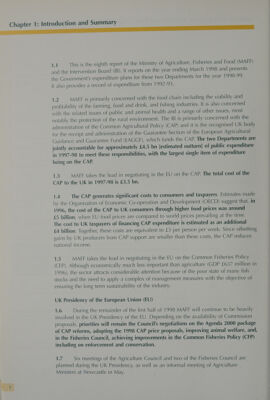
![ace r 1.1 This is the eighth report of the Ministry of Agriculture, Fisheries and Food (MAFF) and the Intervention Board (IB). It reports on the year ending March 1998 and presents the Government's expenditure plans for these two Departments for the year 1998-99. It also provides a record of expenditure from 1992-93. 12 MAFF is primarily concerned with the food chain including the viability and profitability of the farming, food and drink, and fishing industries. It is also concerned with the related issues of public and animal health and a range of other issues, most notably the protection of the rural environment. The IB is primarily concerned with the administration of the Common Agricultural Policy (CAP) and it is the recognised UK body for the receipt and administration of the Guarantee Section of the European Agricultural Guidance and Guarantee Fund (EAGGF), which funds the CAP. The two Departments are jointly accountable for approximately £4.5 bn [estimated outturn] of public expenditure being on the CAP. 1.3 MAFF takes the lead in negotiating in the EU on the CAP. The total cost of the CAP to the UK in 1997-98 is £3.5 bn. 1.4 The CAP generates significant costs to consumers and taxpayers. Estimates made by the Organisation of Economic Co-operation and Development (OECD) suggest that, in 1996, the cost of the CAP to UK consumers through higher food prices was around £5 billion, when EU food prices are compared to world prices prevailing at the time. The cost to UK taxpayers of financing CAP expenditure is estimated as an additional £4 billion. Together, these costs are equivalent to £3 per person per week. Since offsetting gains by UK producers from CAP support are smaller than these costs, the CAP reduces national income. 1D MAFF takes the lead in negotiating in the EU on the Common Fisheries Policy (CFP). Although economically much less important than agriculture (GDP £637 million in 1996), the sector attracts considerable attention because of the poor state of many fish stocks and the need to apply a complex of management measures with the objective of ensuring the long term sustainability of the industry. UK Presidency of the European Union (EU) 1.6 During the remainder of the first half of 1998 MAFF will continue to be heavily involved in the UK Presidency of the EU. Depending on the availability of Commission proposals, priorities will remain the Council’s negotiations on the Agenda 2000 package of CAP reforms, adopting the 1998 CAP price proposals, improving animal welfare, and, in the Fisheries Council, achieving improvements in the Common Fisheries Policy (CFP) including on enforcement and conservation. Ryd Six meetings of the Agriculture Council and two of the Fisheries Council are planned during the UK Presidency, as well as an informal meeting of Agriculture Ministers at Newcastle in May.](https://iiif.wellcomecollection.org/image/b31848758_0012.jp2/full/800%2C/0/default.jpg)