Investigation of glycocoll and some of its products of decomposition / by Eben N. Horsford ; extracted from the American journal of science and arts, vols. III & IV, second series, 1847.
- Eben Norton Horsford
- Date:
- 1847
Licence: Public Domain Mark
Credit: Investigation of glycocoll and some of its products of decomposition / by Eben N. Horsford ; extracted from the American journal of science and arts, vols. III & IV, second series, 1847. Source: Wellcome Collection.
Provider: This material has been provided by the National Library of Medicine (U.S.), through the Medical Heritage Library. The original may be consulted at the National Library of Medicine (U.S.)
42/48
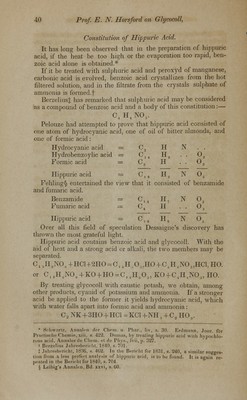
![Constitution of Hippuric Acid. It has long been observed that in the preparation of hippuric acid, if the heat be too high or the evaporation too rapid, ben- zoic acid alone is obtained.* If it be treated with sulphuric acid and peroxyd of manganese, carbonic acid is evolved, benzoic acid crystallizes from the hot filtered solution, and in the filtrate from the crystals sulphate of ammonia is formed.f BerzeliusJ has remarked that sulphuric acid may be considered as a compound of benzoic acid and a body of this constitution :— C4H4N03. ' Pelouze had attempted to prove that hippuric acid consisted of one atom of hydrocyanic acid, one of oil of bitter almonds, and one of formic acid : Hydrocyanic acid = c„ H ] V . Hydrobenzoylic acid = 0,« H6 . 0 Formic acid = . c„ H . 0 Hippuric acid = Cl8 H8 N 03 Fehling<§> entertained the view that it consisted of benzamide and fumaric acid. Benzamide = CI4 H7 N 02 Fumaric acid — C4 H . . 03 Hippuric acid = Cl8 H8 N O. Over all this field of speculation Dessaigne's discovery has thrown the most grateful light. Hippuric acid contains benzoic acid and glycocoll. With the aid of heat and a strong acid or alkali, the two members may be separated. C13II9NO(i+HCl+2HO = C,4HiO;„HO + C,H4N03JHCl,HO. or C18H9N08 + KO+HO=C\4H608J KO-f-C,H4N03, HO. By treating glycocoll with caustic potash, we obtain, among other products, cyanid of potassium and ammonia. If a stronger acid be applied to the former it yields hydrocyanic acid, which with water falls apart into formic acid and ammonia: C2 NK + 3HO + HC1 =KC14-NH3 +C3 H03. * Schwartz, Annulen der Cliprn. u. Phar., liv, s. 30. Erdmann. Jour, filr Praoiische Chemie,xiii. s. 422. Dumas, by treating hippuric acid with hypochlo- rous acid, Annalesde Chem. et de Phys., lvii,p. 327. t Berzeliua Jahresbericht, 1840, g. 701. I Jahresbericht, 1836, s. 4(i2. In the Bdriclit for 1831, s. 240, a similar sugges- tion from a less perfect analysis of hippuric acid, is to be found. It is again re- peated in the Bericht for 1840, s. 704.](https://iiif.wellcomecollection.org/image/b21130218_0042.jp2/full/800%2C/0/default.jpg)