The germ theories of infectious diseases / by John Drysdale.
- Drysdale, John James, 1817-1892.
- Date:
- 1878
Licence: Public Domain Mark
Credit: The germ theories of infectious diseases / by John Drysdale. Source: Wellcome Collection.
Provider: This material has been provided by The Royal College of Surgeons of England. The original may be consulted at The Royal College of Surgeons of England.
37/78 page 33
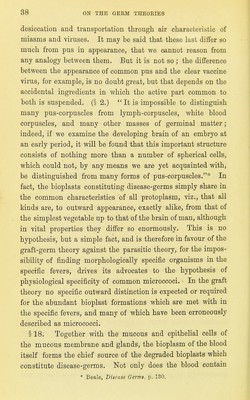
![pathologists have generally admitted diseased secretions as the probable cause of contagious and miasmatic diseases. In Fletcher’s Pathology it is laid down more particularly that the exciting cause of all contagious diseases consists of diseased secretions thrown off by animals affected with the same disease; while miasms, or malarious poisons, consist in diseased secretions thrown off by vegetables in a state of disease. This last distinction has not yet received the attention it deserves. To illustrate further the theory of diseased secretions, a person with a contagious disease may be looked upon as throwing off a secretion which, in virtue of its vitiation, is noxious to others, just as a venomous serpent secretes a poison in health ; and the analogy is closer when we notice that many contagia are thrown off by secreting organs; e.g., the virus of rabies by the salivary glands, scarlet fever by the glands of the throat and skin, measles by the mucous glands of the nose and air passages, typhoid by those of the intestines, &c. But the word secretion must not be limited to glandular products, for it may apply also to all products of perverted nutrition, such as pus, and sanies, and exudations from diseased tissues, or from the blood itself. Thus, if we include the last, viz., all kinds of detachable products of morbid nutrition among secretions, we can perceive that “ diseased secretions ” form a wide enough category to include the exciting causes of infectious and contagious diseases. And if we state, simply as an ultimate fact, that some have the power of causing a secre- tion of matter like themselves [contagia] which others have not [venoms], we probably say all that is certainly known, while renouncing the attempt to explain the remarkable difference between the two. Nevertheless, pathologists cannot rest satisfied without hypothetical attempts at explanation, among which, those tracing .it to chemical changes in the secretions, independent of the purely vital c](https://iiif.wellcomecollection.org/image/b22355248_0039.jp2/full/800%2C/0/default.jpg)