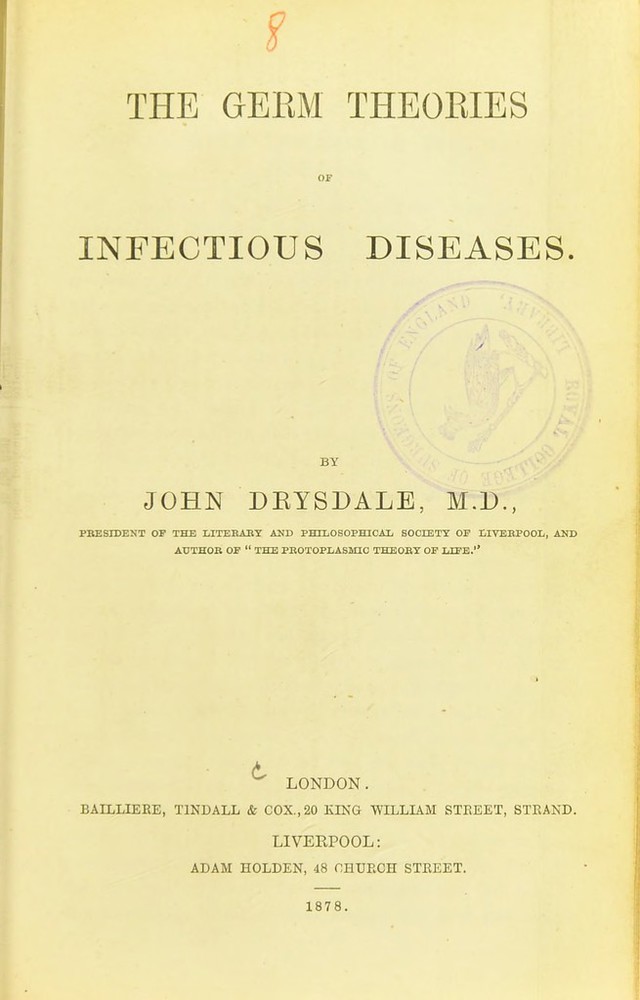
The germ theories of infectious diseases / by John Drysdale.
- Drysdale, John James, 1817-1892.
- Date:
- 1878
Licence: Public Domain Mark
Credit: The germ theories of infectious diseases / by John Drysdale. Source: Wellcome Collection.
Provider: This material has been provided by The Royal College of Surgeons of England. The original may be consulted at The Royal College of Surgeons of England.
38/78 page 34
![action concerned in their formation, are unworthy of atten- tion, and for the most part unintelligible ; while of those tracing it to the presence of living matter, the parasitic category has been already judged. § 17. There remains now the hypothesis of Dr. Lionel Beale, the discoverer of the Protoplasmic theory of life, who lays it down that the miasms and contagia are not only formed from the protoplasm, or living matter, of the sick person, like all other secretions, but they consist of actual portions of protoplasm, or living matter, which, being trans- ferred to a new body, continue to live and grow therein, thus causing the phenomena of contagion and infection. They are thus living portions of the diseased body engrafted on a healthy body, and the name of graft-germs may therefore with propriety be applied to them. The word is the more appropriate since it was the one originally given to the operation of inoculation, as is reported in the celebrated Letters of Lady Mary Wortley Montague, whose words are :— “ The smallpox, so fatal and so general amongst us, is here [Turkey] entirely harmless, by the invention of grafting, which is the term they give it.” The revival of this word, to designate transplantable disease-particles, is due to Dr. James Ross, in his very clever book, The Graft Theory of Disease. He proposes to call the contagium particles simply “ grafts,” but I think it will be more convenient to use the expression graft-germs. Dr. Beale, who is the discoverer of the theory, calls them simply “ disease-germs the word germ being here quite proper and intelligible, for, as he says, “ any living particle growing or capable of growth may be termed a germ.” To trace this theory to its root, we must remember that all diseased processes ought to be traceable to modifica- tions of healthy ones, or, at least, to a strong analogy with them. Now, on the protoplasmic theory, all secretions, as well indeed as all formations of tissue, are the result of the](https://iiif.wellcomecollection.org/image/b22355248_0040.jp2/full/800%2C/0/default.jpg)