The germ theories of infectious diseases / by John Drysdale.
- Drysdale, John James, 1817-1892.
- Date:
- 1878
Licence: Public Domain Mark
Credit: The germ theories of infectious diseases / by John Drysdale. Source: Wellcome Collection.
Provider: This material has been provided by The Royal College of Surgeons of England. The original may be consulted at The Royal College of Surgeons of England.
7/78 page 3
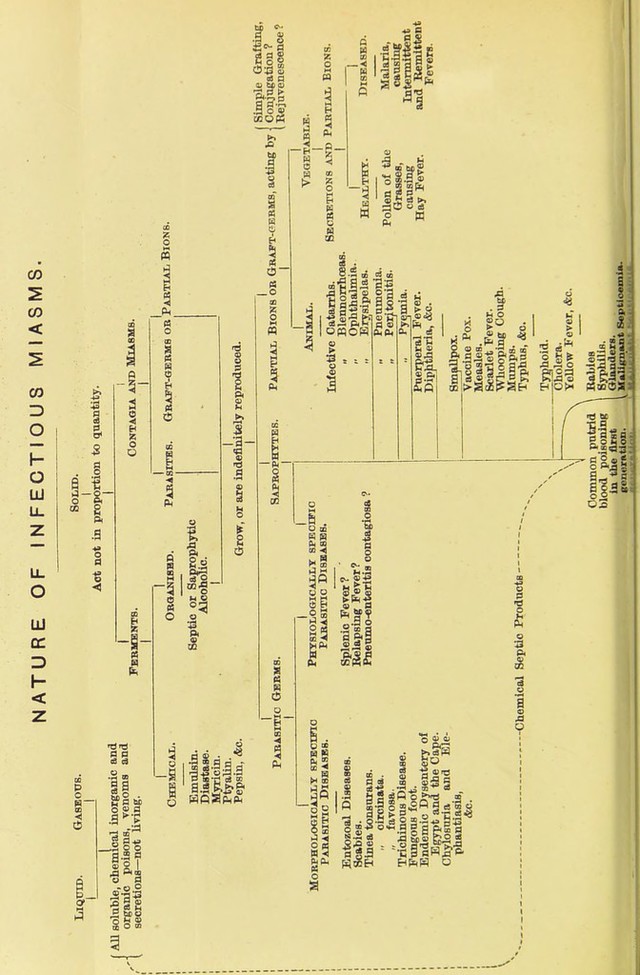
![remittent marsh fevers. Here the poison develops itself externally to the body, and is not reproduced therein so as to affect other men from thence, nor is it excreted thence to pro- pagate itself in any other way. 3rd. The miasmatic-contagious comprehend cholera, typhoid, dysentery, and probably somo others ; here the disease is not readily, if at all, transmissi- ble from person to person; nevertheless, these diseases never originate spontaneously or from purely malarious influences, but always after some person affected with them has been in the neighbourhood; so it is supposed the secretions from infected persons undergo development in favourable media out of the body. In other words, the reproduction of the miasm is partially performed out of the body. § 2. What is the intimate nature of this miasm or infectious matter ? In the first place, as regards its physical state, it has been determined with respect to the vaccine and some other animal poisons, and is almost certain with the rest, that the specific power does not reside in anything which is gaseous, or liquid, or capable of solution, or diffusible from the medium in which it is contained. * Thus when we hear of sewage or paludal liquids or gases spoken of as the exciting causes of infectious diseases, it is to be understood that the true specific matter is a solid merely suspended in the liquid or gas. This at once cuts off a large number of both inorganic and organic substances from the category of possible causes of the specific disease. [See diagram]. Next *Dr. Lionel Beale first attributed the infective properties of vaccine and other contagious diseases exclusively to solid matter, and this was experimentally demonstrated afterwards, first by Ohauveau and then by Dr. B. Sanderson, by the method of diffusion. Filtration was ineffectual for separating the extremely minute particles in which the contagion resides, from the matrix fluid. Chauveau found the same principle to apply to variola, pleuro-pneumonia, glanders, and sheep-pox. The experi- ments with the vaccine matter have been recently repeated with greater care and detail by Drs. Braidwood and Vacher, of Birkenhead, who have proved that the liquid diffused out from vaccine matter is totally devoid of infective power.](https://iiif.wellcomecollection.org/image/b22355248_0009.jp2/full/800%2C/0/default.jpg)