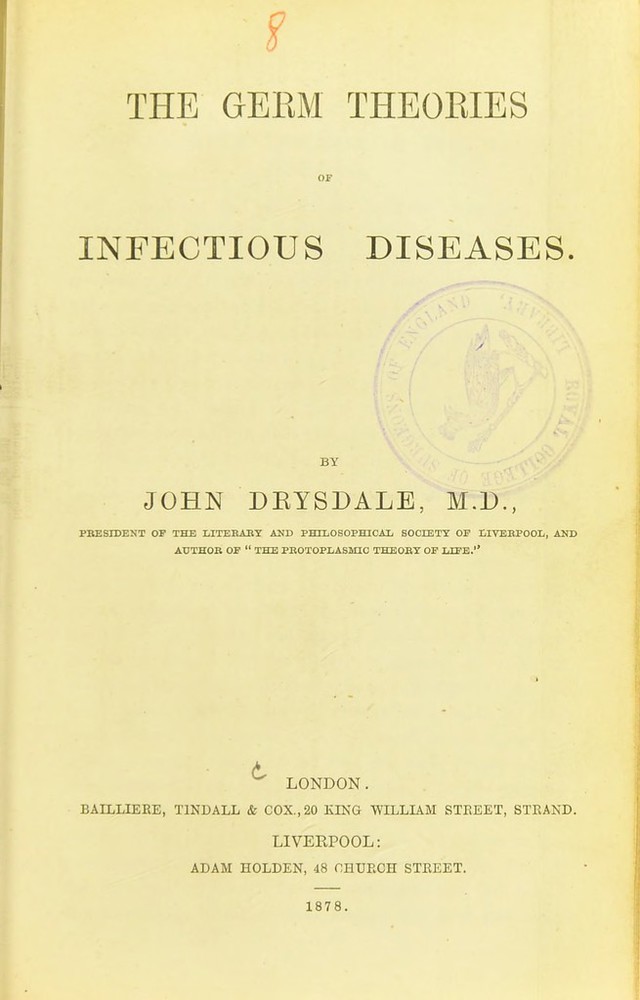
The germ theories of infectious diseases / by John Drysdale.
- Drysdale, John James, 1817-1892.
- Date:
- 1878
Licence: Public Domain Mark
Credit: The germ theories of infectious diseases / by John Drysdale. Source: Wellcome Collection.
Provider: This material has been provided by The Royal College of Surgeons of England. The original may be consulted at The Royal College of Surgeons of England.
9/78 page 5
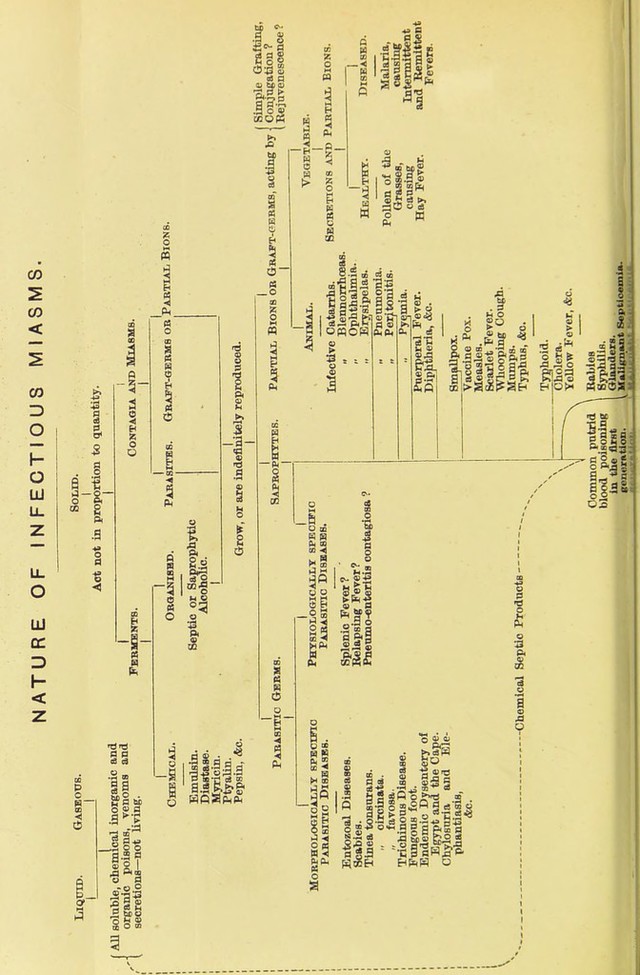
![we are now by the above process of exclusion restricted to three known substances:—1st, parasites, already known as such; 2nd, the organised ferments ; 3rd, portions of altered protoplasm, or living matter capable of transplantation and subsequent growth in the bodies of other persons; here called partial bions or graft-germs. Now, as the organised ferments are independent animal and vegetable beings, with their proper life history and mode of reproduction, they would necessarily come into the category of parasites if capable of running their course within the higher animals. The exciting causes of infectious disease is thus narrowed into two categories, viz., Parasitic-germs and Graft-germs.* (See diagram]. An immense step is thus made in unveiling * It will clear up the subject amazingly if we set aside the questions of fomentation and spontaneous generation from all connection with infecti- ous diseases. The superficial resemblance between the specific fevers and the process of fermentation is false and misleading, and it is unfortunate that the name of Zymotic should be sanctioned by authority as applied to those diseases. The true chemical ferments are recognised as agents which break up, with or without combination with oxygen, dead chemical matters by a purely chemical or non-vital process. There is no proof or probability that any chemical agent acts or could act thus on the living tissues or blood in the production of disease. And the sole analogy between the action of a contagious miasm and a chemical ferment is the circumstance of their both acting in minimal dose. From very different causes however ; the organised ferment reproduces itself, and is thus multiplied indefinitely, while the chemical ferment simply acts over and over again without addition of new particles, and hence the analogy with a contagious miasm quite fails. There is a fallacy in the common mode of comparing the action of a chemical ferment to disease. For example, it is said, a single drop of septicemic blood introduced into the blood of a healthy animal acts like a ferment which, without being itself consumed, alters the whole blood and kills the animal. Again, a drop of the blood of this last animal (contain- ing thus a mere fraction of the original drop) may alter the whole blood of a second animal and kill it. And so on indefinitely, always because an indefinite quantity of blood can be split up catalytically by the ferment, in however small a dose, seeing that it is not consumed in the process. This mode of statement involves several assumptions, and is contrary to the facts. For the natural ferments require a certain degree of concentration, and will not convert an unlimited quantity, and are slowly consumed or absorbed in the process, thus requiring renewal by secretion. If the second](https://iiif.wellcomecollection.org/image/b22355248_0011.jp2/full/800%2C/0/default.jpg)