[Report 1930] / Medical Officer of Health, Tynemouth County Borough.
- Tynemouth (England). County Borough Council.
- Date:
- 1930
Licence: Attribution 4.0 International (CC BY 4.0)
Credit: [Report 1930] / Medical Officer of Health, Tynemouth County Borough. Source: Wellcome Collection.
51/116 (page 45)
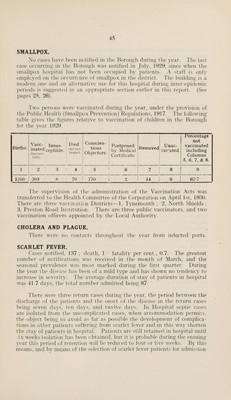
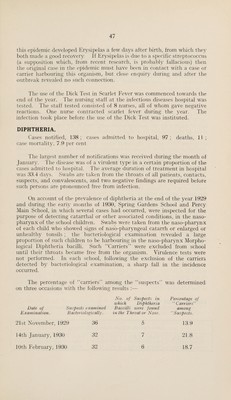
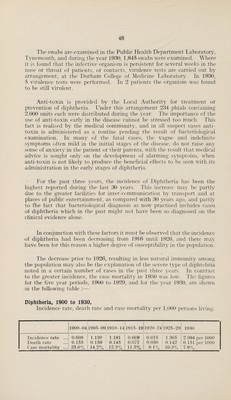
![SMALLPOX. No cases have been notified in the Borough during the year. The last case occurring in the Borough was notified in July, 1929, since when the smallpox hospital has not been occupied by patients. A staff is only employed on the occurrence of smallpox in the district. The building is a modern one and an alternative use for this hospital during inter-epidemic periods is suggested in an appropriate section earlier in this report. (See pages 25, 26). Two persons were vaccinated during the year, under the provision of the Public Health (Smallpox Prevention) Regulations, 1917. The following' table gives the figures relative to vaccination of children in the Borough for the year 1929. Births. Vacc¬ inated Success¬ fully. Insus¬ ceptible. Died unvacc- inated. Conscien¬ tious Objectors. Postponed by Medical Certificate. Removed Unac¬ counted. Percentage not vaccinated including Columns 5, 6, 7, & 8. 1 2 3 4 5 6 7 8 9 1266 393 8 70 770 2 14 ’] 9 62-7 The supervision of the administration of the Vaccination Acts was transferred to the Health Committee of the Corporation on April 1st, 1930. There are three vaccination Districts—1, Tynemouth ; 2, North Shields ; 3, Preston Road Institution. There are three public vaccinators, and two vaccination officers appointed by the Local Authority. CHOLERA AND PLAGUE. There were no contacts throughout the year from infected ports. SCARLET FEVER. Cases notified, 137 ; death, 1 * fatality per cent., 0.7. The greatest number of notifications was received in the month of March, and the seasonal prevalence was most marked during the first quarter. During the year the disease has been of a mild type and has shown no tendency to increase in severity. The average duration of stay of patients in hospital was 41.7 days, the total number admitted being 87. There were three return cases during the year, the period between the discharge of the patients and the onset of the disease in the return cases being seven days, ten days, and twelve days. In Hospital septic cases are isolated from the uncomplicated cases, when accommodation permiis, the object being to avoid as far as possible the development of complica¬ tions in other patients suffering from scarlet fever and in this way shorten the stay of patients in hospital. Patients are still retained in hospital until ix weeks isolation has been obtained, but it is probable during the ensuing year this period of retention will be reduced to four or five weeks. By this means, and by means of the selection of scarlet fever patients for admission-](https://iiif.wellcomecollection.org/image/b30198860_0051.jp2/full/800%2C/0/default.jpg)