The report of the Royal Commission on opium compared with the evidence from China that was submitted to the Commission. : An examination and an appeal. / by Arnold Foster... with preface by the Archbishop of Canterbury, and others.
- Great Britain. Royal Commission on Opium
- Date:
- 1898
Licence: Public Domain Mark
Credit: The report of the Royal Commission on opium compared with the evidence from China that was submitted to the Commission. : An examination and an appeal. / by Arnold Foster... with preface by the Archbishop of Canterbury, and others. Source: Wellcome Collection.
Provider: This material has been provided by London School of Hygiene & Tropical Medicine Library & Archives Service. The original may be consulted at London School of Hygiene & Tropical Medicine Library & Archives Service.
34/52 page 26
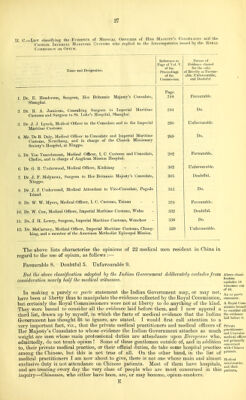
![referring to the Island of Formosa, where he resided for seven years. He writes that: — Y- p. 218. By a high-piincipJed Chinaman the use of opium wouhl be pronounood tlegracling ; but I do not think such is at all the general opinion A new arrival usually finds that his ideas, moulded on statements current at home, are immensely exaggerated; he seldom comes across that type of the degraded opium victim, with the description of whom we have in our earlier days been so familiar. Still, after more mature experience, and looking into the question with an unbiassed mind, he must admit that the habit is an evil. But what race has no pleasant vice ? Opium is a solace to the wretched and luckless, and a stimulant to the hard-working and poorly-fed bread-winner, too often handicapped by malaria in the struggle for existence. As with most of nature's gifts to suffering humanity, abuse often converts the blessing into a curse. But look at the matter how we will, whether or not in its use or abuse it is a danger to the individual, to society, or to the State; we must unhesitatingly declare that the opium habit is in every respect a lesser evil than the consumption of alcohol. Y,^p, 331, We may also quote the following from Br. Matthews, a medical mis- sionary :— It occurs to me to add in connexion with the above answers that, upon my arrival in China, I was naturally prejudiced with regard to the opium habit, and that it is only on conviction that I now speak. To emphasise my position it is right to add that, apart from the interest I have taken in this matter for some years past, and the constant desire to avail myself of all practical information, is the fact that as editor of the only medical journal in China, 1 have had more extended facilities for examining into the question than ordinarily falls to the individual medical man. Such being the case, I, though in all diffidence, state that it is my firm conviction that the evils of the opium habit, though they are many and great, have been exaggerated, and the good derived from it but little recognised. With regard to contrasting opium and alcohol, it seems to mo but the con- flicting of essential requirements of the eastern and western worlds. Y.^p. 324, We may also refer particularly to the answers of Dr. Myers, who, like Dr. Matthews has made the effects of the opium habit the subject of special observation and inquiry (Vol. YL, p. 51.) End of Extract. The analjsis of medical evidence in China by the Indian Government. Here, again, we are helped in the attempt to analyse the evidence before us, by the Blue Book [C.—7791] published by the Indian Government. This book gives (p. 48) two lists professedly classifying the medical evidence from China that was submitted to the Commission. Without accepting this classification as altogether correct, I am content to accept it as being approximately satisfactory so far as it goes. I omit the names of merchants and re-number the medical men. I, B.—List classifying the Evidence of Private Medical Practitioners [and Merchants] resident in China who replied to the Interrogatories issued by the Royal Commission on Opium. Name and Designation. Reference to Page of Vol. V. of the Proceedings of the Commission. Nature of Evidence classed for the sake of Brevity as Favour- able, Unfavourable, to the use of Opium, and Doubtful. Page. 215 Unfavourable. 216 Favourable. 232 Doubtful. 245 Unfavourable. 252 Favourable. 253 Do. 291 Do. 296 Unfavourable. 318 Do. 231 Do. 1. Dr. H. Layng, Private Medical Practitioner, Swatow 2. Dr. A. Eennie „ „ Canton 3. Dr. J. M. Young „ „ Peking 4. Dr. F. J. Burge „ „ Shanghai 5. Dr. W. J. Milles „ „ „ . . . 6. Dr. C. Lalcaca „ „ „ - - 7. Dr. C. Begg „ „ Hankow - 8. Mr. T. Gillison, in charge of a Hospital, Hankow 9. Dr. C. S. Tenill, Private Medical Practitioner, Hainan, has not answered the questions himself, but observes that the Rev. Mr. .Teremiassen, who holds strong auti-opiilm views, has rather under- estimated than over-estimated the evil effects of opium-smoking, 10. Dr. B. C. Atterbury, Peking . . . . .](https://iiif.wellcomecollection.org/image/b2439810x_0034.jp2/full/800%2C/0/default.jpg)