The report of the Royal Commission on opium compared with the evidence from China that was submitted to the Commission. : An examination and an appeal. / by Arnold Foster... with preface by the Archbishop of Canterbury, and others.
- Great Britain. Royal Commission on Opium
- Date:
- 1898
Licence: Public Domain Mark
Credit: The report of the Royal Commission on opium compared with the evidence from China that was submitted to the Commission. : An examination and an appeal. / by Arnold Foster... with preface by the Archbishop of Canterbury, and others. Source: Wellcome Collection.
Provider: This material has been provided by London School of Hygiene & Tropical Medicine Library & Archives Service. The original may be consulted at London School of Hygiene & Tropical Medicine Library & Archives Service.
38/52 page 30
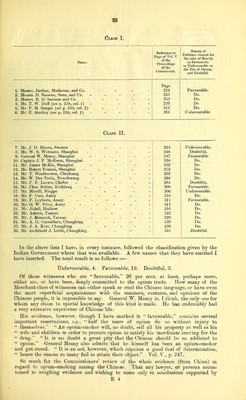
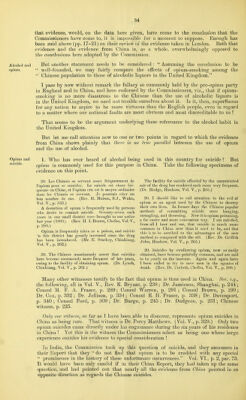
![The above list shows the following results. Chinese witnesses favourable to opium, 2. Doubtful, 1. Unfavourable, 8. It may be observed that some of the unfavourable witnesses speak very strongly indeed on the subject. Here are some specimens of their evidence. They should be read in connexion with the questions to which they are answers. See above, p. 11. 1. A Chinese General:— Those who take to smoking always do so in order to cheer their spirits and feel comfortable. Thev beo-in •with small quantities, but in time it alFects their health and destroys their complexion. The pseiido pleasure is obtained at the expense of natural contentment. As years go on the craving increases. Vol. V., p. 222. For some inscrutable reason Heaven has sent down this curse ; in the interest of the race I earnestly pray that the plans of Heaven may be changed. Vol. V., p. 223. 2. Old Chinese clerk, H.B.M. Consulate, Canton :— Smokers of many years' standing, feeling that the habit enslaves them, would like to give it up; but they fear that it might injure their health, and they hesitate. It is only those who are wealthy and without worldly cares that look upon opium-smoking as harmless. Vol. V., p, 223. 5. Yu Keng Pak :— 6. All, except those who take opium as a remedy for illness, are bound to go to excess in time. 8. The effect of opium is incomparably greater [i.e., than the effect of alcohol]. How can China help beino- weak? Those who discuss the opium trade say that it does incalculable harm to China ; it is from it that China is reduced to poverty and weakness. What can be urged in excuse by the party that at once gets the profit and does the injury ? Surely England must shrink from the judgment that is passed on her behind her back. Surely she cannot bear to sit and see the people of a friendly country injured by herself without even stretching out a helping hand. Vol. V., p. 227. 8. Lu Pao Yii, official writer at H.B.M. Consulate, Chefoo :— 5. Ten per cent, of opium-smokers smoke without the opium craving suffer in a manner indescribable, injury, about 20 per cent, with slight injury, and 70 If they cannot procure the drug they have a running per cent, with great injury. When the rich and well- at the eyes and nose. Their limbs become weak and to-do of the upper classes have the opium craving, feeble. They must satisfy their craving before they they only spend too much money on it, but otherwise can do anything. They look on this as more im- are not injured in their affairs. The second class of portant than their food. To be without opium is to men, that is to say, traders and merchants on a large them worse than being without food. They earn scale, who have the opium craving, may spend too but little wages, out of which they have to get their much on opium, and yet their profits are enough for opium and their food. An evil of this sort is im- their own wants. But artisans and coolies who have measurable. Vol. V., p. 281. 9. Ku Hung Ming, Interpreter to the Viceroy of Hukwang :— 3. The effect morally is to make them capable (ii.) and (iii.) The injury is more or less according of any meanness and crime, except those for which to the quantity taken, and the length of time the habit physical courage and animal spirits are necessary. lias been acquired, as the victim is constitutionally Physically it takes all the stamina out of them for strong or weak, and especially as he is well or in- any sustained exertion, whether physical or mental, and sufficiently fed. Over and above the injury they do socially it makes them unsuccessful for life; (6) themselves it will not be out of place to call attention opium-smokers say they require less of the foreign to the enormous amount of misery which opium drug to satisfy their craving. smokers in China bring upon their family, women and -5.—(i.) None, except perhaps in the early stage of children, who depend upon them for support Vol V the habit. p. 294. ' ' II.-—List of References to Chinese Books or Proverbial Sayings given by Witnesses All these are strongly unfavourable. Not one quotation from a Chinese book favourable to opium was adduced by any witness. 1. Translation of Chinese book, put in by Mr. Broomhall. (Vol. I., Q. 536.) 2. Quotation of common Cantonese sayings, put in by Mr. Stewart Lockhart Eegistrar-Greneral, Plong Kong. (Vol. 1., Q., 1380.) 3. Two pamphlets written by well-meaning Heathen Chinese, put in by Dr. Kuhne (Vol. v., A. 3., p. 220.) 4. Three Chinese authors quoted by Dr. Griffith John. (Vol. V,, p. 265 A 9 and 15.) Dr. John says, I might go on to quote indefinitely from the popular literature of the Chinese and from official proclamations in order to show that the opium habit is utterly condemned by the general opinion of the Nation. (Ihid.) 5. The Anti-foreign Literature of Hunan is referred to by Dr. John as full of the severest denunciations against tis as the originators of the Opium vice in China. {Ibid.) 6. Cp. Reference to a Native Book, by Rev. GS-. Andrew. (Vol, V., p. 258^ A, 15.)](https://iiif.wellcomecollection.org/image/b2439810x_0038.jp2/full/800%2C/0/default.jpg)
 No text description is available for this image
 No text description is available for this image
 No text description is available for this image