The report of the Royal Commission on opium compared with the evidence from China that was submitted to the Commission. : An examination and an appeal. / by Arnold Foster... with preface by the Archbishop of Canterbury, and others.
- Great Britain. Royal Commission on Opium
- Date:
- 1898
Licence: Public Domain Mark
Credit: The report of the Royal Commission on opium compared with the evidence from China that was submitted to the Commission. : An examination and an appeal. / by Arnold Foster... with preface by the Archbishop of Canterbury, and others. Source: Wellcome Collection.
Provider: This material has been provided by London School of Hygiene & Tropical Medicine Library & Archives Service. The original may be consulted at London School of Hygiene & Tropical Medicine Library & Archives Service.
39/52 page 31
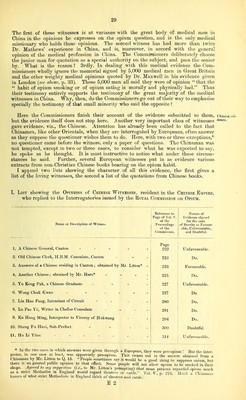
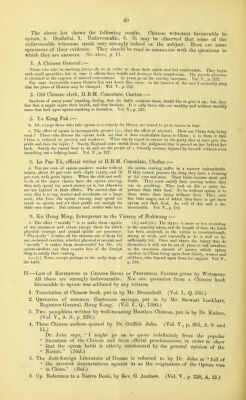
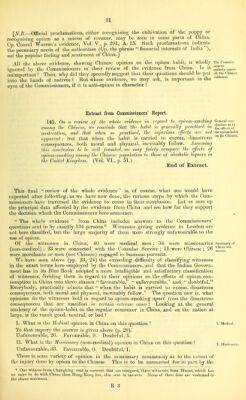
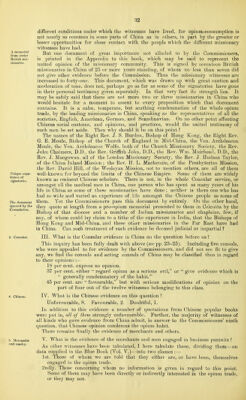
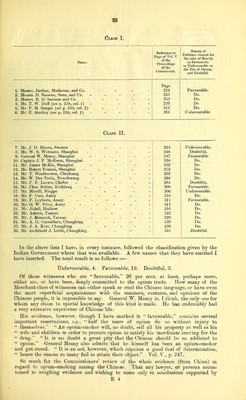
![[iV.5.—Official proclamations, either recognising the cultivation of the poppy or recognising opium as a source of revenue, may be seen in some parts of China. Cp. Consul Warren's evidence, Vol. V., p. 291, A. 15. Such proclamations indicate the pecuniary needs of the authorities (Cp. the_phrase financial interests of India ), not the popular feeling and sentiment of China.] All the above evidence, showing Chinese opinion on the opium habit, is wholly The Commis- ignored by the Commissioners in their reviev^ of the evidence from China. Is it ent^rcfy i^^nore unimportant? Then, why did they specially suggest that their questions should be pat aii jUc^Chiaese into the hands of natives ? But whose evidence, we may ask, is important in the eyes of the Commissioners, if it is anti-opium in character ? Extract from Commissioners' Report. 141. On a review of the whole evidence in regard to opium-smohing General eou- among the Chinese, we conclude that the habit is generally practised in thc'effect^of moderation, and that when so practised, the injurious effects are not the opium habit '-, , , 1 -r -, ■, ■ •- J T J. on the Chinese. apparent; but that when the habit is carriea to excess, disastrous consequences, both moral and physical, inevitably follow. Assuming this conclusion to he well founded, we may fairly compare the effects of opium-smoking among the Chinese population to those of alcoholic liquors in the United Kingdom. (Vol. VI., p. 51.) End of Extract. This final review of the whole evidence is, of course, what one would have expected after following, as we have now done, the various steps by which the Com- missioners have traversed the evidence to come to their conclusion. Let us sum up the principal data afforded by the evidence from China and see how far they support the decision which the Commissioners here announce. The whole evidence from China includes answers to the Commissioners' questions sent in by exactly 134 persons.* Witnesses giving evidence in London are not here classified, but the large majority of them were strongly unfavourable to the use of opium. Of the witnesses in China, 40 were medical men; 34 were missionaries (non-medical) ; 23 were connected with the Consular Service ; 11 were Chinese; 26 were merchants or men (not Chinese) engaged in business pursuits. We have seen above (pp. 23, 24) the exceeding difficulty of classifying witnesses in the exact terms here employed by the Commissioners, and that the Indian Govern- ment has in its Blue Book adopted a more intelligible and satisfactory classification of witnesses, dividing them in regard to their opinions on the efiects of opium con- sumption in China into three classes favourable, unfavourable, and doubtful. Everybody, practically admits that when the habit is carried to. excess, disastrous consequences, both moral and physical, inevitably follow. The question now is, what opinions do the witnesses hold in regard to opium-smoking apart from the disastrous consequences that are manifest in certain extr&ttie cases ? Looking at the general tendency of the opium-habit on the regular consumer in China, and on the nation at large, is the result good, neutral, or bad ? I. What is the Medical opinion in China on this question ? To that inquiry the answer is given above (p. 28). Unfavourable, 26. Favourable, 9. Doubtful, 5. II. What is the Missionary (non-medical) opinion in China on this question? Unfavourable, 33. Favourable, 0. Doubtful, 1. There is some variety of opinion in the missionary community as to the extent of the injury done by opium to the Chinese. This is to be accounted for in part by the * One witness from Chungking sent in answers that are unsigned, three witnesses from Macao, which has no more to do with China than Hong Kong has, also sent in answers. None of these four are reckoned in the above statement. E 3 Summary of China wit- 1, Medical 2. Missionary*](https://iiif.wellcomecollection.org/image/b2439810x_0039.jp2/full/800%2C/0/default.jpg)
 No text description is available for this image
 No text description is available for this image
 No text description is available for this image