Ecological risks of releasing genetically modified organisms into the natural environment / [Directorate for Nature Management] ; foreword by Odd Halvorsen.
- Norway. Direktoratet for naturforvaltning
- Date:
- 1991
Licence: In copyright
Credit: Ecological risks of releasing genetically modified organisms into the natural environment / [Directorate for Nature Management] ; foreword by Odd Halvorsen. Source: Wellcome Collection.
11/62 (page 9)
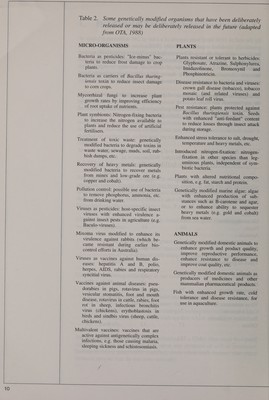
![By the end of 1990 there were reports of a total of 246 deliberate releases of genetically modified organisms globally (Williamson et al. 1990). Most of these are cultivated plants and bacteria that have been supplied with marker genes and/or genes to provide enhanced resistance to disease, pests and herbicides (Table 1). The number of deliberate releases is expected to increase substantially. Worldwide during 1991, there have probably been around 2000 field trials using transgenic plants. Deliberate or unintentional releases of genetically modified organisms into the environment are likely to occur in connection with agriculture, industry, aquaculture, biological treatment of pollutants and the use and disposal of human and veterinary medicines (Table 2). Table 1. Reported deliberate releases of genetically modified organisms and viruses by the end of 1990 (after Williamson et al. 1990) Other USA Europe places ‘Total Types of released organisms: Viruses ys Lis, 3 Ql Micro-organisms 4] 8 - 53 Plants 60 41 28 129 Animals 1 0 ] D Total 109 66 36 DA Types of genetical modification: Markers D2 a5 10 67 Herbicide resistance 25 18 15 58 Insect resistance 35 10 1 46 Vaccines 7 a 6 18 Virus resistance 10 2 1 13 Cold tolerance | 1 1 9 Bacterium resistance 1 0 1 2 Others 17 12 4 33 Total 124 83 39s «246](https://iiif.wellcomecollection.org/image/b3221957x_0011.jp2/full/800%2C/0/default.jpg)