Case of anomalous cardiac murmur, concurring with fatal cerebral disease / by W.T. Gairdner.
- Gairdner W. T. (William Tennant), Sir, 1824-1907.
- Date:
- [1889?]
Licence: Public Domain Mark
Credit: Case of anomalous cardiac murmur, concurring with fatal cerebral disease / by W.T. Gairdner. Source: Wellcome Collection.
Provider: This material has been provided by the Royal College of Physicians of Edinburgh. The original may be consulted at the Royal College of Physicians of Edinburgh.
2/6 page 2
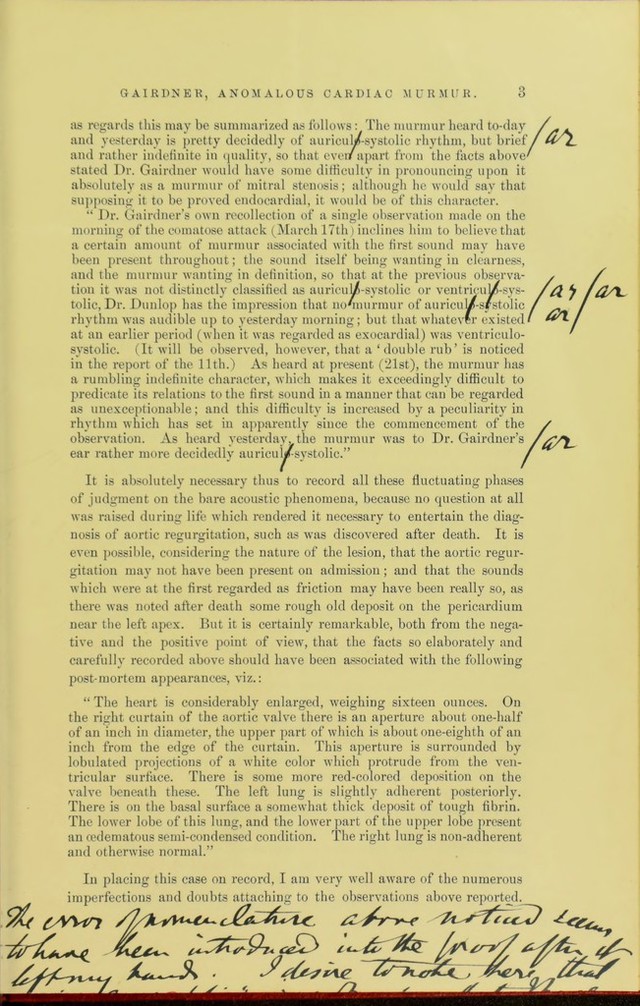
![and by some degree of uncertainty as to the facts. I was, therefore, at first disposed to regard the merely casual mention of the case as enough for practical purposes, especially as I afterward demonstrated the post- mortem appearances at a later meeting of the Medico-Chirurgical Society, and then placed the parts for reference in the IMuseum of the Western Infirmary at Glasgow. When Dr. Bramwell, however, made his communication to the American Journal for March, 1888, of a case observed in October, 1886, I placed the MS. of my own case in his hands, exactly as it was given to the Society, for publication if he should think it worth while; and it is only in consequence of this INIS, having been mislaid (after being returned by bim to me, with the expression of a wish that it should be published) that it has been held over till now. Henry T., let. twenty-four, admitted to Western Infirmary (Ward I) on 8th INIarch, 1887, and died on 22d March; his symptoms being mainly cerebral, and such as to raise questions of i)0ssible surgical inter- ference, as for abscess connected with disease of the middle ear. From this point of view the case has already been fully recorded in the Glas- goxo Medical Journal for October, 1887,^ and it was there indicated that certain cardiac phenomena, detected very shortly before death, and in no way obviously connected with the cerebral asjiects of the case, were passed over in order to avoid undue prolixity. These phenomena will now receive attention, with only so much of reference to the history as may be supposed to be even remotely connected with the lesion of the valves discovered after death. The patient was a seaman, and was known to have led a very dissijiated life, landing him in what seemed closely to resemble symptoms of deli- rium tremens shortly before admission. On admission, he was found to be affected with some kind of condensation over the left lower pul- monary lobe, with acute symptoms and friction sound. A suspicion was entertained of pericarditis associated with pleurisy of the left side, as will appear from the following note of March 11th; “ Cardiac sounds free from murmur, but at the apex beat in the fifth interspace and a little above this, there is a double rub heard, suggestive of probable pericar- dial friction.” After this, he passed into apparent convalescence and was able for some days to be up and to give a good deal of assistance in the ward, when cerebral symptoms suddenly rose into prominence and a.ssumed a degree of importance which only ceased with his death. It is not on record that any detailed examination of the heart took place between the 11th and the 17th of March, but at this date Dr. Gairdner personally made an observation, with a view to the important questions of diagnosis and prognosis emerging from the cerebral symp- toms—not on account of any new thoracic manifestation. The result of this examination, so far as the heart is concerned, is included in the fol- lowing notes, made the day before death : “A cardiac phenomenon noticed for the first time by Dr. Dunlop ye.sterday morning (INlarch 20th), is considered by Dr. Gairdner as of doubtful interpretation, owing to the suspicion entertained of pericarditis at an earlier stage. The facts 1 Three Cases of Brain and Ear Disease, considered witli reference to Diagnosis and also to questions of Brain Surgery. Case I., ]>. 242.](https://iiif.wellcomecollection.org/image/b21695945_0004.jp2/full/800%2C/0/default.jpg)