Case of anomalous cardiac murmur, concurring with fatal cerebral disease / by W.T. Gairdner.
- Gairdner W. T. (William Tennant), Sir, 1824-1907.
- Date:
- [1889?]
Licence: Public Domain Mark
Credit: Case of anomalous cardiac murmur, concurring with fatal cerebral disease / by W.T. Gairdner. Source: Wellcome Collection.
Provider: This material has been provided by the Royal College of Physicians of Edinburgh. The original may be consulted at the Royal College of Physicians of Edinburgh.
3/6 page 3
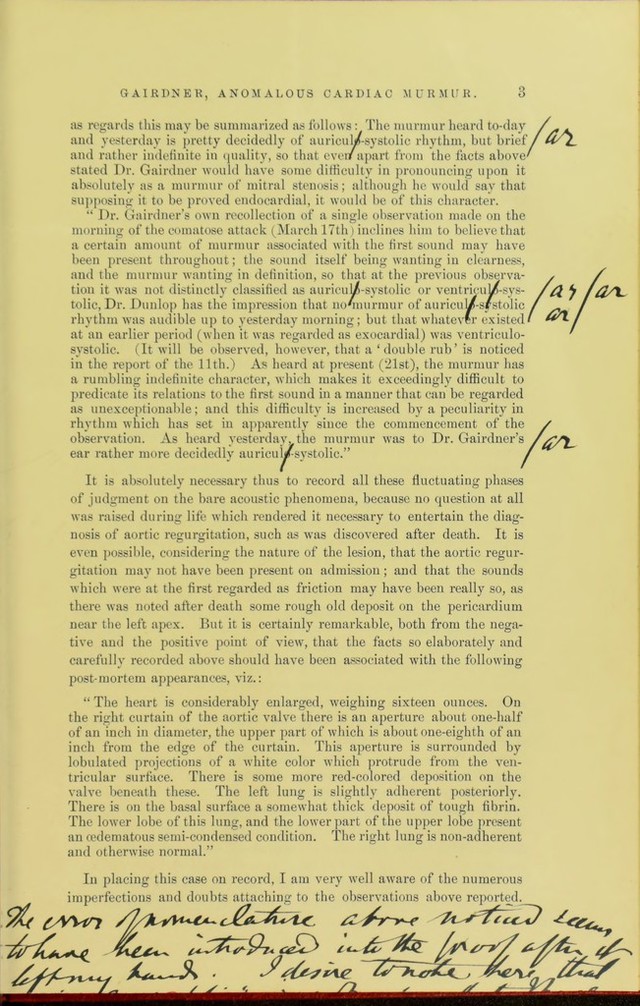
![as regards tliis may be summarized as follows: The murmur heard to-day and yesterday is ]>retty decidedly of auriculZ-systolic rhythm, but brief and rather indetinite in quality, so that cvei/apart from the facts above stated Dr. Gairdner would have some ditiiculty in pronouncing upon it absolutely as a murmur of mitral stenosis; although he would say that su])posing it to be proved endocardial, it would be of this character. “ Dr. Gairdner’s own recollection of a single observation made on the morning of the comatose attack (jMarch 17th) inclines him to believe that a certain amount of murmur associated with the first sound may have been present throughout; the sound itself being wanting in clearness, and the murmur wanting in definition, so that at the previous observa- tion it was not distinctly classified as auricu^-systolic or ventricuW-sys- tolic. Dr. Dunlop has the impression that nonmirmur of auricul/-systolic rhythm was audible up to yesterday morning ; but that whatever existed at an earlier period (when it was regarded as exocardial) was ventriculo- systolic. (It will be obsei-ved, however, that a ‘double rub’ is noticed in the report of the llth.) As heard at present (21st), the murmur has a rumbling indefinite character, which makes it exceedingly difficult to predicate its relations to the first sound in a manner that can be regarded as unexceptionable; and this difficulty is increased by a peculiarityAn rhythm which has set in apparently' since the commencement of the observation. As heard y'esterday, the murmur was to Dr. Gairdner’s ear rather more decidedly' auricui^systolic.” It is absolutely necessary thus to record all these fluctuating phases of judgment on the bare acoustic phenomena, because no question at all was raised during life which rendered it necessary to entertain the diag- nosis of aortic regurgitation, such as was discovered after death. It is even ])0ssible, considering the nature of the lesion, that the aortic regur- gitation may not have been present on admission; and that the sounds which were at the first regarded as friction may have been really so, as thei’e was noted after death some rough old deposit on the pericardium near the left apex. But it is certainly remarkable, both from the nega- tive and the positive point of view', that the facts so elaborately' and carefully recorded above should have been associated with the following post-mortem appearances, viz.: “ The heart is considerably' enlarged, w'eighing sixteen ounces. On the right curtain of the aortic valve there is an aperture about one-half of an inch in diameter, the upper part of which is about one-eighth of an inch from the edge of the curtain. This aperture is surrounded by lobulated projections of a white color w'hich protrude from the ven- tricular surface. There is some more red-colored deposition on the valve beneath these. The left lung is slightly' adherent posteriorly. There is on the basal surface a somewhat thick deposit of tough fibrin. The lower lobe of this lung, and the lower jmrt of the upper lobe present an cedematous semi-conden.sed condition. The right lung is non-adherent and otherwise normal.” In placing this case on record, I am very' w’ell aware of the numerous](https://iiif.wellcomecollection.org/image/b21695945_0005.jp2/full/800%2C/0/default.jpg)