The mad dog, or, hydrophobia, with all its various symptoms, causes, and remedies, minutely described / by Lewis Feuchtwanger.
- Lewis Feuchtwanger
- Date:
- 1840
Licence: Public Domain Mark
Credit: The mad dog, or, hydrophobia, with all its various symptoms, causes, and remedies, minutely described / by Lewis Feuchtwanger. Source: Wellcome Collection.
Provider: This material has been provided by the National Library of Medicine (U.S.), through the Medical Heritage Library. The original may be consulted at the National Library of Medicine (U.S.)
12/16
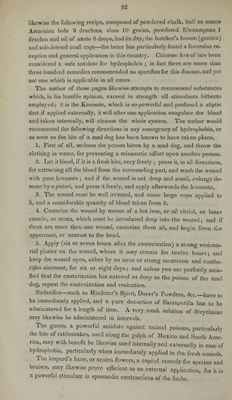
![likewise the following recipe, composed of powdered chalk, half an ounce Armenian hole 3 drachma, alum 10 grains, powdered K'ccumpano I drachm and oil of amiis 6 drops, had its day, the hatcher's broom (genista) and side-leaved scull caps—the latter has particularly found' a favorable re- ception and general application in this country. Chlorine hr>s of lute been considered a safe antidote for hydrophobia ; in fool there are more ihan three hundred remedies recommended as specifics for this diseuse, and yet not one which is applicable in all cases. The author of these pages likewise attempts to recommend substances which, in his humble opinion, exceed in strength all stimulants hitherto employed; it is the Kreosote, which is so powerful and profused a stiptic that if applied externally, it will after one application coagulate the blood and taken internally, will cleanse the whole system. The author would recommend the following directions in any emergency of hydrophobia, or as soon as the bite of a mad dog has been known to have taken place. 1. First of all, undress the person bitten by a mad dog, and throw the clothing in water, for preventing a miasmatic effect upon another person. 2. Let it bleed, if it is a fresh bite, very freely ; press it, in all directions, for extracting all the blood from the surrounding part, and wash the wound with pure kreosote; and if the wound is not deep and small, enlarge the same by a piston, and press it freely, and apply afterwards the kreosote. 3. The wound must be well irritated, and some large cups applied to It, and a considerable quantity of blood taken from it. 4. Cauterise the wound by moans of a hot iron, or oil vitriol, or lunar caustic, or moxa, which must be introduced deep into the wound; and if there are more than one wound, cauterise them ali, and begin from t'..e uppermost, or nearest to the head. 5. Apply (six or seven hours after the cauterization) a strong vesicnto- rial plaster on the wound, where it may remain for twelve hours ; and keep the wound open, either by an issue or strong mezercon and caiitha- rides ointment, for six or eight days; and unless you are perfectly satis- fied that the cauterization has entered as deep as the poison of the mad dog, repeat the cauterization and vesication. Sudorifics—such as Mindcrer's Spirit, Dover's Powders, &c—have to be immediately applied, and a pure decoction of Sarsapnrilla has to be administered for a length of time. A very weak solution of Strychnine may likewise he administered in intervals. The guaco, a powerful antidote against animal poisons, particularly the bite of rattlesnakes, used along the gulph of Mexico and South Ame- rica, may with benefit be likewise used internally and externally in case of hydrophobia, particularly when immediately applied to the fresh wounds. The leopard's bane, or arnica flowers, a capital remedy for sprains and bruises, may likewise prove efficient as an externa] application, for it is a powerful stimulant in spasmodic contractions of the limbs.](https://iiif.wellcomecollection.org/image/b21119089_0012.jp2/full/800%2C/0/default.jpg)