Researches on morphine. Pt. 1 / by S.B. Schryver and and Frederic H. Lees.
- Samuel Barnett Schryver
- Date:
- [1900]
Licence: In copyright
Credit: Researches on morphine. Pt. 1 / by S.B. Schryver and and Frederic H. Lees. Source: Wellcome Collection.
15/20 page 1036
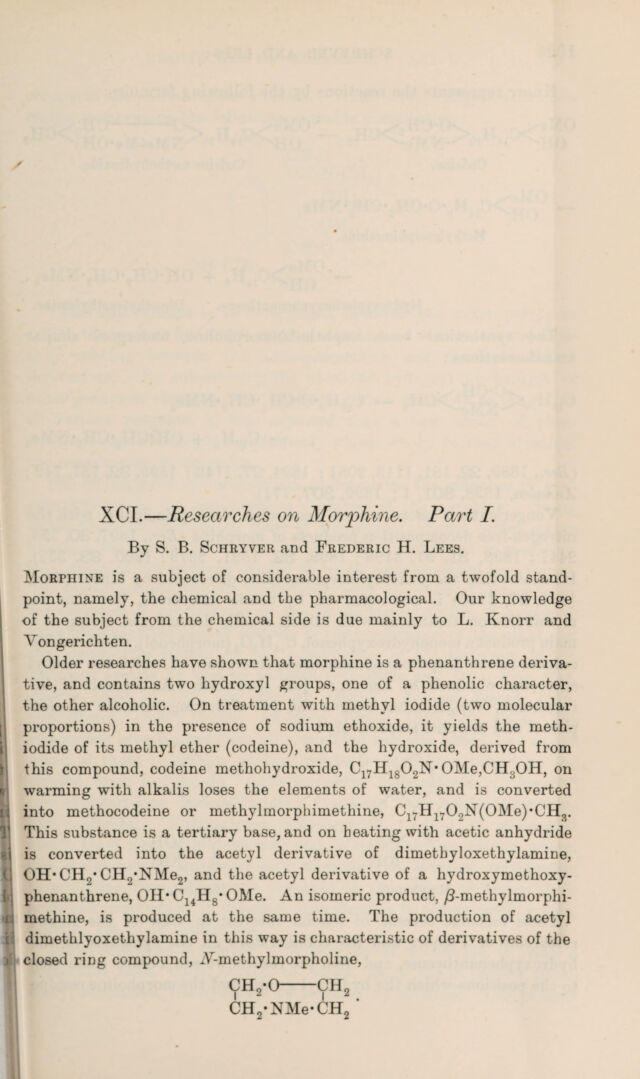
![with a little alcohol, and spread on a porous plate. They are already nearly white \ owing to their extreme solubility in water, purification is best effected by dissolving them in a large quantity of hot alcohol, and concentrating the solution until the hydrobromide separates out as a crystalline powder. The hydrobromide crystallises from water, with 1H20, in hard, stumpy prisms. 0*7078, at 110—120°, lost 0*0360 H20. H2O»5*08. CiYHi903N,HBr,H20 requires H20 = 4*69 per cent. It separates from alcohol as a granular, crystalline powder, without water of crystallisation. 0*2161 gave 0*4466 C02 and 0*1058 H,0. C = 56*36 ; H = 5*40. 0*1688 „ 0*3470 C02 „ 0*0840 H20. C = 56*06; H = 5*50. 0*2817 „ 0*1433 AgBr. Br=21*64. C17H1903N,HBr requires C = 55*75 ; H = 5*46; Br = 21*85 per cent. A determination of the specific rotation gave the following result: aD = - 3°10'; 1= Idem.; c = 2*49; [a]if= -127*2°. The corresponding salt of morphine crystallises with 2H20, and when recrystallised from alcohol in the anhydrous form gave for the specific rotation the following result: a i) — — 5°; 1= 2 dcm. = 9. ■49; [a]L5°= -100*4° In order to obtain salts other than the hydrobromide, the solution of the latter, obtained by decomposition of bromomorphide, is con¬ centrated, made alkaline with sodium carbonate, and extracted five or six times with hot amyl alcohol. To prepare the hydrochloride, the amyl alcoholic solution is extracted with dilute hydrochloric acid, and the acid solution evaporated to a syrup and left to crystallise. The hydrochloride is excessively soluble in water, from which it separates in beautiful, transparent, anhydrous, regular octahedra. The specimen analysed was recrystallised from a large quantity of absolute alcohol, in which it is only slightly soluble. 0*2913 required 9*2 c.c. A/10 AgN03. Cl = 11*21. Ci7H1903N,HC1 requires Cl = 11*04 per cent. A determination of the specific rotation gave the following result : aD= -7°9', 1=1 dcm., c = 4*76, [a]£° = -150°. The corresponding morphine salt crystallises from water in masses of long, silky, radiating needles containing 3H20, and is soluble in about 20 times its weight of water. For purposes of comparison, a](https://iiif.wellcomecollection.org/image/b30599210_0015.jp2/full/800%2C/0/default.jpg)


 No text description is available for this image
 No text description is available for this image
 No text description is available for this image