Improvement to Palmer's endless self-computing scale and key : adapting it to the different professions, with examples and illustrations for each profession, and also to colleges, academies and schools : with a time telegraph making, by uniting the two, a computing telegraph / by John E. Fuller.
- Fuller, John E. (John Emery), 1799-1878
- Date:
- 1851
Licence: Public Domain Mark
Credit: Improvement to Palmer's endless self-computing scale and key : adapting it to the different professions, with examples and illustrations for each profession, and also to colleges, academies and schools : with a time telegraph making, by uniting the two, a computing telegraph / by John E. Fuller. Source: Wellcome Collection.
Provider: This material has been provided by the National Library of Medicine (U.S.), through the Medical Heritage Library. The original may be consulted at the National Library of Medicine (U.S.)
5/16
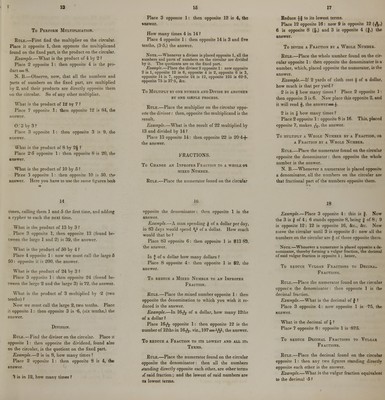
![13 To Perform Multiplication. Role.—First find the multiplier on the circular. Place it opposite 1, then opposite the multiplicand found on the fixed part, is the product on the circular. Example.—What is the product of 4 by 2 ? Place 2 opposite 1: then opposite 4 is the pro- duct = 8. N. B.—Observe, now, that all the numbers and parts of numbers on the fixed part, are multiplied by 2, and their products are directly opposite them en the circular. So of any other multiplier. What is the product of la Dy 7 ? Place 7 opposite 1: then opposite 12 is 84, the Answer. Of 3 by 3' Place 3 opposite 1: then opposite 3 is 9, the answer. What is the product of 8 by 2J ? Place 2-5 opposite 1: then opposite 8 is 20, the answer. What is the product of 10 by 5 ? Plr.ce 5 opposite 1 : then opposite 10 is 50, the answer. Here vou have to use the same figures both 15 Place 3 opposite 1: then opposite 12 is 4, the inswer. How many times 4 in 14 ? Place 4 opposite 1: then opposite 14 is 3 and five tenths, (3-5,) the answer. Note.—Whenever a divisor is placed opposite 1, all the numbers and parts of numbers on the circular are divided by it. The quotients are on the fixed part. Example.—Place the divisor 2 opposite 1: now opposite 2 is 1, opposite 12 is 6, opposite 4 is 2, opposite 6 is 3, opposite 14 is 7, opposite 24 is 12, opposite 125 is 62-5, opposite 75 is 37-5, &c. To Multiply by one number and Divide by another BY ONE SIMPLE PROCESS. Rule.—Place the multiplier on the circular oppo- site the divisor : then, opposite the multiplicand is the result. Example.—What is the result of 22 multiplied by 13 and divided by 14? Place 13 opposite 14: then opposite 22 is 204-f- ihe answer. FRACTIONS. To Change an Improper Fraction to a whole o« mixed Number. Rule.—Place the numerator found on the circular 17 Reduce ^f to its lowest terms. Place 12 opposite 16: now 9 is opposite 12 (^,) 6 is opposite 8 (f,) and 3 is opposite 4 (f,) the answer. To divide a Fraction by a Whole Number. Rule.—Place the whole number found on the cir- cular opposite 1: then opposite the denominator is a number, which, placed opposite the numerator, is the answer. Example.—If 2 yards of cloth cost § of a dollar, how much is that per yard ? 2 is in f how many times ? Place 2 opposite 1: then opposite 3 is 6. Now place this opposite 2, and it will read §, the answer=$. 2 is in \ how many times ? Place 2 opposite 1: opposite 8 is 16. This, placed opposite 7, makes fa, the answer. To multiply a Whole Number by a Fraction, or a Fraction by a Whole Number. Rule.—Place the numerator found on the circular opposite the denominator: then opposite the whole number is the answer. N. B.—Whenever a numerator is placed opposite a denominator, all the numbers on the circular are that fractional part of the numbers opposite them. 14 times, calling them 1 and 5 the first time, and adding a cypher to each the next time. What is the product of 13 by 3 ? Place 3 opposite 1, then opposite 13 (found be- tween the large 1 and 2) is 39, the answer. What is the product of 50 by 4 ? Place 4 opposite 1: now we must call the large 5 50: opposite it is 200, the answer. What is the product of 24 by 3 ? Place 3 opposite 1: then opposite 24 (found be- tween the large 2 and the large 3) is 72, the answer. What is the product of 3 multiplied by -2 (two tenths) ? Now we must call the large 2, two tenths. Place it opposite 1: then opposite 3 is -6, (six tenths,) the answer. Division. Rule.—Find the divisor on the circular. Place ll opposite 1: then opposite the dividend, found also on the circular, is the quotient on the fixed part. Example.—2 is in 8, how many times ? Place 2 opposite 1 : then opposite 8 is 4, the answer. 3 is in 12, how many times ? ]() opposite the denominator: then opposite 1 is the answer. Example.—A man spending £ of a dollar per day, in 83 days would spend *£■ of a dollar. How much would that be ? Place 83 opposite 6: then opposite 1 is $13 83, the answer. In | of a dollar how many dollars ? Place 8 opposite 4: then opposite 1 is $2, the answer. To reduce a Mixed Number to an Improper Fraction. Rule.—Place the mixed number opposite 1: then opposite the denomination to which you wish it re- duced is the answer. Example.—In 16-^- of a dollar, how many 12ths of a dollar ? Place 16-j^j- opposite 1: then opposite 12 is the number of 12ths in 16^, viz., 197=->J82l, the answer. To reduce a Fraction to its lowest and all its Terms. Rule.—Place the numerator found on the circular opposite the denominator: then all the numbers standing directly opposite each other, are other terms /f said fraction; and the lowest of said numbers are its lowest terms. 18 Example.—Place 3 opposite 4 : this is f. Now the 3 is J of 4; 6 stands opposite 8, being § of 8; 9 is opposite 12; 12 is opposite 16, &c, &c Now move the circular until 3 is opposite 5: now all the numbers on the circular are f of those opposite them. Note.—Whenever a numerator is placed opposite a de- nominator, thereby forming a vulgar fraction, the decimal of said vulgar fraction is opposite 1; hence, To reduce Vulgar Fractions to Decimal Fractions. Rule.—Place the numerator found on the circular opposi.e the denominator: then opposite 1 is the decimal fraction. Example.—What is the decimal of $ ? Place 3 opposite 4: now opposite 1 is 75, the answer. What is the decimal of J ? Place 7 opposite 8: opposite 1 is -875. To reduce Decimal Fractions to Vulgar Fractions. Rule.—Place the decimal found on the circuhu opposite 1: then any two figures standing directly opposite each other is the answer. Example.—What is the vulgar fraction equivalent to the decimal -5 ?](https://iiif.wellcomecollection.org/image/b21121175_0005.jp2/full/800%2C/0/default.jpg)