Improvement to Palmer's endless self-computing scale and key : adapting it to the different professions, with examples and illustrations for each profession, and also to colleges, academies and schools : with a time telegraph making, by uniting the two, a computing telegraph / by John E. Fuller.
- Fuller, John E. (John Emery), 1799-1878
- Date:
- 1851
Licence: Public Domain Mark
Credit: Improvement to Palmer's endless self-computing scale and key : adapting it to the different professions, with examples and illustrations for each profession, and also to colleges, academies and schools : with a time telegraph making, by uniting the two, a computing telegraph / by John E. Fuller. Source: Wellcome Collection.
Provider: This material has been provided by the National Library of Medicine (U.S.), through the Medical Heritage Library. The original may be consulted at the National Library of Medicine (U.S.)
9/16
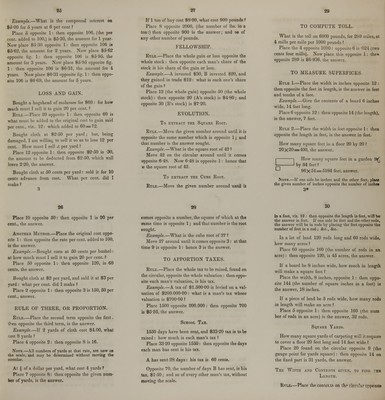
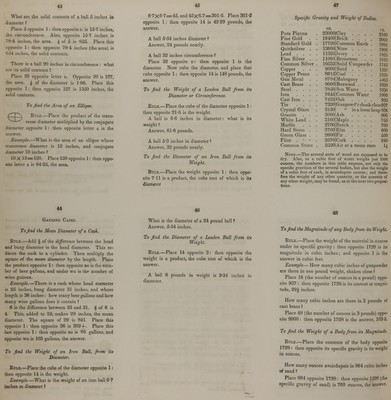
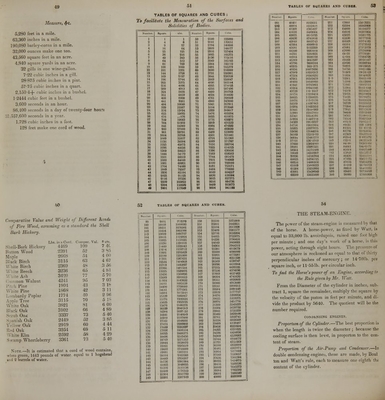
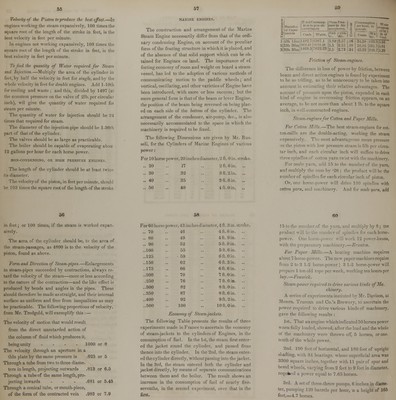
![37 J9 41 Example. What is the length of the side of the greatest cube that can be taken from a globe 82 inches in diameter? Place 577 (the gauge point for the side of an inscribed cube) opposite fig. 1: then opposite 82, on i!i. fixed part, is 47-3 (47-$,) inches, the answer. To find the length of the side of the greatest equi- lateral triangle that can be inscribed in a given circle. Rule.—Place 87, found on the circular, opposite fig. 1: then opposite any diameter on the fixed part, is the length of the side of an inscribed triangle And opposite the length of the side of any triangle on the circular, is the diameter required to inscribe i< in. Example.—What is the length of one side of the greatest equilateral triangle that can be inscribed in a circle 62 inches in diameter? Place 87 opposite fig. 1 : then opposite 62, on the tixed part, is 54 inches, the answer. What is the least diameter of a circle in which a triangle may be inscribed whose side is 6-5 inches (6J)? Place 87 opposite fig. 1 : then opposite 6-5, on the circular, is 7-48 (7^,) inches, the answer. 4 in which may be inscribed an undecagon (eleven- sided figure.) one side of which is 13 inches long? Place 282 opposite fig. 1: then opposite 13 inches, found on the circular, is 46-1 inches, the answer. To find the greatest diameter of each of three equal circles that can be inscribed within a circle of a gioen diameter. Rule.—Place, 464 opposite fig. 1 : then op- posite any diameter on the fixed part, is the diam- eter of one of the three inscribed circles. Example.—What is the greatest diameter of each of three circles, that can be inscribed within a circle 25 inches in diameter? Place 46-1 opposite fig. 1: then opposiif 25 on the fixed part, Is ll(i inches, the answer. To find the greatest diameter of four equal circles that caii be inscribed, within another circle of a given diameter. Rule.—Place 416 opposite fig. 1: then opposite any given diameter on the fixed part, is the diameter of each of the four inscribed circles. Example.—What is (lie greatest diameter of each of four equal circles that can be inscribed in another circle 22 inches in diameter? Place 416 opposite fig. 1 : then opposite 22, on the fixed part, is 9-15 (9-vVff) inches, the answer. In a log 7 inches diameter, 15 feet long ? Answer 4 -j%v feet. Note.—If the diameter and length are both given in inches, place the square of the diameter opposite 1728: then opposite the inches in length, is the answer in feet. Note.—A cylinder that is 12 inches in diameter and 12 inches long, and a globe that is 12 inches in diameter, and a cone that is 12 inches high and 12 inches diameter at its base, bear a proportion to each other as 3, 2 and 1. Therefore if you place the contents of any cylinder on the circular opposite to 3 on the fixed part, then opposite 2 on the fixed pait is the contents of an inscribed globe, and opposite fig. 1 is the contents of an inscribed cone. To find how many Solid Feet a Round Stick of Timber will contain, when hewn Square. Rule.—Place double the square of half the diam- eter opposite 144 : then opposite the length is the answer. Example.—In a log 28 feet long, 22 inches diam- eter, half the diameter is 11, the square of which is 121. This doubled, is 242. Now place 242 oppo- site 144: then opposite 28 (the length) is 47-j-the answer. To find how many feet of Boards can be sawn from a Log of given Diameter. Rule —Find the solid contents of the log wb»r 4* To find the length of the side of the greatest figurt that can be inscribed in a given circle. Rule for a Pentagon (5 sides) Place 589. Hexagon 6 5. Heptagon 7 437. Octagon 8 383 Nonagou 9 337 Decagon 10 •' 31 Undecagon 11 282 Dodecagon 12 26 opposite fig. 1 : then opposite any given diameter on i he fixed part, is the length of the side of the greatest figure that can be inscribed in it. Example 1.—What is the length of one side of the greatest pentagon, or five-sided figure, that can he inscribed in a circle whose diameter is 51 inches ? Place 589 opposite 1: then opposite 51, on the fixed part, is 30 inches, the answer. Example 2.—What is the length of one side of the greatest nonagon (nine-sided figure) that can be .ascribed in a circle 82 feet in diameter ? Place 337 opposite fig. 1: then opposite 82, found on the fixed part, is 27-6 (27$,) feet, the answer. Example 3.—What is the least diameter of a circle 40 mo find the Solidity of a Cylinder, or to measurt Round Timber. £jfr;T:^ ^ Rule.—First find the area of the ^^^SSmS base by the ru]e for finding the area of a circle, place that area opposite 144, then oppo- site the length in feet, is the answer in feet and decimals of a foot. Note.—If the diameter be given in feet, place the area opposite 1, instead of placing it opposite 144. Example.—What are the solid contents of a cyl- inder 5 inches in diameter, and 13 feet long? Place 25 'the square of 5) opposite 1 : then oppo- site a is 1965. Now place 1-965 opposite 144. then opposite 13 (the length) is 177 feet, the answer. How many solid feet in a round log 15 inches in diameter, and 14 feet long? Place 225 (the square of 15) opposite 1: then opposite a is 1-77 the area. Now place 1-77 oppo- site 144: then opposite 14 is 17-2 feet, the answer. In a log 12 feet long, 14 inches diameter? Answer, 128 feet. In a log 16 feet long, 11 inches in diameter* Answer, 105 feet. made square, then place 12 opposite the thickness of the board (including the saw-calf:) then opposite the solid contents is the answer in feet. To find the Area of a Globe or Ball. #Rule.—Place the diameter opposite 1: then opposite the circumference is the answer. Example.—How many square inches of leather will cover a ball 3| inches in diameter ? Place 3^ opposite 1: then opposite d. is 11, the circumference. Opposite 11 is the area, 38J inches. How many square feet on the surface of a globe 4 feet in diameter ? Place 4 opposite 1: then opposite d. is 12-55 feet, the circumference. Opposite 12-55 is 50-4, the answer. To find the Solid Contents of a Globe or Ball. _j^ Rule.—First find its area by the preceding l||||rules: then multiply its area by £ of its ^mtr diameter. Example.—What are the solid contents of a ball 14 inches in diameter? Place 14 opposite 1: then opposite d. is 44 inches, the circumference. Opposite 44 is 617, the area. \ of the diameter, is 233§. Place this opposite 1 : then opposite 617 (the area) is 1437 inches, the solid contents.](https://iiif.wellcomecollection.org/image/b21121175_0009.jp2/full/800%2C/0/default.jpg)