Report of the Director-General of Public Health, New South Wales.
- New South Wales. Department of Public Health
- Date:
- [1933]
Licence: Public Domain Mark
Credit: Report of the Director-General of Public Health, New South Wales. Source: Wellcome Collection.
40/152 page 28
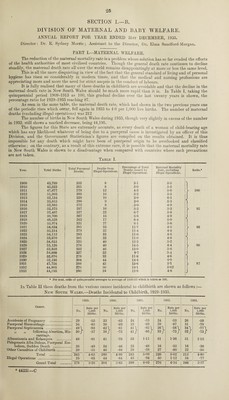
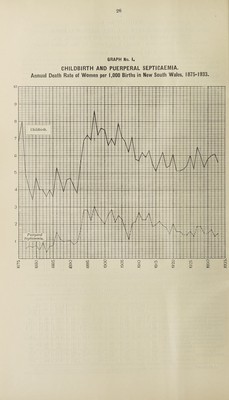
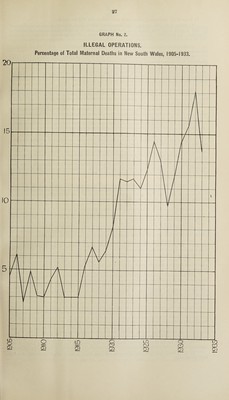
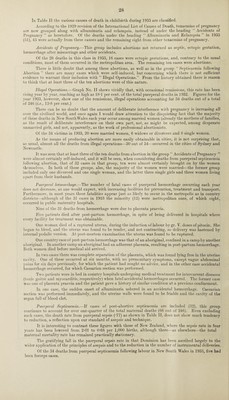
![<2Z In Table II the various causes of death in childbirth during 1933 are classified. According to the .1929 revision of the Internationa] List of Causes of Death, toxaemias of pregnancy are now grouped along with albuminuria and eclampsia, instead of under the heading ‘‘Accidents of Pregnancy ” as heretofore. Of the deaths under the heading “ Albuminuria and Eclampsia ” in 1933 (51), 43 were actually from these causes and the remaining eight from other toxaemias of pregnancy. Accidents of Pregnancy.-—This group includes abortions not returned as septic, ectopic gestation, hemorrhage after miscarriage and other accidents. Of the 26 deaths in this class in 1933, 16 cases were ectopic gestations, and, contrary to the usual conditions, most of them occurred in the metropolitan area. The remaining ten cases were abortions. There is little doubt that among these abortions, as well as in the group “ Septicaemia following Abortion ” there are many cases which were self-induced, but- concerning which there is not sufficient evidence to warrant t-heir inclusion with “ Illegal Operations.” From the history obtained there is reason to think that at least- three of the ten abortions were of this nature. Illegal Operations.—Graph No. II shows vividly that, with occasional remissions, this rate has been rising year by year, reaching as high as 18*1 per cent, of the total puerperal deaths in 1932. Figures for the year 1933, however, show one of the remissions, illegal operations accounting for 34 deaths out of a total of 246 (i.e., 13-8 per cent.) There can be no doubt that the amount of deliberate interference with pregnancy is increasing all over the civilised world, and once again I would draw attention to the disquieting fact that the majority of these deaths in New South Wales each year occur among married women (already the mothers of families, as the result of deliberate interference on their own part, not, as might be exjjected, among desperate unmarried girls, and not, apparently, as the work of professional abortionists. Of the 34 victims in 1933, 20 were married women, 6 widows or divorcees and 8 single women. As the means of producing abortion are more easily obtainable in cities, it is not surprising that, as usual, almost all the deaths from illegal operations—30 out of 34—occurred in the cities of Sydney and Newcastle. It was seen that at least three of the ten deaths from abortion in the group “ Accidents of Pregnancy ” were almost certainly self-induced, and it will be seen, when considering deaths from puerj^eral septicaemia following abortion, that of 32 cases in that group, ten were almost certainly brought on by the women themselves. In both of these groups, also, the majority of the women were married—the former group included only one divorced and one single woman, and the latter three single girls and three women living apart from t-heir husbands. Puerperal hcemorrliage.—The number of fatal cases of puerperal haemorrhage occurring each year does not decrease, as one would expect, with increasing facilities for prevention, treatment and transport. Furthermore, in most years these fatalities appear just as likely t-o occur in the metropolis as in country districts-—although of the 31 cases in 1933 the minority (12) were metropolitan ones, of which eight, occurred in public maternity hospitals. Nine of the 31 deaths from haemorrhage were due to placenta praevia. Five patients died after post-partum haemorrhage, in spite of being delivered in hospitals where every facility for treatment was obtainable. One woman died of a ruptured uterus, during the induction of labour by gr. V. doses of pitocin. She began to bleed, and the uterus was found to be tender, and not contracting, so delivery was hastened by internal podalic version. At post-mortem examination the uterus was found t-o be ruptured. One country case of post-partum haemorrhage was that of an aboriginal, confined in a camp by another aboriginal. In another camp an aboriginal had an adherent placenta, resulting in post-partum haemorrhage. Both women died before medical aid arrived. In two cases there was complete separation of the placenta, which was found lying free in the uterine cavity. One of these occurred at six months, with no premonitory symptoms, except vague abdominal pains for six daj^s previously, for which the patient had sought no advice, and in the other case accidental haemorrhage occurred, for which Caesarian section was performed. Two patients were in bed in country hospitals undergoing medical treatment for int-ercurrent diseases (toxic goitre and myocarditis, respectively) when fatal accidental haemorrhages occurred. The former case was one of placenta praevia and the patient gave a history of similar condition at a previous confinement-. In one case, the sudden onset of albuminuria ushered in an accidental haemorrhage. Caesarian section was performed immediately, and the uterine walls were found to be friable and the cavity of the organ full of blood clot. Puerperal Septicaemia.—If cases of post-abortive septicaemia are included (32), this group continues to account- for over one-quarter of the total maternal deaths (66 out of 246). Even excluding such cases, the death rate from puerperal sepsis {’11) as shown in Table II, does not show much tendency to reduction, a reflection upon our standard of asepsis and technique. It is interesting to contrast these figures with those of New Zealand, where the sepsis rate in four years has been lowered from 2-01 t-o 0-68 per 1,000 births, although there-—as elsewhere—the total maternal mortality rate has remained practically stationary. The gratifying fall in the puerperal sepsis rate in that Dominion has been ascribed largely to the wider application of the principles of asepsis and to the reduction in the number of instrumental deliveries. Of the 34 deaths from puerperal septicaemia following labour in New South Wales in 1933, five had been forceps cases.](https://iiif.wellcomecollection.org/image/b31485248_0040.jp2/full/800%2C/0/default.jpg)