Wadi Sarga - Coptic and Greek text edited by W. E. Crum and H. I. Bell with an Introduction by R. Campbell Thompson
- Date:
- 1922
- Reference:
- WA/HMM/CM/Sal/52/66
Licence: Public Domain Mark
Credit: Wadi Sarga - Coptic and Greek text edited by W. E. Crum and H. I. Bell with an Introduction by R. Campbell Thompson. Source: Wellcome Collection.
104/264 (page 76)
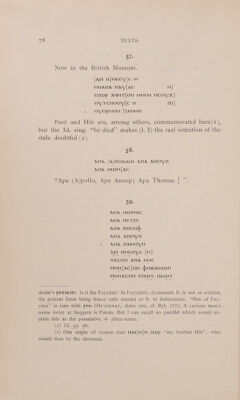
![57: Now in the British Museum. [Apl n]meey[e m MNANA MAY[AG M | Nzmp AIMTLON MMOU NCOY xX] OYTCNOOY[C N 2n] 5 OYEIPHNH [2AMHN -aul and Hér are, among others, commemorated here(1r), but the 3d. sing. “the died” makes (1. 3) the real intention of the stele doubtful (2). 58. ANA (A)MOAAM ANA ANOY ANA O@M[AC “Apa (A)pollo, Apa Anoup; Apa Thomas [ ”. 99: ANA OG@MAC ANA NETPE ANA 1DCHdp ANA ANOYH Nr ANA MAMOYN Ap] NMEOYE [M1] MACON AMA NOG mninm{Acjon :bowAmann MNMACON EN@MX NKMT dealer's PMNIOM. Is it the Fayyim: In Fayytimic documents it is not so written, the present form being found only around or S. of Ashmunain. “Man of Fay- yam” is rare with pM- (HyVERNAT, Actes 100, cf. Ryl. 277). A curious man’s name twice at Saqqara is Paiom. But I can recall no parallel which would ex- plain this as the possessive -++ place-name. Ch)h CE. 55. 350: (2) One might of course read NACOJN 2~@p “my brother Hér’, who would thus be the deceased. 4](https://iiif.wellcomecollection.org/image/b33159324_0104.jp2/full/800%2C/0/default.jpg)