Wadi Sarga - Coptic and Greek text edited by W. E. Crum and H. I. Bell with an Introduction by R. Campbell Thompson
- Date:
- 1922
- Reference:
- WA/HMM/CM/Sal/52/66
Licence: Public Domain Mark
Credit: Wadi Sarga - Coptic and Greek text edited by W. E. Crum and H. I. Bell with an Introduction by R. Campbell Thompson. Source: Wellcome Collection.
125/264 (page 97)
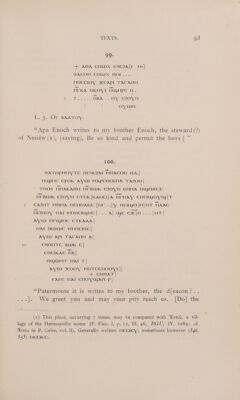
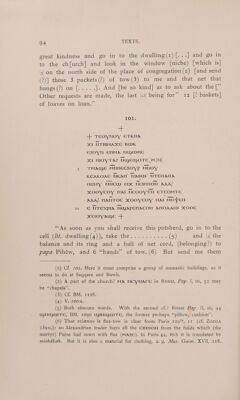
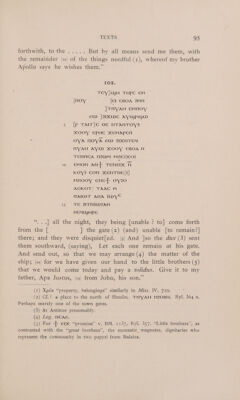
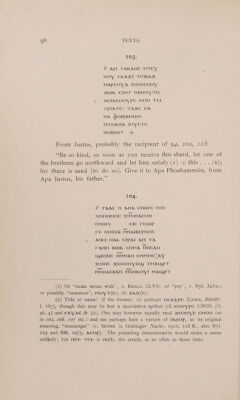
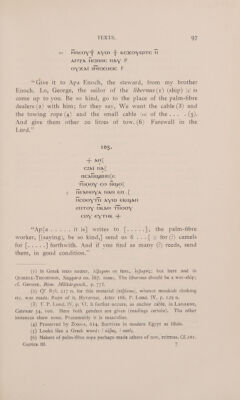
![1 mMnooyy Ay@ -+- KeExoywTE N AIrpA WeINME NAY L oyxAl emnxoeic P “Give it to Apa Enoch, the steward, from my brother Enoch. Lo, George, the sailor of the ibernus(1) (ship) ({s| is come up to you. Be so kind, go to the place of the palm-fibre dealers (2) with him; for they say, We want the cable (3) and the towing rope (4) and the small cable |: of the... . (5). And give them other 20 litres of tow.(6) Farewell in the Lord,” 105. + ant Cari NAL NCANU)BNN[E TNOOY CO NGO NOAMOYA NAN Er. [ NCOOYTHN AY@ EKGAN GNTOY NKAM THOOY coy 6YTHK + On Dana se, it is] writes to te |], the palm-fibre worker, [(saying), be so kind,] send us 6 ...[ |s) for (?) camels RO tal ea 0 tate ] forthwith. And if you find as many (°) reeds, send them, in good condition.” (1) In Greek texts neuter, AiSvevov or fem., .AiBupvis; but here and in QUIBELL-THompPson, Saggara no. 367, masc. The /iburnus should be a war-ship; cf. Grosse, Rom. Militdrgesch., p.77f. (2) Cf. Ryl. 217 n. for this material (cefeviov), whence monkish clothing etc. was made. Rope of it, Hyvernat, Actes 166, P. Lond. IV, p. 129 n. (3) V. P. Lond. IV, p. VI. It further occurs, as anchor cable, in LAGARDE, Catenae 54, 100. Here both genders are given (readings certain), The other instances show none. Presumably it is masculine. (4) Preserved by ZorGa, 614. Survives in modern Egypt as liban. (5) Looks like a Greek word: ? 208o:, ? zonts. (6) Makers of palm-fibre rope perhaps made others of tow, atinmoy. Cf. 7oz. Coptica. III. 7](https://iiif.wellcomecollection.org/image/b33159324_0125.jp2/full/800%2C/0/default.jpg)